
Looking for the 15 best telescopes for astrophotography in 2025? I’ve found a great mix, from beginner-friendly models like the ZWO Seestar S50 and smartphone-enabled guides like the Celestron StarSense Explorer LT 114AZ, to more advanced options like the NexStar 130SLT and SVBONY 102mm refractors. These setups offer crisp images, portability, and smart features that make capturing stunning celestial shots easier than ever. Stick around to discover which models best fit your needs.
Key Takeaways
- Prioritize telescopes with high-quality optics, stable mounts, and compatibility with astrophotography accessories for sharp, detailed images.
- Consider models with integrated imaging systems like the ZWO Seestar S50 for beginner-friendly, all-in-one astrophotography.
- Look for guided, computerized telescopes such as Celestron NexStar series for precise tracking and deep-sky imaging.
- Opt for portable, versatile options like travel-friendly refractors and compact all-in-one systems suitable for outdoor astrophotography.
- Evaluate user reviews and expert ratings to identify the best combination of features, ease of use, and image quality in 2025 models.
ZWO Seestar S50 Smart Digital Telescope
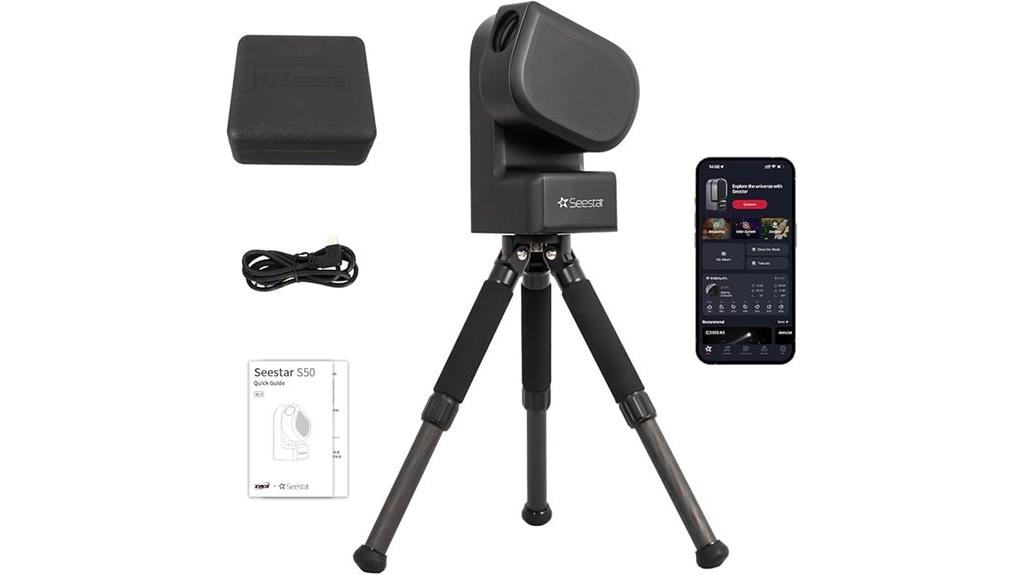
If you’re a beginner or someone looking for a portable, all-in-one telescope that simplifies astrophotography, the ZWO Seestar S50 Smart Digital Telescope is a standout choice. It’s lightweight at just 2.5kg and combines a telescope, electrical focuser, camera, ASIAIR, and altazimuth mount in a compact design. The professional-grade triplet apochromatic optics deliver crisp, high-quality images, with coatings that reduce light loss and chromatic aberration. Its automation features let you find, track, and target celestial objects via smartphone effortlessly. Plus, the Seestar app offers multiple modes for scheduling and panoramic imaging, making astrophotography accessible and fun for all skill levels.
Best For: beginners, hobbyists, and educators seeking a portable, all-in-one telescope that simplifies astrophotography and celestial observation.
Pros:
- Lightweight and compact design (weighs only 2.5kg) for easy portability and setup
- Professional-grade triplet apochromatic optics providing crisp, high-quality images with reduced chromatic aberration
- Fully automated smartphone control with multiple imaging modes, making it user-friendly for all skill levels
Cons:
- May have limited aperture size compared to larger, more specialized telescopes, affecting deep-sky imaging detail
- The integrated all-in-one design might restrict upgrades or modifications for advanced users
- Reliance on smartphone app control may pose challenges in low-signal or technical environments
Telescope 150EQ Newtonian Reflector Telescope for Adults
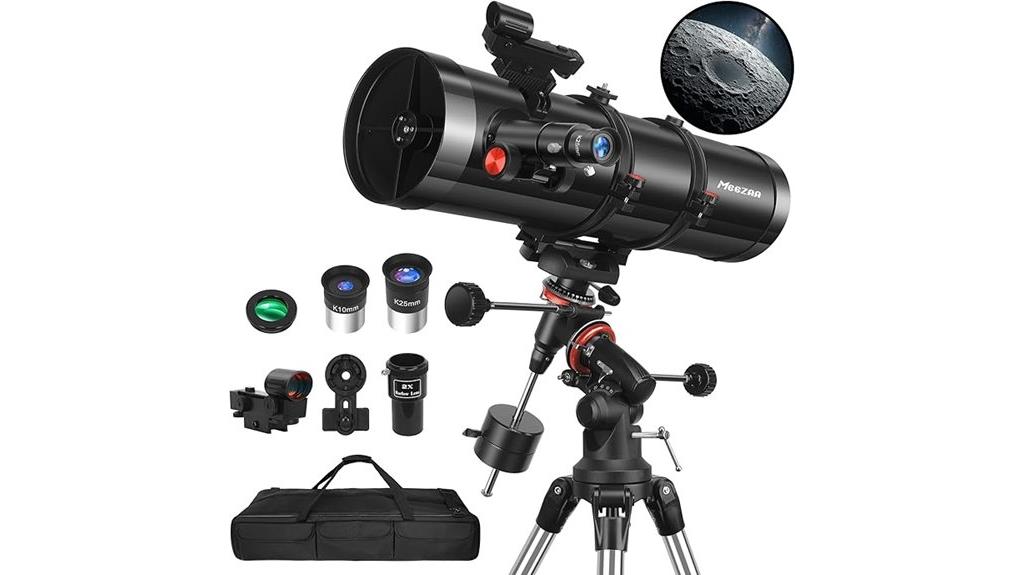
The Telescope 150EQ Newtonian Reflector is an excellent choice for adults new to astrophotography who want professional-quality images without complicated setups. Its 150mm aperture and 650mm focal length deliver bright, detailed views of deep space objects, planets, and the Moon. With a versatile magnification range from 26X to 130X, it offers flexibility for various observations. The upgraded German equatorial mount ensures smooth tracking, while the sturdy tripod provides stability. Included accessories like eyepieces, a Barlow lens, and a moon filter make setup quick and straightforward. Plus, the large carry bag makes it easy to transport and store, perfect for both beginners and experienced stargazers.
Best For: beginners and amateur astronomers seeking a portable, easy-to-use telescope with professional-quality viewing capabilities.
Pros:
- Large 150mm aperture and 650mm focal length provide bright, detailed images of planets, the Moon, and deep space objects
- Upgraded German equatorial mount allows smooth, precise manual tracking for accurate observations
- Complete accessory kit, including eyepieces, Barlow lens, moon filter, and carry bag, for easy setup and transport
Cons:
- May require some initial familiarization for optimal use, especially for complete beginners
- Heavier setup due to sturdy tripod and accessories, potentially less portable for some users
- Limited to magnifications up to 130X, which may not suffice for extremely detailed planetary observations
Celestron StarSense Explorer LT 114AZ Telescope with Smartphone Dock
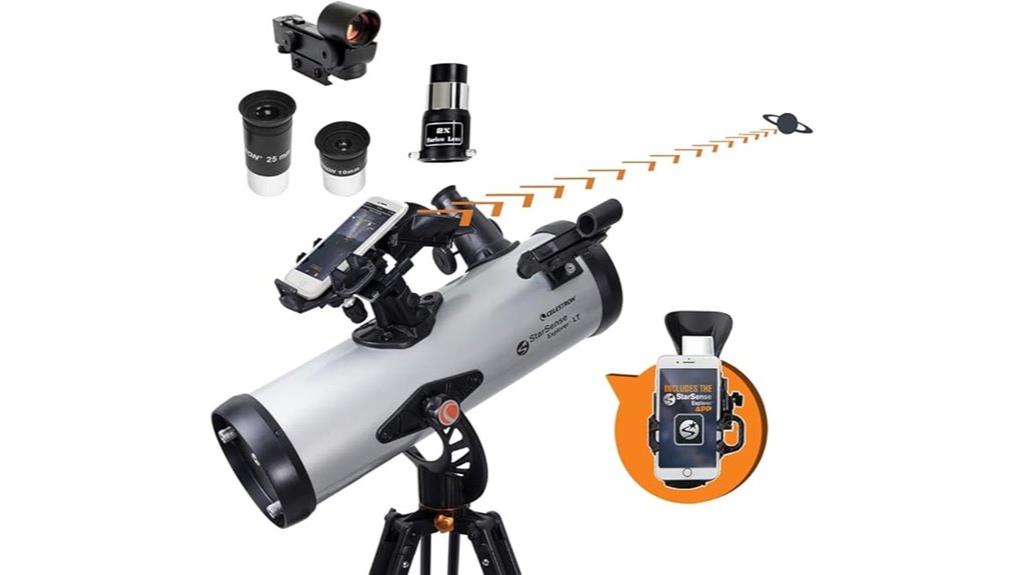
Designed for beginners enthusiastic to explore the night sky, the Celestron StarSense Explorer LT 114AZ stands out with its smart smartphone docking and app-guided object location. The 114mm Newtonian reflector provides bright, detailed views of the Moon, planets, and deep-sky objects like Orion and Andromeda. Its sky recognition technology uses your phone to analyze star patterns, guiding you to celestial targets with on-screen arrows. The manual altazimuth mount with slow-motion controls makes setup simple and adjustments precise. Overall, it’s an intuitive, user-friendly telescope that leverages modern tech to make astronomy accessible and enjoyable for newcomers.
Best For: beginners and amateur astronomers looking for an easy-to-use, app-guided telescope to explore the night sky with minimal setup and technical knowledge.
Pros:
- User-friendly with intuitive app guidance and sky recognition technology
- Bright, sharp images of Moon, planets, and deep-sky objects thanks to high-quality 114mm reflector optics
- Portable and easy to set up with manual altazimuth mount and slow-motion controls
Cons:
- Manual mount may require some practice for precise tracking during extended observations
- Smartphone docking and app reliance could limit usability if the app encounters issues or compatibility problems
- Not motorized, which might be less ideal for tracking objects over long periods
Celestron StarSense Explorer DX 130AZ Telescope with Smartphone Dock
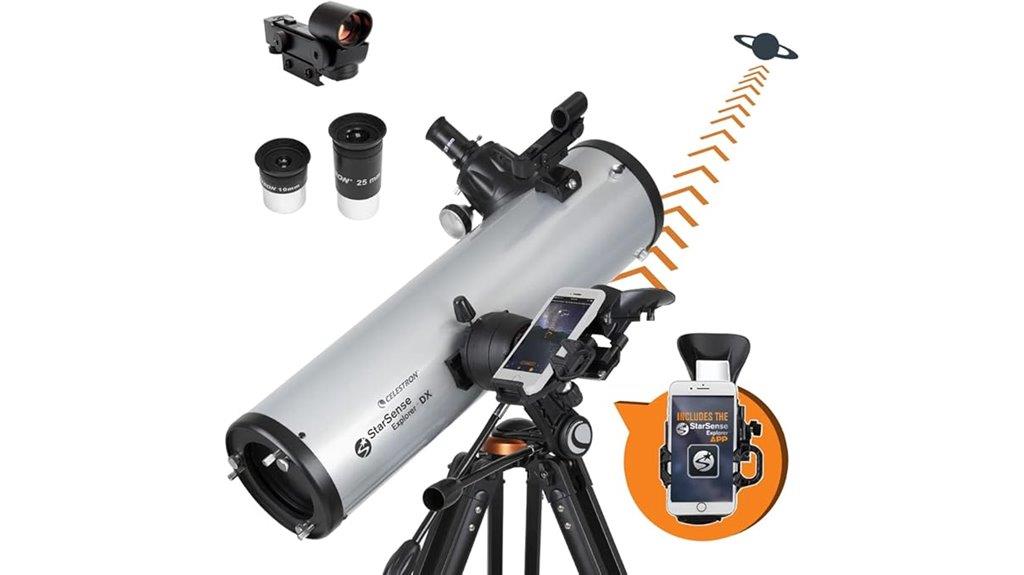
For beginners looking to explore astrophotography without a steep learning curve, the Celestron StarSense Explorer DX 130AZ stands out as an excellent choice. Its 130mm Newtonian reflector delivers sharp, bright views of the Moon, planets, and deep-sky objects like the Orion Nebula and Andromeda Galaxy. The smartphone dock and StarSense app make locating celestial targets easy—just align the app, follow on-screen arrows, and enjoy guided star-hunting. The manual altazimuth mount with slow-motion controls ensures smooth tracking and simple setup. Plus, with Celestron’s 2-year warranty and US-based support, you get dependable help whenever needed.
Best For: beginners and amateur astronomers seeking an easy-to-use telescope with smartphone integration for quick setup and guided star-hunting.
Pros:
- User-friendly app-guided navigation simplifies locating celestial objects.
- High-quality 130mm Newtonian reflector provides bright, clear views of the Moon, planets, and deep-sky objects.
- Manual altazimuth mount with slow-motion controls offers smooth tracking and quick setup.
Cons:
- Limited to visual observing; not designed for astrophotography.
- Manual mount requires steady handling for precise tracking over extended periods.
- Smartphone reliance may be less convenient in low-light conditions or if the device runs out of battery.
Celestron NexStar 130SLT Computerized Telescope
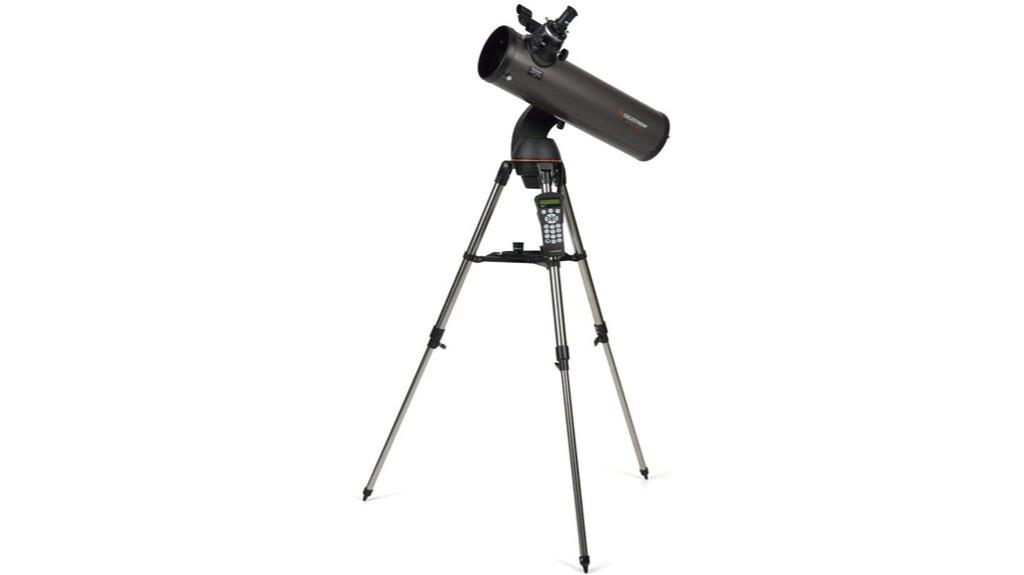
If you’re seeking a versatile telescope that combines powerful optics with user-friendly features, the Celestron NexStar 130SLT Computerized Telescope is an excellent choice. Its compact, portable design and 130mm aperture deliver bright, detailed views of planets, the Moon, and deep-sky objects. The computerized system with over 4,000 celestial objects guarantees quick, precise locating and tracking, making stargazing easier for beginners and kids alike. With SkyAlign technology, setup is straightforward. Plus, the included astronomy software enhances your experience. Backed by a two-year warranty and expert support, this telescope is a reliable, user-friendly option for both terrestrial and celestial observing.
Best For: beginners, kids, and amateur astronomers seeking a portable, easy-to-use telescope with powerful optics and computerized object locating.
Pros:
- Compact and portable design ideal for traveling and outdoor use
- User-friendly SkyAlign technology simplifies setup and alignment
- Includes a database of over 4,000 celestial objects for versatile viewing
Cons:
- Slightly limited aperture size compared to larger telescopes for deep-sky imaging
- May require additional accessories (like 2-inch eyepieces) for optimal viewing options
- Software and features may have a learning curve for absolute beginners
Dwarf 3 Smart Telescope
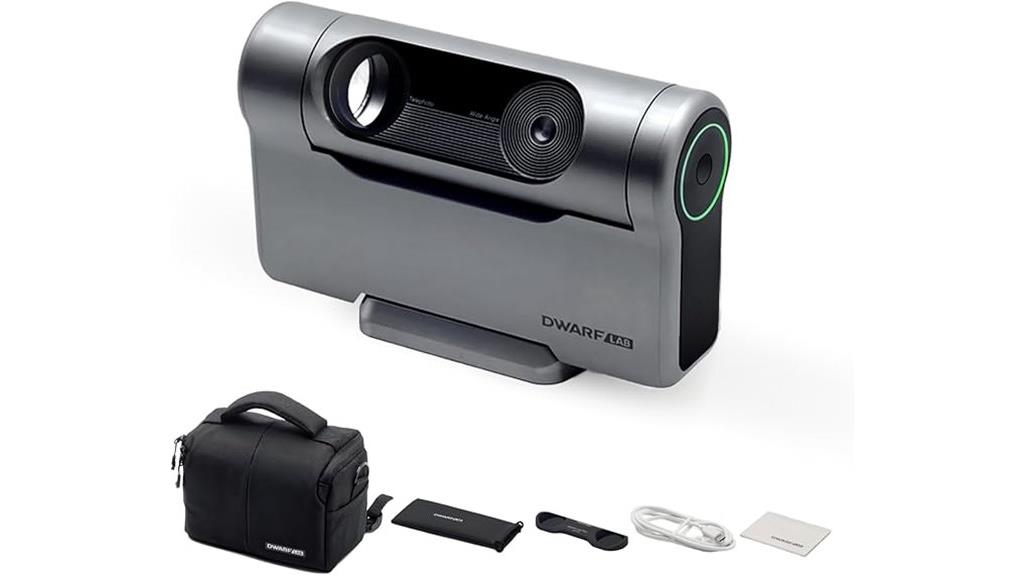
The Dwarf 3 Smart Telescope stands out as the perfect choice for travelers and outdoor enthusiasts who want high-quality astrophotography without sacrificing portability. Weighing just 3 pounds, it easily fits into a backpack, making it ideal for spontaneous stargazing, outdoor adventures, or quick trips. Its dual imaging system offers versatility for daytime wildlife, landscapes, or night sky shots, while smart auto-tracking keeps objects sharp and in frame. With cloud-powered processing, your images are enhanced instantly via the DWARFLAB app. Compact, user-friendly, and packed with features, it’s a powerful, portable tool for capturing stunning celestial and terrestrial images on the go.
Best For: travelers, outdoor enthusiasts, and beginner to expert astrophotographers seeking a portable, versatile, and easy-to-use telescope for celestial and terrestrial imaging.
Pros:
- Ultra-lightweight at just 3 pounds, making it highly portable for travel and outdoor adventures
- Dual imaging system offers versatility for both daytime and nighttime photography needs
- Cloud-powered processing provides instant, high-quality image enhancement via the user-friendly DWARFLAB app
Cons:
- Limited to a 4K auto-tracking system, which may not be sufficient for highly detailed astrophotography enthusiasts
- Battery life details are not specified, potentially affecting extended use in remote locations
- The compact design might limit the size of the aperture, impacting light-gathering capability for deep-sky objects
Telescope 90mm Aperture 800mm for Adults & Kids
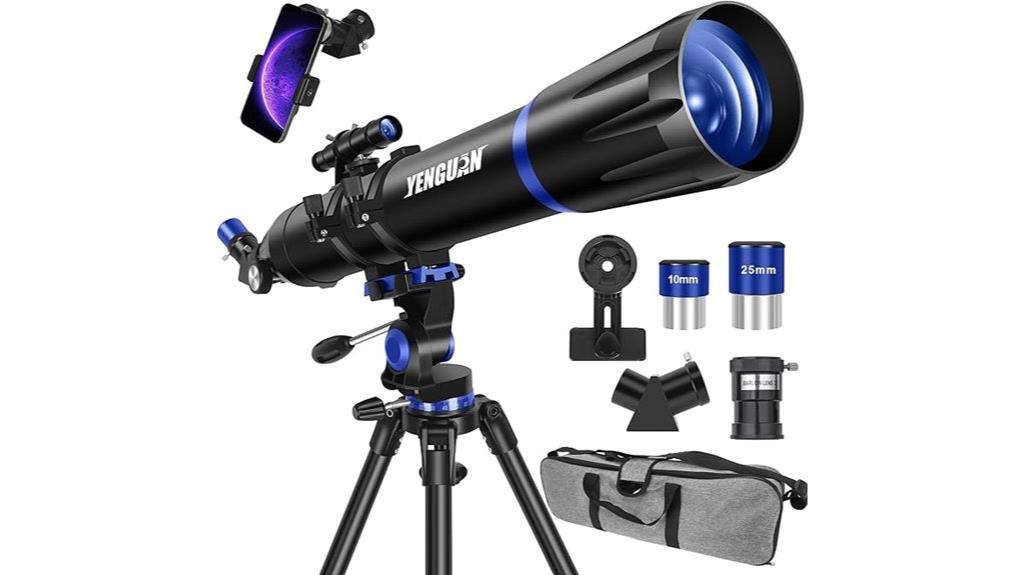
A 90mm aperture combined with an 800mm focal length makes this telescope an excellent choice for both adults and kids enthusiastic to explore the night sky. Its bright, crisp images reveal lunar crater textures and surface details, thanks to the expanded light-gathering capacity. The multi-layer optics protect against moisture, ensuring clear views and durability. With versatile magnification options and easy setup using a finderscope and 25mm eyepiece, it’s perfect for beginners. The lightweight, rugged design includes a stainless steel tripod and phone adapter, making it portable and ideal for terrestrial and celestial observations. It’s a reliable, user-friendly telescope that sparks curiosity in astronomy.
Best For: beginners, students, and outdoor enthusiasts of all ages eager to explore the night sky and terrestrial landscapes with a portable, easy-to-use telescope.
Pros:
- Bright, crisp images with detailed lunar and surface features thanks to 90mm aperture and 800mm focal length.
- Lightweight, durable construction with a stainless steel tripod and portable carry bag for easy transport.
- Versatile magnification options and included accessories like finderscope, phone adapter, and multiple eyepieces for varied observations.
Cons:
- May require some initial adjustment or learning curve for complete beginners.
- Limited to outdoor use during dry, clear nights; not suitable for daytime or cloudy conditions.
- Slightly larger setup size may be cumbersome in very tight or crowded spaces.
Gskyer 70mm Refracting Telescope with Mount and Accessories
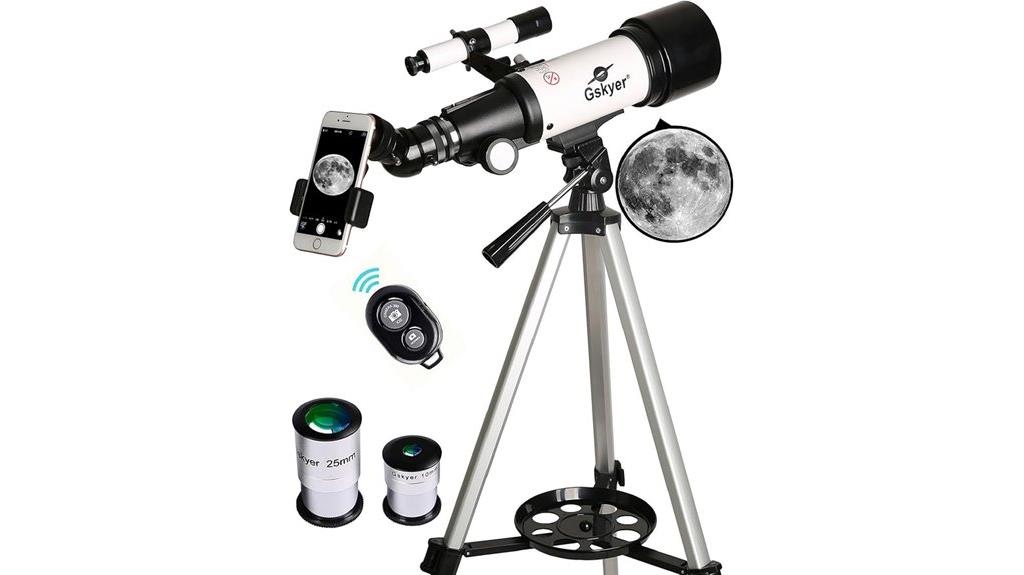
For beginners and kids interested in exploring the night sky, the Gskyer 70mm Refracting Telescope with Mount and Accessories offers an excellent entry point. Its 70mm aperture and 400mm focal length deliver sharp, clear images of the moon and stars, making celestial observation enjoyable. The fully coated optics glass lens ensures high transmission and eye protection. With two eyepieces, a 3x Barlow lens, and a 5×24 finder scope, it’s easy to locate and magnify objects. The adjustable tripod, portable carry bag, and smartphone adapter make it perfect for travel and outdoor adventures, all backed by quality assurance for confident ownership.
Best For: beginners and kids interested in exploring the night sky, moon, and stars with an easy-to-use, portable telescope.
Pros:
- High-quality fully coated optics glass lens for sharp and clear images
- Comes with versatile accessories including eyepieces, 3x Barlow lens, and finder scope for easy object location
- Portable design with adjustable tripod, carry bag, and smartphone adapter ideal for travel and outdoor use
Cons:
- May have limited magnification compared to larger telescopes
- Requires some setup and adjustment for optimal viewing
- Not suitable for advanced astronomical observations requiring higher magnification
SVBONY SV503 Refractor Telescope with Built-in Field Flattener
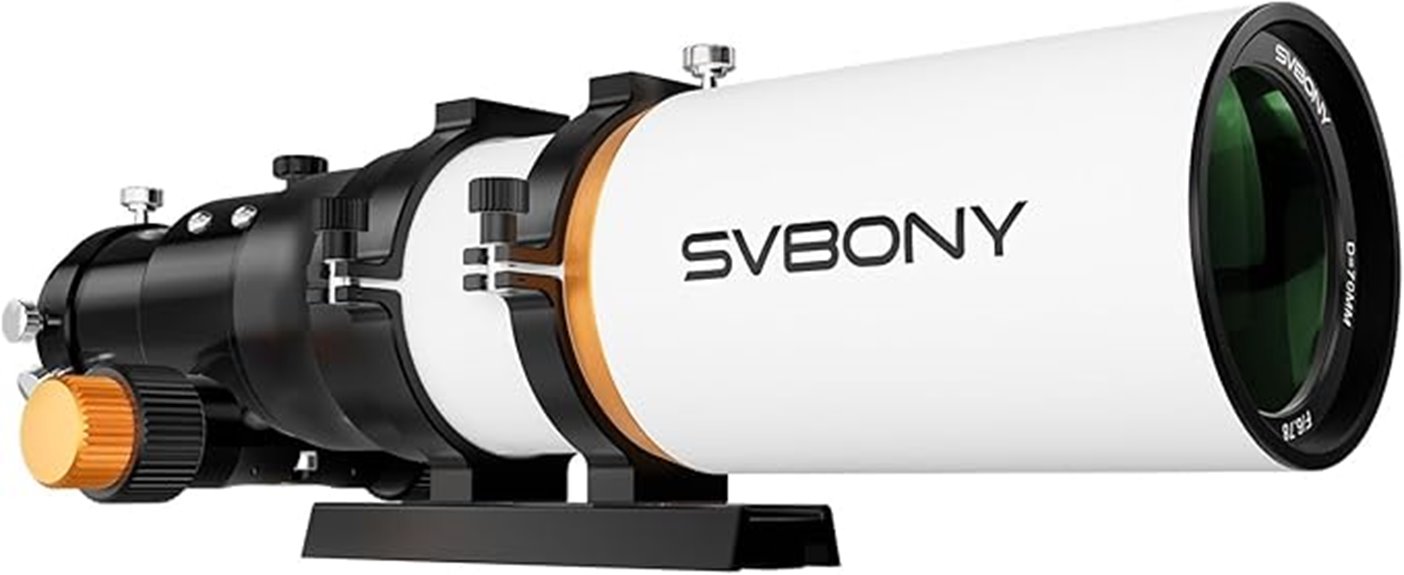
If you’re seeking a telescope that combines high-quality optics with user-friendly features, the SVBONY SV503 Refractor Telescope with Built-in Field Flattener stands out. Its flat-field design delivers wide, distortion-free views of galaxies, nebulae, and star clusters, thanks to a built-in field flattener that eliminates field curvature. The 70mm aperture with ED glass reduces chromatic aberration, producing true-to-life colors and sharp images. The dual-speed focuser allows quick coarse adjustments and fine-tuning for precise focus. Built with durable CNC components, it offers stability during long sessions. Its straightforward setup makes it ideal for both beginners and experienced astronomers aiming for high-quality astrophotography.
Best For: amateur astronomers and astrophotographers seeking a durable, high-quality refractor telescope with excellent image correction and user-friendly features for both visual and imaging applications.
Pros:
- Flat-field design delivers wide, distortion-free views with edge-to-edge sharpness
- ED glass reduces chromatic aberration for true-to-life colors and crisp images
- Dual-speed focuser allows quick coarse adjustments and fine tuning for precise focus
Cons:
- 70mm aperture may limit brightness for deep-sky imaging compared to larger telescopes
- Designed primarily for astrophotography and visual astronomy; less suitable for planetary observation
- Requires stable mounting and setup, which might be challenging for absolute beginners without prior experience
Telescope for Adults, 90mm Aperture, 800mm Refractor with Mount, Tripod, Phone Adapter & Carry Bag
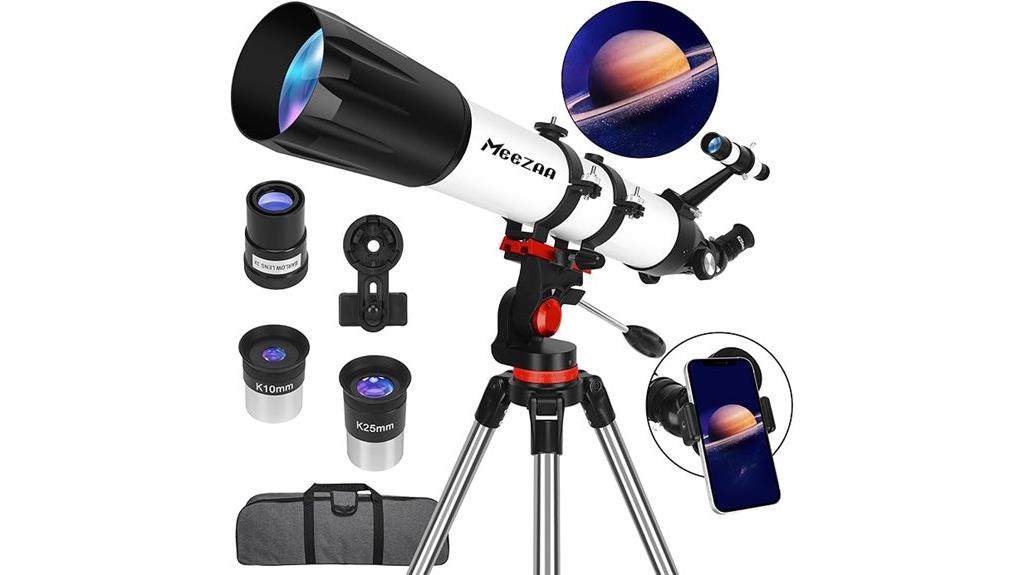
Designed specifically for adults and beginners, this 90mm aperture refractor telescope offers an excellent balance of performance and portability. Its 800mm focal length captures plenty of light, delivering bright, clear images of the moon, planets, and stars. The fully multi-coated lenses enhance viewing quality, while the included 10mm and 25mm eyepieces, along with the 3X Barlow lens, provide up to 240X magnification for detailed observations. The adjustable stainless steel tripod sets up quickly, and the phone adapter makes capturing images easy. Packaged in a carry bag, it’s perfect for backyard astronomy, camping, or star parties. It’s an accessible, reliable choice for exploring the night sky.
Best For: beginners and adults interested in exploring astronomy, nature, and outdoor star gazing with a portable, easy-to-use telescope.
Pros:
- High-quality 90mm aperture captures bright, clear images of the moon, planets, and stars.
- Comes with multiple eyepieces and a 3X Barlow lens for versatile magnification options up to 240X.
- Includes a phone adapter and carry bag, making it convenient for outdoor and travel use.
Cons:
- Assembly and setup may still be challenging for complete beginners without careful reading of the manual.
- Limited to daytime use for terrestrial viewing, as designed primarily for astronomical observation.
- The tripod, while adjustable, may not be as stable as professional-grade mounts for very precise observations.
Telescope 80mm Aperture 600mm Refracting Telescope with Tripod and Accessories
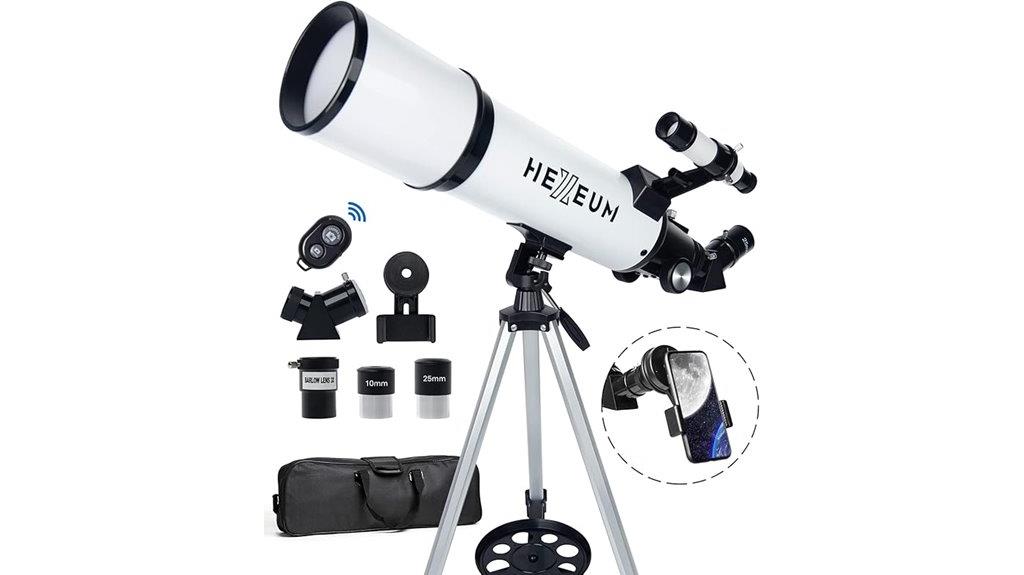
This 80mm Aperture 600mm Refracting Telescope is an excellent choice for beginners who want to explore astrophotography without breaking the bank. Its bright optics, thanks to multi-coated lenses, deliver clear, vivid images of the night sky. The two interchangeable eyepieces and 3x Barlow lens offer versatile magnification—from 24x up to 180x—perfect for moon and planetary viewing. Setup is quick and tool-free, thanks to the user-friendly focusing mechanism. It comes with an adjustable tripod, phone adapter, and remote control, making capturing images easy. Plus, its portability and lifetime support ensure a reliable, beginner-friendly experience for aspiring astrophotographers.
Best For: beginners and amateur astronomers seeking an affordable, portable telescope with easy setup and astrophotography capabilities.
Pros:
- Bright, clear images facilitated by multi-coated all-optical lenses.
- Versatile magnification options with interchangeable eyepieces and Barlow lens.
- User-friendly setup with quick, tool-free assembly and included accessories for easy capturing.
Cons:
- Might have limited deep-sky viewing capabilities for advanced astronomers.
- Requires careful handling of small components like eyepieces and phone adapters.
- The fixed aperture size may restrict detailed observations of faint objects.
Celestron StarSense Explorer 130AZ Telescope with Smartphone Dock
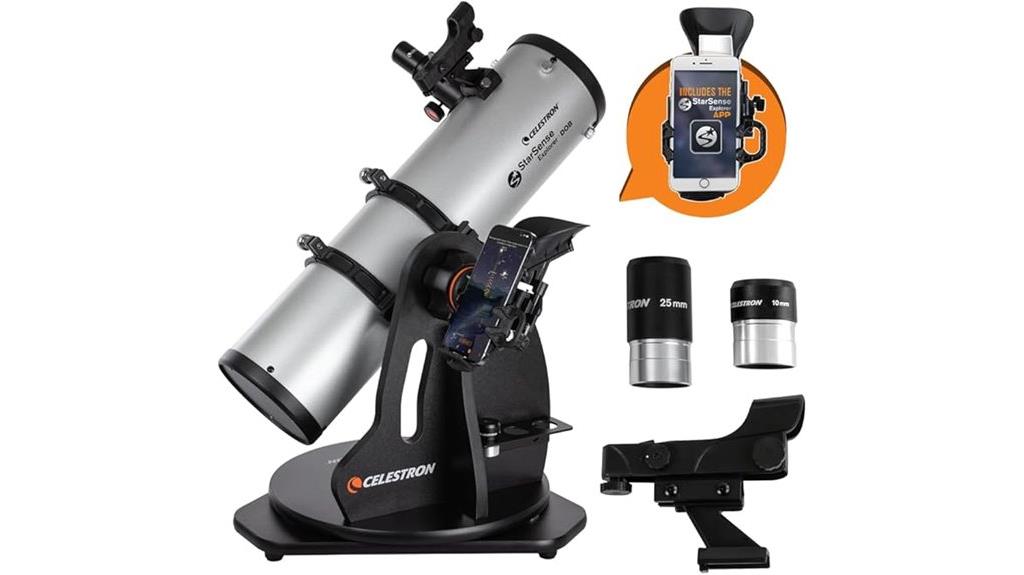
The Celestron StarSense Explorer 130AZ Telescope with Smartphone Dock stands out as an excellent choice for beginners excited to explore astrophotography. Its 130mm Newtonian mirror provides sharp views of the Moon, planets, and deep-sky objects like Orion Nebula and Andromeda Galaxy. The star recognition technology and compatible app make locating objects simple, even from city skies. Setting up is straightforward, with a manual altazimuth base and intuitive guidance through your phone. Dock your smartphone, follow the app’s cues, and enjoy vivid, detailed images. Backed by Celestron’s two-year warranty and US-based support, it’s a reliable, user-friendly option for aspiring astrophotographers.
Best For: beginners and amateur astronomers seeking an easy-to-use, smartphone-integrated telescope for exploring the night sky.
Pros:
- User-friendly setup with intuitive app guidance and star recognition technology
- Sharp, vivid views of lunar, planetary, and deep-sky objects with high-quality optics
- Reliable 2-year warranty and US-based support from a trusted brand
Cons:
- Manual altazimuth base may require adjustments for prolonged tracking
- Smartphone docking and app functionality depend on device compatibility and updates
- Not designed for advanced astrophotography or long-exposure imaging
SVBONY SV503 Refractor Telescope, 102mm F7 Achromatic Refractor
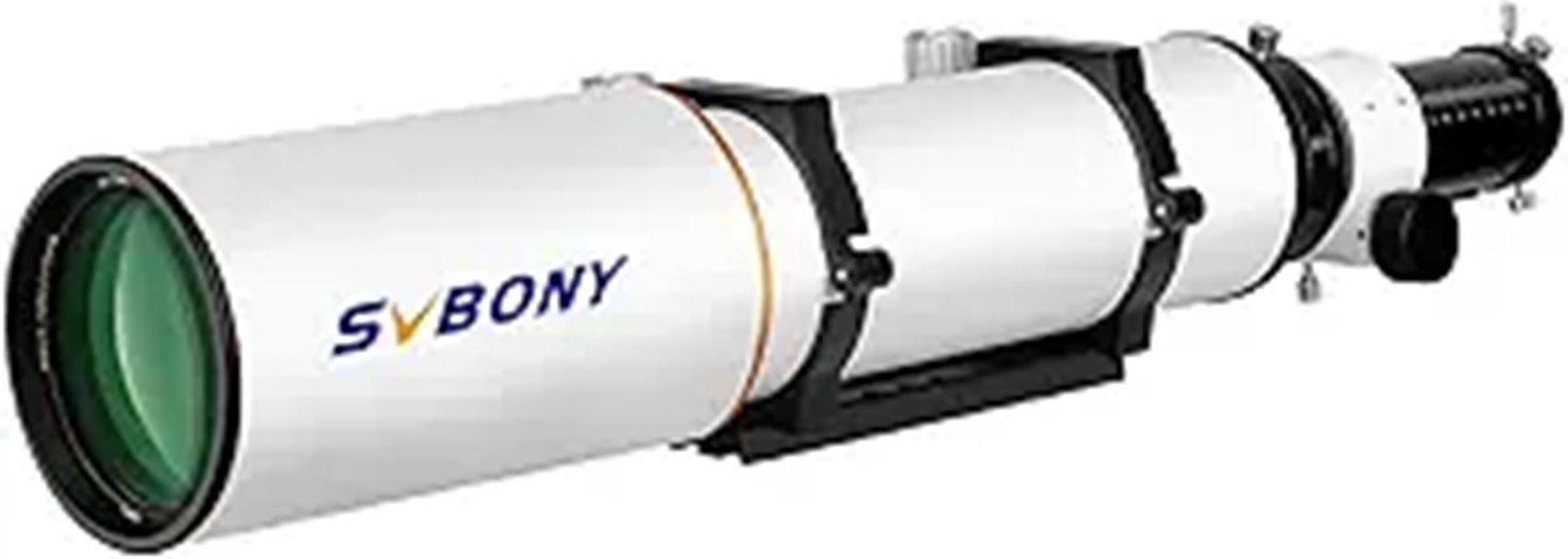
If you’re serious about capturing vibrant, detailed images of deep-sky objects or planets, the SVBONY SV503 Refractor Telescope is an excellent choice. Its 102mm aperture and 714mm F7 focal length deliver bright, sharp images ideal for astrophotography. The achromatic design with S-FPL51 ED glass minimizes chromatic aberration, ensuring accurate color reproduction. Fully multi-coated optics boost brightness and contrast, while the dual-speed focuser allows precise adjustments. The 360° field rotator simplifies framing, and the retractable lens hood helps block stray light. Overall, this telescope offers great performance and flexibility for both planetary and deep-sky imaging.
Best For: amateur astronomers and astrophotographers seeking a versatile, high-quality refractor telescope for both planetary and deep-sky imaging.
Pros:
- Bright, sharp images with minimized chromatic aberration due to S-FPL51 ED glass and achromatic design
- Precise focusing and framing with dual-speed focuser and 360° field rotator
- Fully multi-coated optics for enhanced brightness, contrast, and overall image quality
Cons:
- Slightly heavier and bulkier compared to smaller refractors, requiring sturdy mounting equipment
- May be more expensive than entry-level telescopes for casual users
- Requires some experience to fully utilize advanced features like the field rotator and precise focusing
Vespera Pro Smart Telescope with Observation Station Functionality
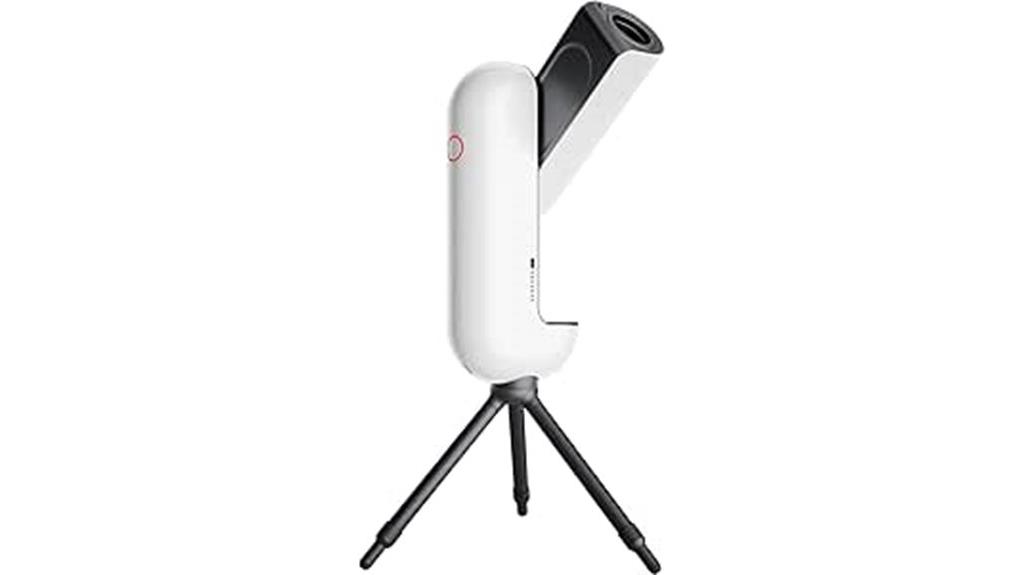
For amateur and professional astronomers seeking a compact, user-friendly astrophotography solution, the Vespera Pro Smart Telescope with Observation Station Functionality stands out. It’s app-controlled, allowing automated stargazing and high-resolution imaging with ease. The telescope features an ultra-high sensitive SONY IMX676 Starvis 2 sensor, capturing detailed images, while a custom-developed field corrector maximizes optical performance. Proprietary CovalENS technology enables live panoramic captures, expanding observational capabilities. The Vespera Pro app offers both automatic calibration and an Expert Mode for advanced control. Its combination of premium optics, smart automation, and seamless app integration makes it a versatile choice for capturing stunning celestial images effortlessly.
Best For: amateur and professional astronomers seeking a compact, easy-to-use astrophotography telescope with advanced imaging and observation capabilities.
Pros:
- App-controlled automation for effortless stargazing and imaging
- Equipped with a high-sensitivity SONY IMX676 Starvis 2 sensor for detailed images
- Proprietary CovalENS technology enables live panoramic captures and expanded observational views
Cons:
- May require a compatible smartphone or tablet for full functionality
- Advanced features like Expert Mode might have a learning curve for beginners
- Larger sensor and specialized optics could increase the overall cost compared to simpler telescopes
Dianfan Telescope with 90mm Aperture and 800mm Focal Length
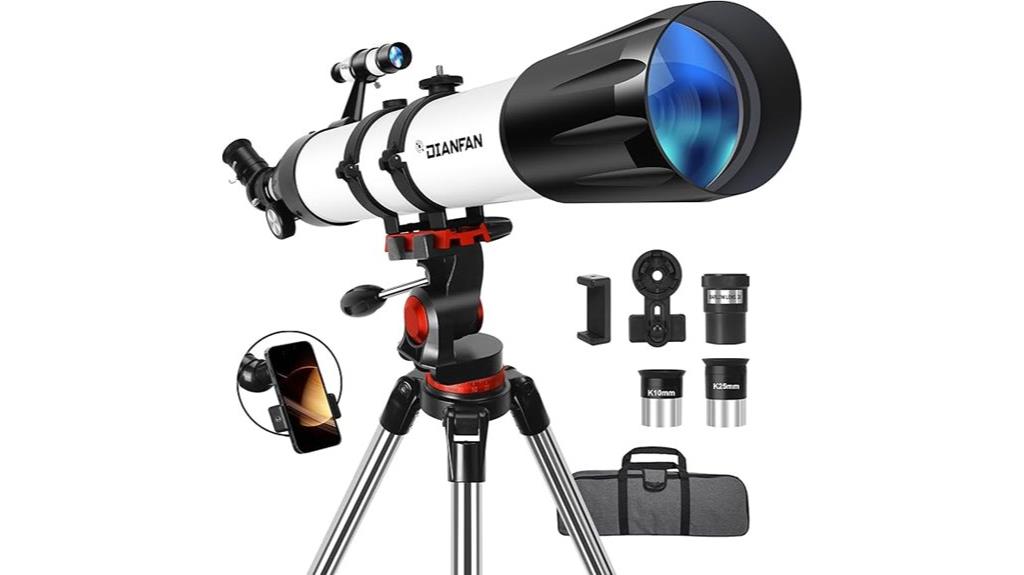
Designed with beginners in mind, the Dianfan Telescope with 90mm aperture and 800mm focal length offers an excellent balance of performance and ease of use. Its fully coated optics deliver bright, clear images with rich contrast and vibrant colors, making celestial objects stand out. With two eyepieces and a 3× Barlow lens, you can achieve magnifications from 32× up to 240×, perfect for lunar, planetary, and deep-sky viewing. The 45° zenith mirror provides upright images, ideal for terrestrial observations. Lightweight and portable, it’s easy to set up in about 15 minutes, making stargazing accessible for families and beginner astronomers alike.
Best For: Beginners, families, and outdoor enthusiasts seeking an easy-to-use, portable telescope for celestial and terrestrial viewing.
Pros:
- Fully coated optics for bright, high-contrast images
- Lightweight and portable with quick setup in about 15 minutes
- Versatile with 32×–240× magnification and included accessories
Cons:
- May require additional accessories for advanced astrophotography
- Limited aperture size for very deep-sky object observation
- Manual focusing may be challenging for some users
Factors to Consider When Choosing Telescopes for Astrophotography
When selecting a telescope for astrophotography, I consider several key factors to guarantee great results. These include aperture size, focal length, mount stability, optical quality, and ease of setup. Each element plays an essential role in capturing clear, detailed images of the night sky.
Aperture Size Importance
Aperture size plays a crucial role in astrophotography because it determines how much light the telescope can gather, directly affecting the brightness and detail of your images. Larger apertures allow more light to enter, resulting in brighter, sharper photographs with greater detail. For deep-sky objects like galaxies and nebulae, an aperture of 70mm or more is recommended to capture sufficient clarity. Increasing the aperture enhances the telescope’s ability to resolve fine features, such as planetary surface details and star clusters. It also improves the signal-to-noise ratio, reducing graininess and boosting overall image quality. Ultimately, a bigger aperture means better light-gathering power, making it essential for long-exposure astrophotography and achieving stunning, high-quality celestial images.
Focal Length Selection
Choosing the right focal length is essential because it directly affects how much of the sky you can capture and the level of detail in your images. Longer focal lengths, like 800mm or more, deliver higher magnification, making them ideal for planetary and lunar shots where detail matters most. Shorter focal lengths, around 400-600mm, provide wider fields of view, perfect for capturing deep-sky objects such as nebulae and star clusters. It’s important to balance focal length with your camera sensor and pixel size to optimize resolution without over-magnifying or causing vignetting. Additionally, ensure your mount’s tracking accuracy matches your chosen focal length; otherwise, long exposures may result in blurry images. Picking the right focal length helps you achieve sharp, detailed astrophotos aligned with your targets.
Mounting Stability & Accuracy
A stable mount is fundamental for capturing sharp astrophotos, especially during long exposures where even slight vibrations can blur your images. An equatorial mount with precise slow-motion controls allows for accurate tracking of celestial objects as they drift across the sky, making long exposures more manageable. Auto-guiding capabilities are also essential, as they can correct tracking errors in real-time, ensuring consistent image quality over extended sessions. The mount’s weight capacity should comfortably support your telescope and accessories, maintaining stability throughout your observation. Proper balancing of the telescope on the mount reduces strain on motors and boosts tracking accuracy. Investing in a sturdy, well-designed mount helps prevent vibrations and guarantees your astrophotography sessions produce sharp, clear images.
Optical Quality & Coatings
Optical quality and coatings play a crucial role in achieving sharp, detailed astrophotographs. High-quality optics with multi-coated or fully coated lenses and mirrors improve light transmission, brightness, and contrast, making celestial objects pop in your images. Achromatic or apochromatic designs minimize chromatic aberration, resulting in sharper images with true-to-life colors. Proper coatings reduce reflections and light loss, which helps eliminate glare and halo effects, ensuring clearer, more precise details. Additionally, advanced coatings protect against moisture and scratches, maintaining optical clarity and durability over time. These coatings also enhance contrast and detail resolution, essential for capturing fine features like nebulae, galaxies, and star clusters. Investing in well-coated optics makes a noticeable difference in the quality of your astrophotography results.
Ease of Setup
Setting up your telescope for astrophotography can be quick and straightforward if you select models with user-friendly features. Look for telescopes that offer quick, tool-free assembly to save time and frustration. Models with detailed, step-by-step instructions or automated alignment systems make initial setup easier, especially for beginners. Integrated or compatible smartphone adapters and remote controls streamline operation and help you capture images more efficiently. Prioritize telescopes with user-friendly focusing mechanisms, such as dual-speed or motorized focusers, to achieve precise focus without hassle. Additionally, lightweight components and carrying cases make outdoor setup quick and simple, enabling you to start imaging sooner. Choosing a telescope with ease of setup ensures more time capturing stunning celestial images and less time dealing with technical difficulties.
Portability & Travel
When choosing a telescope for astrophotography on the go, prioritizing portability is essential. Lightweight, compact models under 3.5kg make travel easier, allowing you to carry them comfortably in backpacks or carry-on luggage. Foldable or collapsible designs further reduce storage space and simplify packing. Portable mounts, like adjustable tripods or lightweight altazimuth and equatorial options, improve mobility without sacrificing stability. Integration with smartphone adapters and remote controls enables quick setup and remote operation, which is especially handy in unfamiliar locations. Durability features, such as weather-resistant coatings and sturdy construction, ensure your telescope withstands various outdoor conditions. Overall, a portable telescope combines ease of transport, quick setup, and reliable performance—crucial factors when capturing celestial images away from home.
Imaging Compatibility
Choosing a portable telescope for astrophotography means guaranteeing it can connect smoothly with your camera setup. You’ll want a model with a compatible camera mount, like a T-ring or dedicated adapters, to secure your camera properly. Built-in or compatible field flatteners and reducers are essential for minimizing distortion and achieving sharp, even images across your frame. Check that the telescope’s focal length and aperture support your target exposure times and desired resolution. Electronic or motorized focusing systems are also valuable for precise adjustments during long exposures. Ultimately, verify that the telescope can connect seamlessly with your preferred imaging software, whether through USB, HDMI, or wireless options. These factors help ensure your setup is efficient, reliable, and capable of capturing stunning celestial images.
Budget & Value
Finding a telescope that offers the best value for your money requires balancing cost with essential features. I recommend considering the total expense, including accessories, to guarantee it fits your budget while meeting your astrophotography needs. Look for good optical quality—larger apertures and quality coatings boost brightness and detail without breaking the bank. It’s also important to weigh features like motorized tracking, camera compatibility, and stability, which enhance imaging quality and ease of use. Durability and long-term support are vital to avoid costly repairs or upgrades later on. Finally, compare bundled packages versus buying components separately; sometimes, bundles offer better value, but individual purchases can be more tailored. Striking this balance helps you invest wisely in a telescope that delivers great performance without overspending.
Frequently Asked Questions
How Does Aperture Size Impact Astrophotography Quality?
Aperture size directly impacts the quality of astrophotography because it determines how much light the telescope collects. The larger the aperture, the more light I can gather, which means brighter, clearer images and better detail, especially of faint objects like distant galaxies or nebulae. With a bigger aperture, I can also achieve shorter exposure times, reducing motion blur and capturing stunning, sharp celestial images more effectively.
What Is the Ideal Mount Type for Astrophotography Stability?
I recommend a equatorial mount for astrophotography stability because it tracks celestial objects smoothly and accurately, reducing star trails. It compensates for Earth’s rotation, allowing longer exposures without blurring images. I personally prefer mounts with motorized tracking and precise alignment features, which help me capture sharp, detailed images of the night sky. For the best results, invest in a sturdy, well-balanced mount that suits your telescope and photography needs.
How Important Is the Telescope’s Focal Length for Capturing Detailed Images?
Focal length is essential for capturing detailed images because it determines the telescope’s magnification and field of view. A longer focal length allows me to zoom in on distant celestial objects, revealing fine details like planetary surface features or distant galaxies. However, it also means a narrower field of view and potential challenges with tracking. Balancing focal length with my mount’s stability is key to getting crisp, detailed astrophotos.
Can Smartphone Adapters Significantly Enhance Astrophotography Results?
Smartphone adapters can definitely enhance your astrophotography results. They make it easier to stabilize your phone camera, ensuring sharper images of stars and planets. I’ve found that using a good adapter reduces vibrations and allows for longer exposures without losing clarity. Plus, they’re affordable and compatible with many telescopes. If you want to improve your astrophotos without investing in a dedicated camera, a smartphone adapter is a simple, effective upgrade.
What Additional Accessories Are Recommended for Beginner Astrophotographers?
Did you know that over 60% of beginner astrophotographers find that accessories like a sturdy tripod, a remote shutter release, and a star tracker markedly improve their results? I recommend starting with a good mount to stabilize your shots, a wide-angle lens for capturing star fields, and filters to reduce light pollution. These tools make a huge difference in capturing clear, stunning celestial images right from your backyard.
Conclusion
Choosing the right telescope is like finding the perfect lens to capture a fleeting moment in time. With the options listed, you’re equipped to chase the stars and turn celestial dreams into vivid images. Remember, each telescope is a key opening a different universe of wonder. So, pick your companion wisely, and let your passion for astrophotography illuminate the night sky’s endless canvas. Happy stargazing and capturing those cosmic masterpieces!