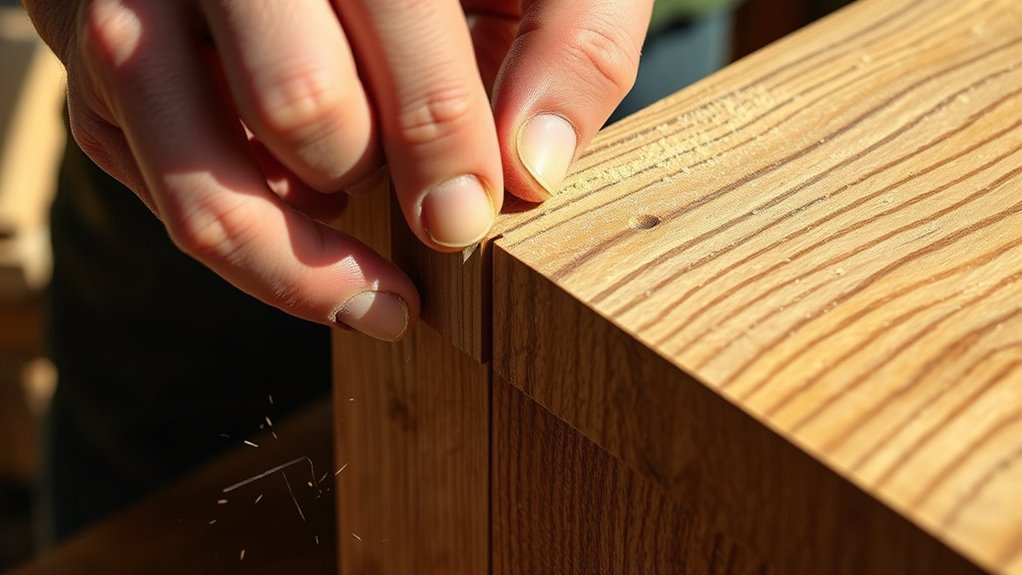

To start with basic woodworking joints, you’ll want to learn about simple yet strong connections like dovetail and mortise and tenon joints. Dovetails fit together tightly, offering durability and a beautiful look, perfect for boxes and drawers. Mortise and tenon joints are great for frames and furniture, providing stability and strength. mastering these joints takes patience and practice, but if you keep exploring, you’ll discover how to create lasting, professional-quality wood projects.
Key Takeaways
- Basic woodworking joints like dovetail and mortise and tenon are essential for creating strong, durable connections without nails or screws.
- Dovetail joints are ideal for drawers and boxes, offering interlocking strength and visual appeal.
- Mortise and tenon joints are commonly used in furniture frames, providing stability and load distribution.
- Precision, patience, and practice are vital to mastering these joints for secure, seamless connections.
- Proper tools such as chisels, saws, and routers help achieve accurate cuts for effective joint fitting.
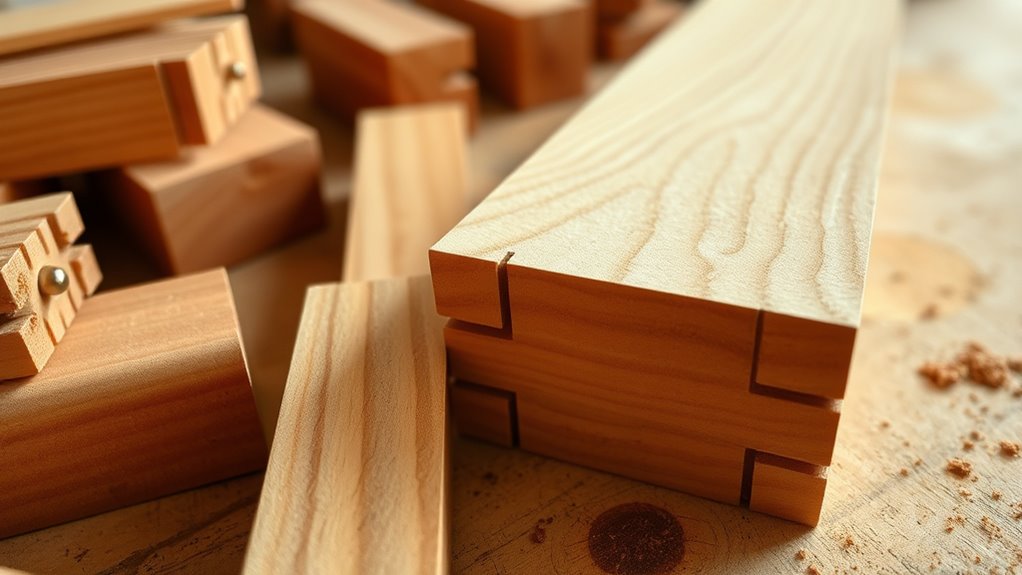
Have you ever wondered how woodworkers create strong, durable joints that hold furniture and structures together? The secret lies in mastering basic woodworking joints, which are the foundation of any sturdy project. Two of the most effective techniques are dovetail joints and mortise and tenon joints. Dovetail techniques are often used in drawer construction and box making because they provide excellent tensile strength and a visually appealing interlocking pattern. When you cut dovetails, you create a series of projections and recesses that fit together tightly, resisting pulling apart. This process requires precision, patience, and practice, but once mastered, dovetail joints become a reliable way to connect pieces without nails or screws. You can achieve strong joints with hand tools like saws and chisels or use jigs and routers for faster results. Dovetail joints not only add strength but also enhance the aesthetic appeal of your projects, showcasing craftsmanship. Properly fitting joints are essential for both strength and appearance, which is why accurate measurement and careful cutting are so important.
On the other hand, mortise and tenon joints are a classic choice for framing and structural work. They involve creating a rectangular hole, called a mortise, in one piece of wood, which fits snugly with a corresponding projection called a tenon on the connecting piece. When you assemble these joints, you often secure them with glue, pins, or wedges to ensure stability. Mortise and tenon joints are highly regarded for their strength and longevity because they distribute loads evenly across the joint and resist twisting and pulling forces. They’re a staple in furniture making, from tables to chairs, because they can handle both compression and tension. To create a mortise and tenon joint, you typically use a chisel, saw, or power tools to cut the precise dimensions needed for a perfect fit. Properly executed, this joint becomes almost seamless, providing durability that lasts for generations.
Frequently Asked Questions
Which Woodworking Joint Is Strongest for Load-Bearing Projects?
The mortise and tenon joint is the strongest wood joint type for load-bearing projects. You’ll find it offers exceptional load capacity because it creates a large surface area for glue and a tight fit, making it highly durable. When you choose this joint, you’re ensuring your project can handle heavy loads and stress. Its impressive strength makes it ideal for furniture, frames, and structural applications where load capacity is critical.
How Do I Choose the Right Joint for Curved Wood Pieces?
Choosing the right joint for curved wood is like fitting puzzle pieces together smoothly. You should pick joints that allow for flexibility, like a dowel or a loose mortise and tenon, respecting the grain direction to prevent splitting. These joints bend gently with the curve and maintain strength. Always consider the joint’s flexibility and how well it follows the curve, so your piece stays durable and visually appealing.
Can I Assemble Joints Without Using Nails or Screws?
Yes, you can assemble joints without nails or screws by using alternative fastening methods like adhesive bonding. Choose a strong wood glue suitable for your project, apply it evenly, and clamp the pieces tightly until it cures. This method provides a clean, seamless look and is ideal for delicate or curved wood pieces. Just make certain the surfaces are clean and well-prepared for a secure bond that lasts.
What Safety Precautions Should I Take When Making Joints?
You should always prioritize your well-being when making joints by wearing personal protective equipment like safety glasses and ear protection. Follow workshop safety rules diligently, such as keeping your workspace tidy and using tools properly. Avoid distractions, handle sharp tools with care, and always disconnect power tools when not in use. These precautions help prevent injuries and guarantee a safe, enjoyable woodworking experience.
How Do Temperature and Humidity Affect Joint Stability?
Temperature and humidity greatly impact joint stability because climate control is essential. When the air is dry, wood shrinks, causing joints to loosen or crack. Conversely, high humidity makes wood swell, which can lead to warping or joint failure. To minimize wood movement, store your projects in a controlled environment, and allow wood to acclimate before joining. Proper climate control helps maintain consistent joint strength and durability over time.
Conclusion
Now that you understand the fundamental woodworking joints, you’re ready to start your projects with confidence. For instance, imagine building a simple bookshelf using a dado joint for shelves, ensuring sturdy and clean connections. As you practice, you’ll improve your skills and create stronger, more polished pieces. Remember, every joint you master brings you closer to turning your woodworking ideas into reality. Keep experimenting, stay patient, and enjoy bringing your craftsmanship to life!