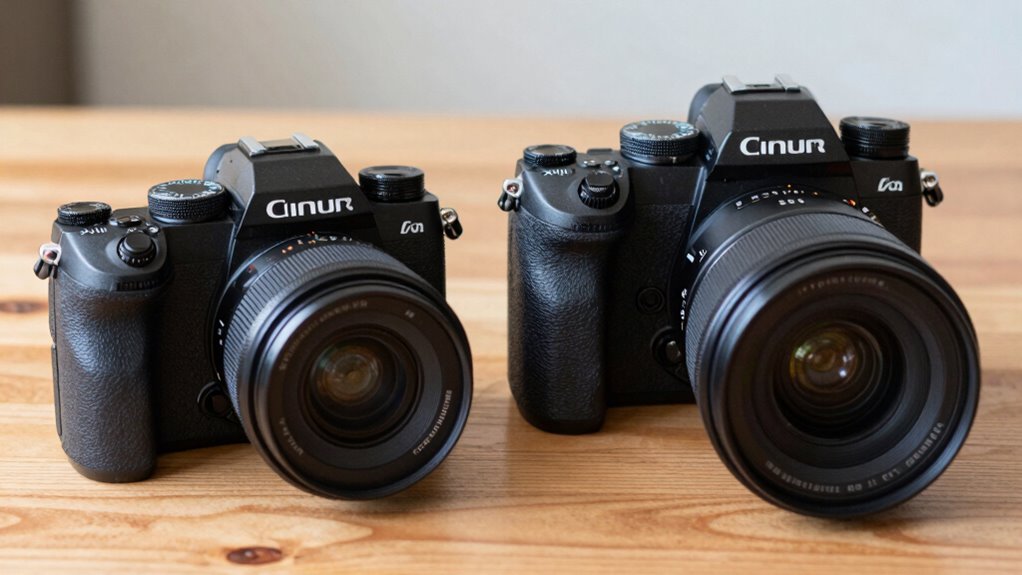

Mirrorless cameras lack a mirror and optical viewfinder, making them more compact and often faster in focusing, especially with advanced autofocus modes like face and eye detection. Full-frame cameras, whether mirrorless or DSLR, have larger sensors that capture more light, resulting in better image quality, especially in low-light conditions, and more creative control with depth of field. Understanding these terms helps you choose the right gear—continue exploring for more details that can improve your photography skills.
Key Takeaways
- Full-frame cameras have larger sensors matching 35mm film, offering better low-light performance and depth of field.
- Mirrorless cameras use electronic viewfinders and on-sensor autofocus, often providing faster focus and live preview.
- Full-frame models are typically larger and more expensive, while mirrorless options are more compact and budget-friendly.
- Autofocus in mirrorless cameras is advanced due to on-sensor focusing technology, improving subject tracking.
- Sensor size and camera design influence image quality, portability, and suitability for different photography needs.
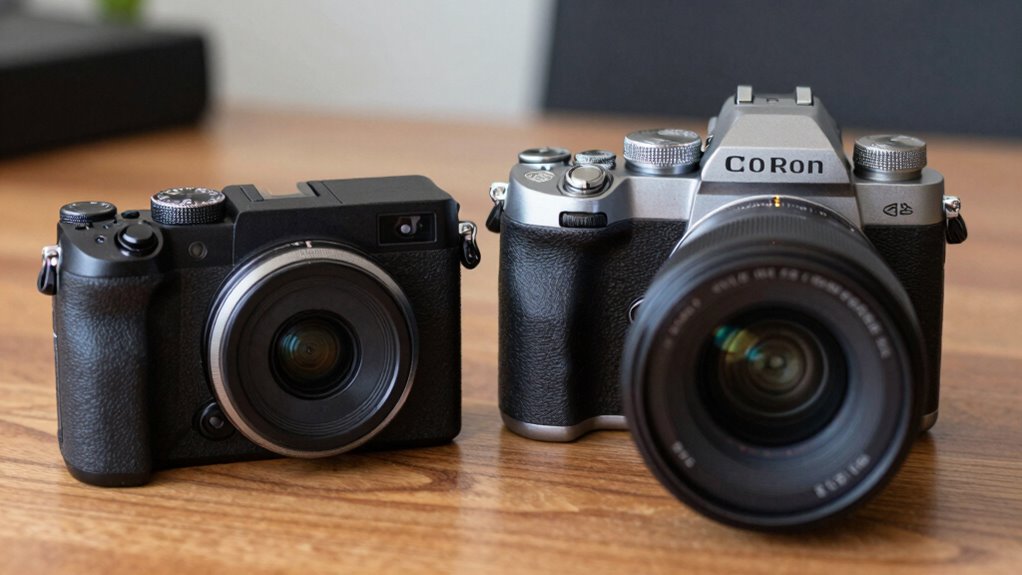
Have you ever been confused by camera jargon that seems like a different language? It’s common when you’re trying to understand the differences between mirrorless and full-frame cameras. Terms like sensor size and autofocus modes can feel overwhelming, especially if you’re new to photography. Let’s break down these concepts to help you make sense of what each type offers.
Sensor size is a major factor in how a camera performs. In simple terms, it’s the physical size of the camera’s image sensor—the part that captures light. Full-frame cameras have larger sensors, roughly the same size as 35mm film, which allows them to gather more light. This translates into better image quality, especially in low-light conditions, and a shallower depth of field, giving your photos a pleasing background blur. Mirrorless cameras, on the other hand, can have sensors of various sizes. Some mirrorless models feature full-frame sensors, matching traditional DSLRs, while others use smaller sensors like APS-C or Micro Four Thirds. Smaller sensors tend to be more compact and affordable but might not perform as well in challenging lighting or produce as rich a depth of field. Additionally, sensor size can influence the overall camera design and how portable your gear can be. Recognizing the sensor size difference can help you choose the right camera for your needs. Understanding the sensor size impact on image quality can guide your decision based on your photography style. Moreover, sensor size also affects lens compatibility and the availability of accessories, which can be an important consideration for future upgrades.
Autofocus modes are another key aspect to weigh up. These are the settings that determine how your camera focuses on subjects. Most cameras offer multiple autofocus modes such as single-point, continuous, and face or eye detection. In mirrorless cameras, autofocus systems are often more advanced because they rely on on-sensor focusing technology. They can quickly lock onto moving subjects and track them smoothly, which is great for action shots or wildlife photography. Full-frame cameras, especially high-end models, often feature sophisticated autofocus modes that provide precise focus in complex scenes. The autofocus system’s capability can greatly influence your shooting experience, making it easier to get sharp images without fussing over manual focus every time. A well-optimized autofocus system can significantly improve your chances of capturing clear, focused images in various situations. Understanding autofocus modes can help you select a camera that matches your shooting style. Knowing how autofocus performance varies across systems can also assist in choosing the right camera for dynamic or fast-paced environments.

Canon EOS RP Full-Frame Mirrorless Interchangeable Lens Camera + RF24-105mm Lens F4-7.1 is STM Lens Kit- Compact and Lightweight for Traveling and Vlogging, Black (3380C132)
Compact, Lightweight and High-Quality RF Lens with a Versatile Zoom Range of 24-105 millimeter
As an affiliate, we earn on qualifying purchases.
As an affiliate, we earn on qualifying purchases.
Frequently Asked Questions
How Does Sensor Size Affect Low-Light Performance?
Sensor size directly impacts your camera’s low-light performance because larger sensors have greater sensor sensitivity, capturing more light. This means you can shoot at higher ISO settings without introducing excessive noise. With a bigger sensor, noise reduction becomes more effective, resulting in clearer, sharper images in dim conditions. So, if you want better low-light shots, a full-frame camera’s larger sensor gives you the advantage of improved sensitivity and reduced noise.
What Is Crop Factor and How Does It Impact Lens Choice?
Think of crop factor as a friendly nudge from your camera’s sensor size, gently influencing how your lens behaves. It multiplies your lens’s focal length, making wide angles appear more zoomed-in. Knowing this helps you choose compatible lenses that match your creative vision, especially since sensor size affects lens compatibility. So, understanding crop factor guides you to select lenses that work best with your camera, enhancing your photography experience.
Are Mirrorless Cameras More Durable Than DSLRS?
Mirrorless cameras generally aren’t more durable than DSLRs, but their compact design can affect camera ergonomics, making them feel less sturdy for some users. Battery life tends to be shorter in mirrorless models because of electronic viewfinders and smaller batteries. If durability is your priority, choose a robust DSLR with weather-sealing; if portability and modern features matter, a mirrorless might suit you better despite potential durability trade-offs.
How Does Autofocus Speed Compare Between the Two Systems?
You might think mirrorless cameras always have faster autofocus, but that’s not entirely true. Their autofocus speed depends on autofocus system complexity and accuracy. Mirrorless systems often have quicker, more accurate autofocus because of on-sensor phase detection and eye-tracking. However, some high-end DSLRs still rival or surpass mirrorless in autofocus speed, especially in challenging conditions. So, the key lies in the specific camera’s autofocus technology, not just the system type.
Do Full-Frame Cameras Require Different Lenses Than Mirrorless Cameras?
Full-frame cameras often use different lenses than mirrorless cameras, mainly due to lens compatibility. Mirrorless systems typically have their own mount types, so you might need adapters for full-frame lenses. Additionally, full-frame cameras tend to offer better ergonomics, which can influence your lens choices. Be sure to check compatibility and ergonomics when selecting lenses, ensuring they fit your camera system and suit your shooting style.

8K Digital Camera for Photography with WiFi 96MP Autofocus Vlogging Camera for YouTube Video 3.5'' 180°Flip Screen 20X Zoom Anti-Shake Compact Point and Shoot Cameras for Beginner Creator with SD Card
2026 Next-Gen 96MP 8K Digital Camera with Flash : Capture life’s most vibrant moments with this advanced 8K…
As an affiliate, we earn on qualifying purchases.
As an affiliate, we earn on qualifying purchases.
Conclusion
Now that you understand the differences between mirrorless and full-frame cameras, you’re like an artist with a fresh palette, ready to paint your unique vision. Whether you choose the compact agility of mirrorless or the expansive depth of a full-frame, you hold the brush to craft stunning images. Remember, it’s not just about the tools but how you wield them—like a master sculptor shaping light and shadow into your story.
Canon EOS RP Full-Frame Mirrorless Interchangeable Lens Camera + RF24-105mm Lens F4-7.1 is STM Lens Kit- Compact and Lightweight for Traveling and Vlogging, Black (3380C132)
Compact, Lightweight and High-Quality RF Lens with a Versatile Zoom Range of 24-105 millimeter
As an affiliate, we earn on qualifying purchases.
As an affiliate, we earn on qualifying purchases.

Canon EOS R100 Mirrorless Camera RF-S18-45mm F4.5-6.3 is STM Lens Kit, 24.1 Megapixel CMOS (APS-C) Sensor, 4K Video, Wi-Fi & Bluetooth, Beginner Photographers and Creators, Digital Camera, Black
Stellar Image Quality: Canon EOS R100 4K digital camera with 24.1 megapixel CMOS (APS-C) sensor for superb image…
As an affiliate, we earn on qualifying purchases.
As an affiliate, we earn on qualifying purchases.