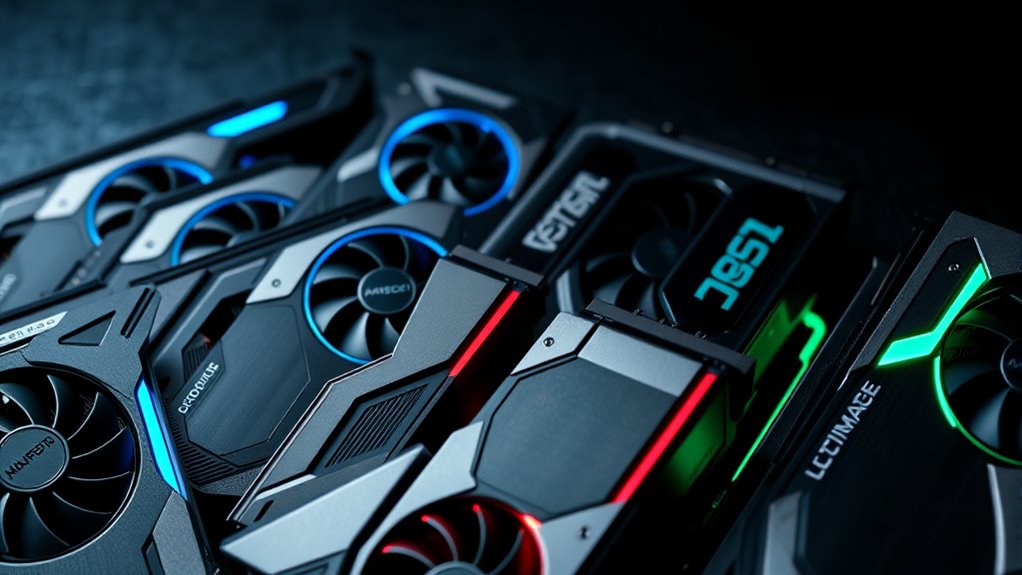

High end graphics cards are the backbone of premium gaming, professional rendering, and demanding creative workflows. The best models offer exceptional performance, cutting-edge features, and robust build quality, but come with notable tradeoffs such as high cost and power consumption. The NVIDIA GeForce RTX 5080 Founders Edition stands out for its raw speed and efficiency, while the ASUS ROG Strix GeForce RTX 5070 Ti offers great value for high performance. Buyers must weigh factors like performance, price, and future-proofing to find the right fit. Keep reading for a detailed breakdown of these top options and what makes each unique.

Get everyday essentials delivered free with Prime
- Fast, free delivery on millions of items
- Prime Video, Amazon Music and more included
- Member-only deals all year
Key Takeaways
- The RTX 5080 models dominate in absolute performance, but come at a higher cost and power draw.
- AMD’s Radeon RX 9070 XT offers a compelling alternative for those seeking high-end gaming without NVIDIA’s premium price tag.
- The best models balance raw power with features like advanced cooling and efficient power use, avoiding thermal throttling.
- Price-to-performance varies significantly, with some cards excelling in specific tasks like ray tracing or AI-based workloads.
- Size and compatibility are often overlooked; compact high-end cards can be hard to fit in smaller cases.
| ASUS ROG Strix GeForce RTX 5070 Ti 16GB GDDR7 Gaming Graphics Card |  | Best Overall for High-End Gaming and Customization | Memory: 16GB GDDR7 | Boost Clock: 2602MHz | Design: 3.2-slot | VIEW ON AMAZON | See Our Full Breakdown |
| ASUS TUF Gaming GeForce RTX 5080 16GB GDDR7 OC Edition Graphics Card |  | Best for Durability and High-Resolution Gaming | GPU Clock Speed: 2730 MHz | Memory: 16GB GDDR7 | Maximum Resolution: 7680×4320 | VIEW ON AMAZON | See Our Full Breakdown |
| ASUS ROG Strix NVIDIA GeForce RTX 3090 Gaming Graphics Card – 24GB GDDR6X |  | Best for Creative Work and 8K Gaming | Memory: 24GB GDDR6X | Max Resolution: 7680×4320 | GPU Architecture: NVIDIA Ampere | VIEW ON AMAZON | See Our Full Breakdown |
| GIGABYTE GeForce RTX 5080 Gaming OC 16G Graphics Card |  | Best for Raw Power and Future-Ready Features | Architecture: NVIDIA Blackwell | Memory: 16GB GDDR7 | Interface: PCIe 5.0 | VIEW ON AMAZON | See Our Full Breakdown |
| ASUS TUF Gaming GeForce RTX 5070 12GB GDDR7 OC Edition Graphics Card |  | Best for High-Resolution Gaming with Durability | GPU Clock Speed: 2640 MHz | Memory: 12GB GDDR7 | Maximum Resolution: 7680×4320 | VIEW ON AMAZON | See Our Full Breakdown |
| ASUS Prime Radeon RX 9070 XT 16GB GDDR6 OC Edition Gaming Graphics Card |  | Best Overall for Gaming Performance and Reliability | Memory: 16GB GDDR6 | Cooling Technology: Axial-tech fans, phase-change thermal pads | Design: 2.5-slot | VIEW ON AMAZON | See Our Full Breakdown |
| GIGABYTE GeForce RTX 5070 Ti Gaming OC 16G Graphics Card |  | Best Value for Cutting-Edge Performance | Memory: 16GB GDDR7 | Memory Interface: 256-bit | Architecture: NVIDIA Blackwell | VIEW ON AMAZON | See Our Full Breakdown |
| NVIDIA GeForce RTX 5080 Founders Edition |  | Best for High-End Creative and Gaming Demands | Graphics Coprocessor: NVIDIA GeForce RTX 5080 | RAM: 16 GB | GPU Clock Speed: 2806 MHz | VIEW ON AMAZON | See Our Full Breakdown |
| high end graphics card | Memory |
|---|---|
| ASUS ROG Strix GeForce RTX 507 | 16GB GDDR7 |
| ASUS TUF Gaming GeForce RTX 50 | 16GB GDDR7 |
| ASUS ROG Strix NVIDIA GeForce | 24GB GDDR6X |
| GIGABYTE GeForce RTX 5080 Gami | 16GB GDDR7 |
| ASUS TUF Gaming GeForce RTX 50 | 12GB GDDR7 |
| ASUS Prime Radeon RX 9070 XT 1 | 16GB GDDR6 |
| GIGABYTE GeForce RTX 5070 Ti G | 16GB GDDR7 |
| NVIDIA GeForce RTX 5080 Founde | — |
More Details on Our Top Picks
ASUS ROG Strix GeForce RTX 5070 Ti 16GB GDDR7 Gaming Graphics Card
The ASUS ROG Strix GeForce RTX 5070 Ti stands out for combining top-tier gaming performance with extensive customization options. Its 16GB GDDR7 memory and 2602MHz boost clock make it ideal for demanding titles, while the advanced cooling system ensures stability during long gaming sessions. Compared to the ASUS TUF Gaming RTX 5070, this model offers higher clock speeds and more refined software controls, but it comes at a larger size and a higher price. Its Aura Sync ARGB lighting adds flair, making it perfect for gamers who want both performance and aesthetic appeal. However, its size might require a spacious case, and the software complexity could overwhelm less experienced users.
Pros:- Exceptional gaming performance with high AI capabilities
- Effective cooling with vapor chamber and axial-tech fans
- Customizable RGB lighting with Aura Sync
- Stable power delivery with premium components
Cons:- Large form factor requiring ample case space
- High price point may be prohibitive for some
Best for: High-end gamers who want maximum customization and performance tuning.
Not ideal for: Casual gamers or those with smaller cases, due to its size and complexity.
- Memory:16GB GDDR7
- Boost Clock:2602MHz
- Design:3.2-slot
- AI Performance:1492 AI TOPS
- Cooling:Axial-tech fans, vapor chamber
- Lighting:Aura Sync ARGB
Our verdict“This card is ideal for gamers seeking top performance and aesthetic flexibility, provided they have a spacious case and are willing to invest in premium features.”
ASUS TUF Gaming GeForce RTX 5080 16GB GDDR7 OC Edition Graphics Card
The ASUS TUF Gaming RTX 5080 OC offers robust performance built around NVIDIA’s Blackwell architecture, with a boost clock of 2730 MHz and military-grade components that emphasize durability. It supports resolutions up to 7680×4320, making it suitable for ultra-high-definition gaming and professional workloads. Compared with the GIGABYTE RTX 5080 Gaming OC, this card emphasizes durability and thermal stability, but it requires an 850W power supply and might not fit in smaller cases. Its three fan cooling system and reinforced components make it a reliable choice for users pushing their systems to the limit, though the size and price could exclude budget-conscious buyers.
Pros:- High-performance GPU with 2730 MHz boost clock
- Durable military-grade components for longevity
- Supports high resolutions up to 7680×4320
- Effective three-fan cooling system
Cons:- Requires a minimum 850W power supply
- Large size may limit compatibility with smaller cases
Best for: Enthusiasts who demand durability and high-resolution gaming performance.
Not ideal for: Budget builders or small-form-factor PC users, due to its size and power requirements.
- GPU Clock Speed:2730 MHz
- Memory:16GB GDDR7
- Maximum Resolution:7680×4320
- Cooling:3 fans
- Components:Military-grade
- Interface:PCIe 5.0
Our verdict“This card suits users focused on durability and high-res gaming, willing to accommodate its size and power needs.”
ASUS ROG Strix NVIDIA GeForce RTX 3090 Gaming Graphics Card – 24GB GDDR6X
The ASUS ROG Strix RTX 3090 makes an excellent choice for creative professionals and gamers who require massive memory capacity. Its 24GB GDDR6X memory and support for 8K resolution enable demanding workloads like 3D rendering, video editing, and immersive gaming. In comparison to the GIGABYTE RTX 5080, it offers more memory but relies on PCIe 4.0, which is slightly less future-proof than PCIe 5.0. The Axial-tech cooling design helps manage heat, yet the large 2.9-slot profile may limit case options. Its high price reflects its professional-grade capabilities, making it less ideal for budget-conscious users.
Pros:- Massive 24GB GDDR6X memory for demanding applications
- Supports up to 8K resolution with advanced ray tracing
- Enhanced cooling with Axial-tech fan design
- Excellent AI and ray tracing capabilities
Cons:- Requires a high-wattage 850W power supply
- Large size may limit case compatibility
- Premium price for niche use
Best for: Creative professionals and gamers seeking extreme performance and large memory buffer.
Not ideal for: Casual gamers or those with smaller cases, due to its size and high power draw.
- Memory:24GB GDDR6X
- Max Resolution:7680×4320
- GPU Architecture:NVIDIA Ampere
- RT Cores:2nd Generation
- Tensor Cores:3rd Generation
- Fan Design:Axial-Tech
Our verdict“This card offers unmatched memory and 8K support for professional workloads, suitable for users with ample space and budget.”
GIGABYTE GeForce RTX 5080 Gaming OC 16G Graphics Card
The GIGABYTE RTX 5080 Gaming OC leverages NVIDIA’s Blackwell architecture with DLSS 4, offering competitive performance with 16GB GDDR7 memory. Its PCIe 5.0 interface ensures future compatibility, while the WINDFORCE cooling system maintains thermal efficiency. Compared to the ASUS TUF RTX 5080, this model emphasizes raw power and future readiness, though it might come at a higher price and power consumption. Its solid build and cooling make it suitable for gamers and enthusiasts pushing high resolutions and demanding titles, but users with limited power supplies or smaller cases should consider compatibility carefully.
Pros:- NVIDIA Blackwell architecture for high performance
- Large 16GB GDDR7 memory supports intensive tasks
- Supports PCIe 5.0 for future compatibility
- Effective WINDFORCE cooling system
Cons:- Potentially high power consumption
- Price may be high for budget builds
Best for: Power users and gamers who want cutting-edge features and future-proofing.
Not ideal for: Budget-conscious buyers or small-form-factor builds, due to power and size considerations.
- Architecture:NVIDIA Blackwell
- Memory:16GB GDDR7
- Interface:PCIe 5.0
- Cooling System:WINDFORCE
Our verdict“This card caters to enthusiasts seeking future-proofing and raw power, assuming they can support its power and size requirements.”
ASUS TUF Gaming GeForce RTX 5070 12GB GDDR7 OC Edition Graphics Card
The ASUS TUF Gaming RTX 5070 OC balances high performance with durability, featuring 12GB GDDR7 memory and a boost clock of 2640 MHz. Its three-fan cooling system and military-grade components make it well-suited for intensive gaming at high resolutions, including 7680×4320. Compared with the ASUS ROG Strix RTX 5070 Ti, it offers slightly less memory and clock speed but benefits from a more compact 3.125-slot design, suitable for larger but not overly spacious cases. Its rugged build and thermal management make it reliable for demanding uses, though it may not match the peak performance of more expensive models.
Pros:- Solid high-performance GPU with 12GB GDDR7
- Effective cooling with three axial-tech fans
- Military-grade components for longevity
- Supports resolutions up to 7680×4320
Cons:- Larger size may limit smaller case compatibility
- No specific pricing info, potential high power use
Best for: High-resolution gamers seeking durability and stability without the highest price tag.
Not ideal for: Enthusiasts requiring maximum AI or ray tracing performance or those with very small cases.
- GPU Clock Speed:2640 MHz
- Memory:12GB GDDR7
- Maximum Resolution:7680×4320
- Cooling System:3 axial-tech fans
- Design:3.125-slot
- Components:Military-grade
Our verdict“This card suits users wanting reliable high-res gaming with durable components, in cases that can accommodate its size.”
ASUS Prime Radeon RX 9070 XT 16GB GDDR6 OC Edition Gaming Graphics Card
This ASUS Prime Radeon RX 9070 XT stands out for its high boost clock of up to 3030 MHz, surpassing many competitors like the RTX 5070 Ti. Its axial-tech fans and phase-change thermal pads deliver robust cooling, making it suitable for extended gaming sessions. While it offers quiet operation thanks to 0dB tech, it requires a 2.5-slot space and consumes significant power during overclocking, which could limit compatibility and efficiency for some builds. Compared to the NVIDIA options, this card emphasizes cooling and stability, but at a premium price and power draw.
Pros:- High boost clock of up to 3030 MHz for smooth gaming
- Excellent cooling with axial-tech fans and thermal pads
- Quiet operation with 0dB technology
- Durable dual-ball fan bearings for longevity
Cons:- Requires a 2.5-slot space in the case
- High power consumption in OC mode
- Premium price may deter budget buyers
Best for: High-end gamers who prioritize stable, quiet performance and reliable cooling in a demanding system
Not ideal for: Budget-conscious users or small cases where space and power are limited
- Memory:16GB GDDR6
- Cooling Technology:Axial-tech fans, phase-change thermal pads
- Design:2.5-slot
- Fan Bearings:Dual-ball
- Boost Clock:up to 3030 MHz
- Game Clock:up to 2480 MHz
Our verdict“This card makes the most sense for gamers seeking top-tier performance with reliable cooling and quiet operation, despite higher costs.”
GIGABYTE GeForce RTX 5070 Ti Gaming OC 16G Graphics Card
Compared with the ASUS RX 9070 XT, the GIGABYTE RTX 5070 Ti offers a compelling mix of modern features, including 16GB of GDDR7 memory and PCIe 5.0 support, making it a strong choice for gamers wanting future-proofing. Its WINDFORCE cooling system ensures effective heat dissipation, but it may come with higher power requirements and a price tag that edges toward premium levels. While the RTX 5070 Ti integrates DLSS 4 and NVIDIA’s Blackwell architecture, it might be overkill for gamers with less demanding resolutions or those on tighter budgets, especially since it’s primarily aimed at high-performance scenarios.
Pros:- 16GB GDDR7 memory for demanding textures and multitasking
- Supports PCIe 5.0 for faster data transfer
- Effective WINDFORCE cooling system
- NVIDIA DLSS 4 enhances frame rates in demanding titles
Cons:- Potentially high power consumption
- Premium price point may be prohibitive for some
- Requires a high-performance system to fully utilize PCIe 5.0 benefits
Best for: Enthusiasts who want cutting-edge features and future-proof gaming with high frame rates
Not ideal for: Casual gamers or users with limited power supplies, as it demands high power and budget flexibility
- Memory:16GB GDDR7
- Memory Interface:256-bit
- Architecture:NVIDIA Blackwell
- DLSS:4
- PCIe:5.0
- Cooling System:WINDFORCE
Our verdict“This pick makes the most sense for gamers seeking advanced features and future-proofing, provided their system can handle the power needs.”
NVIDIA GeForce RTX 5080 Founders Edition
The NVIDIA GeForce RTX 5080 Founders Edition is a powerhouse built for the most demanding gaming and creative tasks, featuring a high GPU clock speed of 2806 MHz and 16 GB of GDDR7 memory. Its full ray tracing and DLSS 4 support make it ideal for 4K gaming and real-time rendering. Unlike the ASUS RX 9070 XT, which emphasizes cooling and quiet operation, the RTX 5080 prioritizes raw power, but this comes with a high cost and significant power draw. Its PCI Express 4.0 interface might slightly limit data transfer compared to PCIe 5.0, but for most high-end desktops, this isn’t a dealbreaker.
Pros:- High GPU clock of 2806 MHz for maximum performance
- Supports full ray tracing and DLSS 4
- Large 16 GB GDDR7 memory handles demanding workloads
- Ideal for 4K resolution and beyond
Cons:- Likely high cost due to premium specs
- Requires compatible, high-performance PC setup
- High power consumption may increase operational costs
Best for: Creative professionals and gamers demanding the highest resolution and detail with AI-enhanced features
Not ideal for: Budget builders or those with older systems not compatible with PCIe 4.0 or high power supplies
- Graphics Coprocessor:NVIDIA GeForce RTX 5080
- RAM:16 GB
- GPU Clock Speed:2806 MHz
- Video Output:HDMI, DisplayPort
- Graphics RAM Type:GDDR7
- Interface:PCI Express 4.0
Our verdict“This card is suited for users who need top-tier power for gaming and creative workflows, accepting the high cost and power demands.”

How We Picked
Our evaluation focused on performance benchmarks, build quality, feature set, and value relative to price. We prioritized models that demonstrate top-tier gaming and creative work capabilities while considering thermal management and power efficiency. To rank these options, we examined recent testing data, manufacturer specifications, and user feedback, aiming to identify models that offer the best balance of speed, durability, and future-proofing. This approach ensures the selections are suitable for demanding enthusiasts and professionals alike, highlighting the strengths and tradeoffs of each card.Factors to Consider When Choosing High End Graphics Cards
Choosing a high end graphics card involves more than just raw numbers. The key factors include performance needs, compatibility, power requirements, and budget. Understanding these aspects can help prevent costly mistakes and ensure your system reaches its full potential without bottlenecks or overheating. This guide explores the most important considerations for selecting the right GPU in 2026.Performance and Use Case
Assess what you primarily need your high end graphics card for — gaming, content creation, 3D rendering, or AI workloads. Not all top-tier cards excel equally across these tasks. For instance, some models are optimized for ray tracing and AI acceleration, while others focus on raw FPS in competitive gaming. Matching the card’s strengths to your use case ensures you get the best value and experience without overpaying for unnecessary features.
Compatibility and Size
High end graphics cards tend to be large and require substantial space and power. Before purchase, verify your case’s dimensions and power supply capacity. Smaller cases can struggle with full-sized models, and inadequate power can cause stability issues or damage. Choosing a card that fits comfortably, with appropriate power connectors, prevents installation headaches and system crashes down the line.
Cooling and Noise
Thermal management is critical for high end GPUs, which generate significant heat under load. Cards with advanced cooling solutions, like multiple fans or vapor chamber designs, often run quieter and maintain higher performance for longer periods. Be wary of overly noisy models or those with minimal cooling, as thermal throttling can negate performance gains and shorten component lifespan.
Price and Future-Proofing
While high end GPUs are a substantial investment, their longevity depends on how well they handle upcoming software and game demands. Paying more for a model with advanced features like DLSS 3.0 or PCIe 5.0 support can extend usefulness. However, balancing initial cost against expected lifespan and your current system’s capabilities avoids overspending on features you won’t utilize immediately.
Power Consumption and Efficiency
Advanced GPUs consume considerable power, impacting electricity bills and cooling needs. Look for models with good power efficiency ratings; they deliver high performance without excessive energy use. This consideration is especially important for those building compact or eco-conscious setups, where heat dissipation and power supply capacity are limited.
Frequently Asked Questions
How do I choose the right high end GPU for gaming?
When selecting a high end GPU for gaming, prioritize models that excel in frame rates and visual fidelity for your favorite titles. Consider your monitor’s resolution and refresh rate; high-end cards are best paired with 1440p or 4K displays for maximum benefit. Also, ensure your system’s CPU and RAM can keep pace to avoid bottlenecks. Budget and future-proofing are additional factors—spending slightly more now can extend your system’s relevance for upcoming game releases.
Is it worth investing in a premium GPU like the RTX 5080?
Premium GPUs like the RTX 5080 deliver exceptional performance, which is valuable for 4K gaming, VR, and professional applications such as 3D rendering. However, they come with higher costs and power requirements. If your workload demands these capabilities, the investment can be justified, especially if you want to maximize longevity and future compatibility. For casual gaming or moderate creative work, lower-tier high end cards may provide better value.
How important is cooling in choosing a high end graphics card?
Cooling significantly impacts a GPU’s performance and lifespan. High end models often feature elaborate cooling solutions that keep temperatures low during intensive tasks. Efficient cooling reduces thermal throttling, maintaining high performance for longer periods. Conversely, inadequate cooling can cause noise issues and reduce hardware durability. If you plan to overclock or run the GPU under sustained loads, investing in a card with superior cooling is advisable.
Should I consider AMD or NVIDIA for a high end GPU?
Both AMD and NVIDIA offer competitive high end graphics cards, each with distinct advantages. NVIDIA’s models tend to lead in ray tracing and AI features, making them appealing for certain professional and gaming applications. AMD’s offerings often come at a slightly lower price point and can provide excellent performance for traditional rasterization tasks. Your choice depends on your specific needs, software optimization, and budget considerations.
What should I look for in future-proofing a high end GPU?
Future-proofing involves selecting a GPU with support for the latest standards like PCIe 5.0, DDR6 or GDDR7 memory, and advanced features like DLSS or FidelityFX Super Resolution. Consider the card’s performance headroom, VR capabilities, and driver support longevity. Investing in a slightly more powerful model than your current needs ensures the GPU remains relevant as software demands increase, extending the lifespan of your investment.
Conclusion
For most enthusiasts seeking the best overall performance, the NVIDIA GeForce RTX 5080 Founders Edition offers unmatched speed and efficiency. Those prioritizing value without sacrificing too much power might prefer the ASUS TUF Gaming GeForce RTX 5070 Ti for its balanced features. Buyers who want top-tier premium quality should consider the ASUS ROG Strix GeForce RTX 5090 when available, while newcomers or budget-conscious users can look at slightly lower-tier options like the RTX 5070 variants. For specialized needs, such as creative work or high-resolution gaming, matching the card’s strengths to your workload ensures a satisfying experience.
As an affiliate, we earn on qualifying purchases.Columbus Day / Indigenous Peoples' Day Picks
long weekend sales