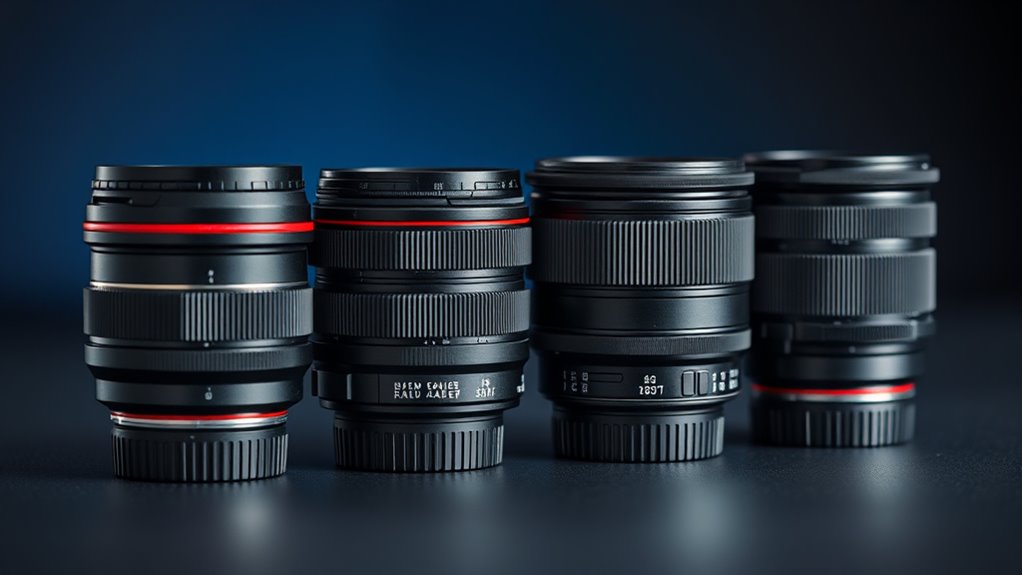

If you want to elevate your photography, I recommend four top professional lenses known for their sharpness, fast autofocus, and excellent low-light performance. The Canon EF 50mm f/1.8 STM is perfect for portraits and everyday shooting, while the EF 85mm f/1.8 excels at capturing stunning headshots. For mirrorless systems, the Meike 85mm f/1.8 Pro II and the Meike 55mm F/1.8 Pro L-Mount offer outstanding quality and versatility. Keep exploring to find which lens suits your style best.
Key Takeaways
- Choose lenses with advanced autofocus like USM or NanoDrive for fast, silent focusing in dynamic shooting scenarios.
- Opt for wide-aperture primes (f/1.4 or f/1.8) to enhance low-light performance and achieve beautiful background blur.
- Select lenses with high-quality optical elements and coatings to ensure sharp, vibrant images with minimal aberrations.
- Prioritize weather-sealed, durable builds for reliable performance in challenging outdoor conditions.
- Consider compatibility with your camera system (mount type and sensor size) to maximize performance and future-proof your investment.

Canon EF 50mm f/1.8 STM Lens, Black
50 millimeter focal length and maximum aperture of f/1.8
As an affiliate, we earn on qualifying purchases.
Canon EF 50mm f/1.8 STM Lens
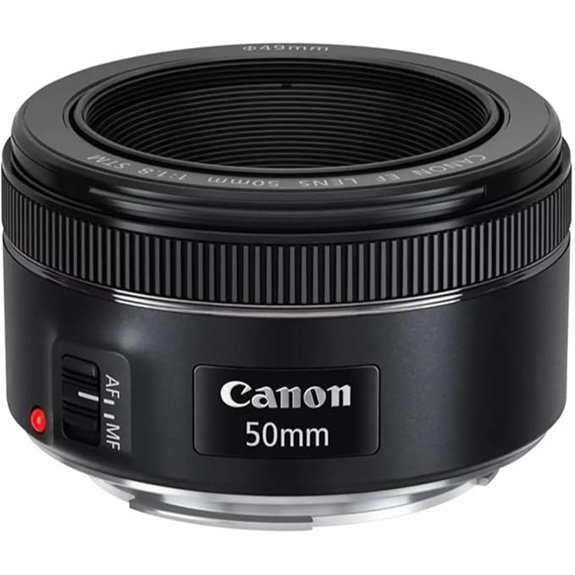
If you’re looking for a versatile, budget-friendly lens that delivers professional-quality images, the Canon EF 50mm f/1.8 STM is an excellent choice. Its compact and lightweight design makes it perfect for everyday shooting, whether you’re capturing portraits, low-light scenes, or night photography. The fast f/1.8 aperture lets in over 8 times more light than standard zooms, creating beautiful background blur and sharp details. With smooth, near-silent autofocus thanks to the STM motor, it’s equally great for photos and videos. Its durable build and compatibility with full-frame and APS-C cameras make it a reliable, versatile lens for any photographer.
Best For: photographers seeking an affordable, lightweight lens ideal for portraits, low-light, and everyday photography with excellent autofocus performance.
Pros:
- Compact and lightweight design for easy portability and everyday use
- Bright f/1.8 aperture for stunning background blur and low-light shooting
- Near-silent STM autofocus ideal for both stills and video recording
Cons:
- Fixed focal length limits versatility compared to zoom lenses
- Slightly lower build quality than professional-grade lenses, though still durable
- No image stabilization, which may affect handheld shots in low light

EF 85mm f1.8 Portrait Lens - MF for Canon EOS Rebel T8i/T7i/T7/T6i/T5/T3i/T3/T2i/XSi/XS/SL3/SL2/T100/90D/80D/70D/50D/5D Mark IV/6D II/7D II/1D X III II-Manual Focus DSLR Cameras Lenses(EF/EF-S Mount)
[Easy-to-Use Warm Tips] - ⚠Fully manual, Non-autofocus(Advantages: precise focus control, creative freedom, high adaptability, stability and durability, and...
As an affiliate, we earn on qualifying purchases.
EF 85mm f1.8 Portrait Lens for Canon DSLRs

Looking for a dedicated portrait lens that offers exceptional image quality and precise manual control? The EF 85mm f1.8 for Canon DSLRs is perfect. It’s fully manual, with no electronic contacts, so you’ll need to switch to full manual mode, but that gives you incredible focus precision. Its hybrid aspherical lens and UMC coating minimize aberrations and glare, ensuring sharp, beautiful images with stunning bokeh. The internal focus design provides fast, quiet operation, ideal for capturing expressive portraits. Built for durability and stability, this lens elevates your artistic control, making it a valuable tool for serious portrait photographers seeking top-tier image quality.
Best For: professional portrait photographers and enthusiasts seeking precise manual focus and exceptional image quality with beautiful bokeh.
Pros:
- Provides high manual focus precision for creative control
- Equipped with hybrid aspherical lens and UMC coating for sharp images and reduced glare
- Durable and stable build, suitable for professional use
Cons:
- Fully manual operation requires switching to manual mode, which may be less convenient for some users
- No electronic contacts, limiting automatic features and metadata transfer
- Requires familiarity with manual focusing techniques for optimal results

Meike 85mm f1.8 Pro Full Frame STM Auto Focus Medium Telephoto Lens High Resolution 8K Fixed Prime Portrait Lenses for Nikon Z Mount Mirrorless Cameras Z5 Z6 Z7 Z6II Z7II Z9 Z30 Z50 Z fc
Compatible with Nikon Z mount full frame mirrorless cameras, such as Z5 Z6 Z7 Z8 Z9 Z6II Z7II,...
As an affiliate, we earn on qualifying purchases.
Meike 85mm f1.8 Pro II Nikon Z Portrait Lens
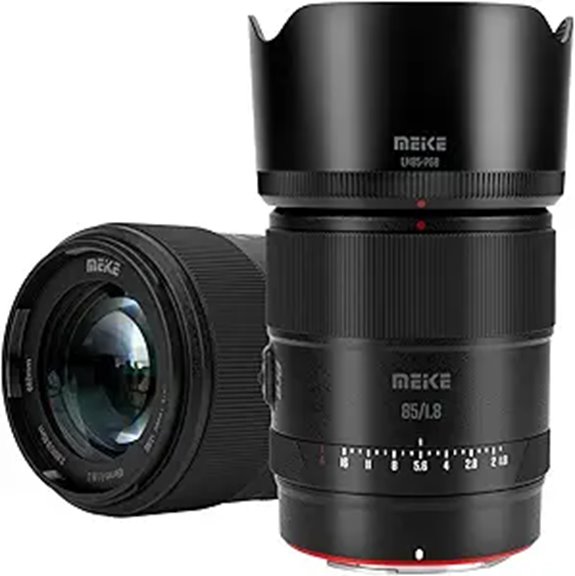
The Meike 85mm f/1.8 Pro II Nikon Z Portrait Lens stands out as an excellent choice for photographers who prioritize sharp, high-quality portraits with beautiful background blur. Designed for Nikon Z mirrorless cameras, it supports high-resolution 8K images, zero distortion, and smooth bokeh, making it perfect for portraits, landscapes, and more. Its fast autofocus, quiet STM motor, and low-light performance ensure professional results in any setting. Lightweight at just 7.1 ounces, it’s portable and versatile. Plus, firmware updates keep it performing at its best. With a high customer rating and compatibility across various Z models, this lens truly elevates your photography.
Best For: Portrait photographers and videographers seeking a lightweight, high-performance lens with excellent bokeh and fast autofocus for Nikon Z mirrorless cameras.
Pros:
- Sharp image quality with high-resolution support and zero distortion
- Fast, quiet autofocus thanks to STM stepping motor and NanoDrive system
- Lightweight and portable at only 7.1 ounces, ideal for on-the-go shooting
Cons:
- Firmware updates require a Type-C interface and are not compatible with Mac systems
- May be less suitable for users needing a zoom or versatile focal length
- Limited compatibility with non-Nikon Z mount cameras

Meike 55mm F1.8 Pro Full Frame AF STM Lens Auto Focus High Resolution 8K Fixed Prime Portrait Lenses for Panasonic Lumix Sigma Leica L Mirrorless Camera S1 S1R S9 S1H S5 FP FPL SL SL2 T TL TL2
Compatible with L full frame mirrorless cameras, such as L Large Panasonic Sigma Mirrorless Cameras S1 S1R S9...
As an affiliate, we earn on qualifying purchases.
Meike 55mm F1.8 Pro L-Mount Mirrorless Lens

For photographers seeking a versatile portrait lens that delivers stunning image quality, the Meike 55mm F1.8 Pro L-Mount Mirrorless Lens stands out. Compatible with L-mount full-frame cameras like Panasonic, Sigma, and Leica, it offers seamless integration. Its wide f/1.8 aperture creates beautiful background blur, perfect for portraits. The lens features 11 elements, including low dispersion and high refractive index glass, ensuring sharp, high-resolution images with minimal aberration. The AF STM motor provides fast, quiet autofocus, while the multi-coating reduces flare and ghosting. Ideal for low-light situations, this lens elevates your portrait photography with clarity, detail, and professional performance.
Best For: photographers seeking a high-quality, versatile portrait lens with excellent low-light performance for full-frame mirrorless cameras.
Pros:
- Wide f/1.8 aperture creates beautiful background blur and enhances low-light shooting capabilities
- Fast, quiet autofocus with AF STM stepping motor for seamless capturing
- High-resolution optics with low dispersion and high refractive index elements for sharp, detailed images
Cons:
- Fixed focal length limits versatility compared to zoom lenses
- May be relatively heavy or bulky for some mirrorless camera setups
- Firmware updates require a Type-C connection and may only be available via Android devices
Factors to Consider When Choosing Professional Camera Lenses

When selecting a professional camera lens, I consider compatibility with my camera body and the specific features I need. I look at aperture size for better control over depth of field, along with autofocus technology for quick, sharp shots. Additionally, I prioritize image quality and build durability to guarantee my lens performs reliably in various conditions.
Lens Compatibility Options
Choosing the right professional camera lens depends heavily on guaranteeing compatibility with your camera body. First, check that the lens mount matches your camera’s mount type, like EF, EF-S, Z-mount, or L-mount. It’s also vital to verify if the lens suits your sensor size—full-frame or APS-C—to ensure ideal image quality. Additionally, confirm whether the lens supports electronic communication for autofocus and aperture control, which is essential for modern digital cameras. If your camera doesn’t support electronic contacts, manual focus lenses are an option, but you need to be comfortable operating in full manual mode. Lastly, verify the lens is compatible with your camera’s firmware and software updates to keep performance smooth and reliable. Compatibility is key to seamless operation and top-tier results.
Aperture Size Benefits
A larger aperture size, such as f/1.8 or wider, offers significant advantages for professional photographers. It allows more light to reach the sensor, which is especially useful in low-light settings, helping you capture clear, bright images without extra lighting. Wider apertures also create a shallow depth of field, giving your photos a beautiful background blur (bokeh) that isolates your subject effectively. This increased light intake enables faster shutter speeds, reducing motion blur and camera shake, essential for capturing sharp images in dynamic situations. Additionally, large apertures give you greater creative control over exposure and focus, allowing for artistic and cinematic effects. Overall, choosing a lens with a larger aperture enhances versatility and quality in various shooting conditions.
Autofocus Technology
Autofocus technology plays a key role in guaranteeing sharp and well-focused images, especially in fast-paced or unpredictable shooting conditions. Modern lenses feature systems like STM, USM, and NanoDrive, each offering different speeds and noise levels. Fast, accurate autofocus is essential for capturing fleeting moments in sports, wildlife, or events. Quiet mechanisms also matter, especially when recording videos, as they minimize noise and enable smooth focus shifts. Advanced features like Eye AF and tracking autofocus use sensors and algorithms to keep moving subjects sharp. Firmware updates further enhance autofocus performance, making sure your lens remains compatible with evolving camera technology. Choosing a lens with reliable autofocus ensures you don’t miss critical moments and produces professional-quality images consistently.
Image Quality Features
When selecting professional camera lenses, considering their image quality features is essential to guarantee sharp, vibrant photos. High-quality lenses incorporate advanced optical elements like aspherical and low-dispersion glass, which minimize aberrations and distortions. Precise lens coatings are vital for reducing flare, ghosting, and chromatic aberration, ensuring clear images with accurate colors. A wide maximum aperture, such as f/1.8 or f/1.4, not only improves low-light performance but also enhances background blur, creating beautiful bokeh. The lens design with multiple elements and groups helps maintain consistent sharpness and contrast from the center to the edges. Overall, these features work together to produce images that are crisp, vibrant, and true to life, making them crucial factors in choosing a professional lens.
Build Durability
Choosing a professional camera lens means considering how well it can withstand the rigors of frequent use and challenging environments. Durable lenses usually feature metal mounts and weather-sealed bodies, making them reliable in tough conditions. High-quality lenses are reinforced with coatings and elements that resist scratches, dust, and moisture, guaranteeing consistent performance over time. Rugged materials and precise engineering boost their resistance to physical impacts, protecting your investment. Weather-sealed lenses are especially valuable for outdoor shooting, handling rain, snow, and dusty environments without faltering. Proper maintenance and careful handling further extend a lens’s lifespan, keeping it in top shape for years. When choosing a lens, prioritize build quality to ensure durability matches your professional demands.
Low-Light Performance
To excel in low-light conditions, a lens’s maximum aperture is essential because it controls how much light enters the camera. Lenses with wider apertures, like f/1.8 or lower, let in more light, making it easier to shoot in dim environments without increasing ISO excessively. Fast autofocus systems, such as STM stepping motors, help quickly lock focus, reducing motion blur in low light. Optical elements with specialized coatings minimize flare, ghosting, and chromatic aberrations, ensuring sharp, clear images even in challenging lighting. Prime lenses often feature larger maximum apertures than zooms, making them better suited for dark settings. Additionally, the minimum focusing distance and maximum magnification can influence performance in close-up low-light photography. All these factors contribute profoundly to superior low-light performance.
Price and Value
Professional camera lenses vary greatly in price, making it essential to weigh their costs against the features and quality they offer. I always consider how optical quality, durability, and features justify the price. A pricier lens often delivers better low-light performance, sharper images, and longer lifespan, which can mean better long-term value. Comparing the price-to-performance ratio helps me ensure I’m investing in a lens that truly meets my specific needs. I also look for warranties and after-sales support, as these add to the overall value. While high-end models may seem costly upfront, their superior performance and durability often warrant the investment, especially for professional work. Balancing cost with features ensures I get the best bang for my buck.
Frequently Asked Questions
How Do Lens Aperture Sizes Affect Image Quality?
Lens aperture sizes directly impact image quality by controlling light and depth of field. A wider aperture (like f/1.4) lets in more light, creating a soft background blur and excellent low-light performance. Smaller apertures (like f/16) increase depth of field, keeping more of the scene in focus. However, very small apertures can cause diffraction, reducing sharpness. Choosing the right aperture balances brightness, focus, and overall image clarity.
What Lens Features Improve Low-Light Photography?
Ever wondered how some photos in dim light turn out stunning? It’s all about lens features that excel in low-light conditions. I look for lenses with wide apertures—f/1.4 or lower—because they let in more light. Additionally, image stabilization helps reduce blur caused by hand movements. These features make a huge difference, transforming your night shots from mediocre to breathtaking, even without a flash.
Are Prime Lenses Better Than Zoom Lenses for Professionals?
I believe prime lenses are better for professionals because they typically offer sharper images, wider apertures, and better optical quality. Their fixed focal lengths encourage more deliberate composition, which improves creativity. While zoom lenses provide versatility, primes excel in low-light conditions and producing beautifully blurred backgrounds. For serious photographers aiming for exceptional results, investing in prime lenses is often the smarter choice for their precision and image quality.
How Does Lens Weight Impact Long Shooting Sessions?
Lens weight can feel like carrying a heavy backpack during long shoots; it wears you down faster. I once shot a wedding with a bulky lens, and by the end of the day, my arm was sore. Lighter lenses reduce fatigue, letting me focus on capturing moments rather than battling discomfort. For extended sessions, investing in lighter, high-quality glass keeps you comfortable and sharp throughout the day.
What Maintenance Is Required to Keep Professional Lenses in Top Condition?
I regularly clean my lenses with a soft, lint-free cloth and use a blower to remove dust and debris. I keep them in protective cases when not in use and avoid touching the glass directly. Periodically, I check for fungus or scratches and have them serviced if needed. Proper maintenance guarantees my lenses stay sharp and reliable, helping me capture stunning photos every time.
Conclusion
Choosing the right lens is like selecting a brush for your masterpiece; each one adds a unique stroke to your storytelling. Whether it’s the versatile 50mm, the intimate 85mm, or the specialized options from Meike, your lens choice shapes your vision. Remember, the right lens isn’t just gear—it’s a key to revealing your creative soul and capturing moments that resonate. Embrace the tool that turns your perspective into art.