
If you’re after the best field flatteners for refractor telescopes in 2025, I recommend options like the SVBONY SV503 with its built-in flat-field system, the Sky-Watcher Evolux 62ED reducer/flattener for wider views, and the SVBONY Focal Reducer for specific telescope models. These tools guarantee sharp, distortion-free images. If you want more detailed comparisons and tips, just keep going to find out which fits your needs best.
Key Takeaways
- Look for field flatteners with integrated correction to ensure distortion-free, sharp wide-field astrophotography.
- Prioritize models with high-quality ED or multi-coated optics for minimal aberrations and bright, clear images.
- Verify compatibility with your telescope’s threading, focal ratio, and back focus requirements for seamless installation.
- Consider focal reducers or flatteners offering effective focal length adjustments to widen your field of view.
- Balance your budget with optical performance, choosing durable, precise flatteners that deliver consistent, sharp images in 2025.
SVBONY SV503 Refractor Telescope with Built-in Field Flattener
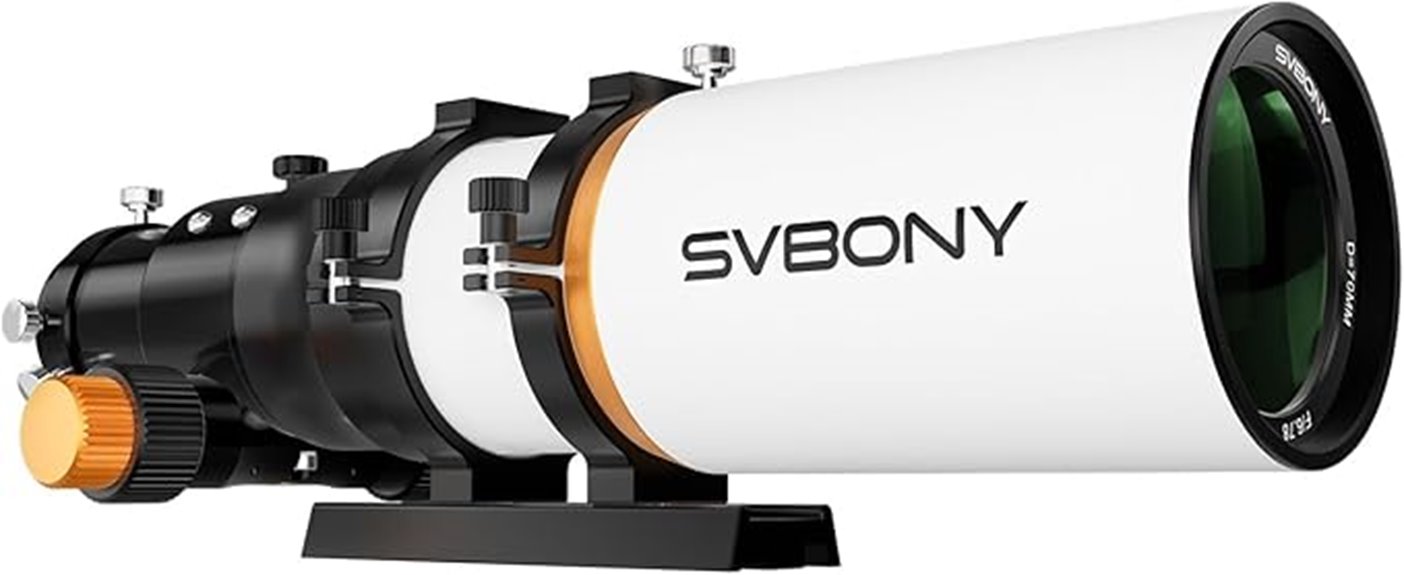
If you’re looking for a refractor telescope that delivers sharp, distortion-free images right out of the box, the SVBONY SV503 with its built-in field flattener is an excellent choice. Its 70mm aperture and F/6.78 focal ratio produce bright, detailed views of galaxies, nebulae, and star clusters. The integrated field flattener eliminates field curvature, providing wide, flat images without the need for external accessories. Built with durable CNC aluminum components and featuring a dual-speed focuser, it offers precise focusing and stability. Whether for astrophotography or visual observation, the SV503’s high-quality optics and compact design make it a versatile, reliable tool.
Best For: amateur astronomers and astrophotographers seeking a compact, high-quality refractor telescope with built-in field flattening for sharp, distortion-free images.
Pros:
- Built-in field flattener eliminates the need for external accessories, ensuring quick setup and optimal image quality.
- Durable CNC aluminum construction provides stability and resilience for outdoor use.
- Dual-speed focuser allows precise and easy focusing for both imaging and visual observation.
Cons:
- Limited aperture size may not capture very faint or distant objects as effectively as larger telescopes.
- The compact design might restrict the field of view for some wide-angle astrophotography.
- Requires compatible mounts and accessories to maximize its full potential, which may add to the overall cost.
Sky-Watcher Evolux 62ED Reducer/Flattener (0.9X) for Astrophotography
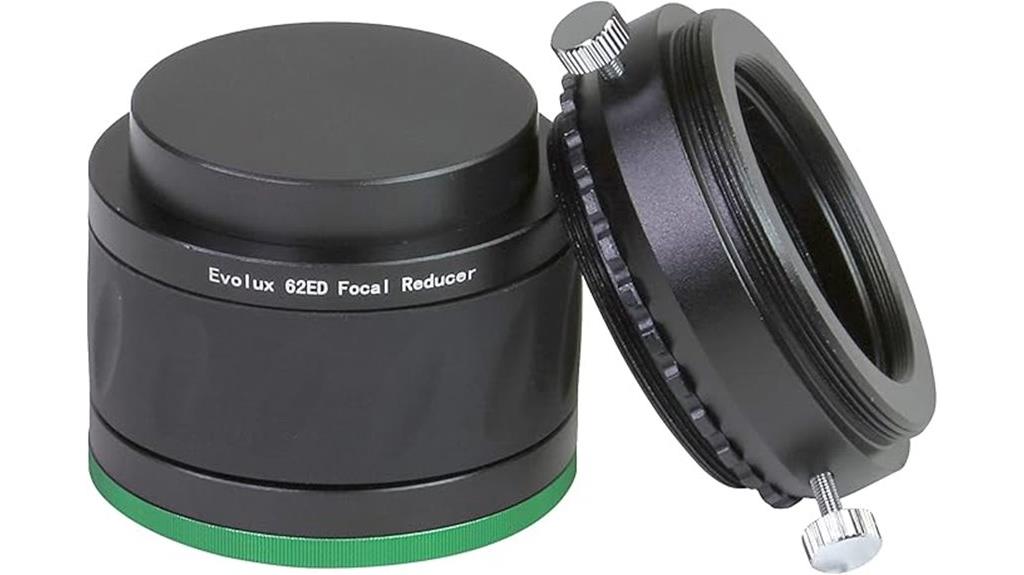
The Sky-Watcher Evolux 62ED Reducer/Flattener (0.9X) is an ideal choice for astrophotographers seeking sharp, flat-field images with minimal exposure times. Its 62mm aperture and f/5.8 focal ratio deliver bright, detailed images, while the 0.9X reduction helps achieve a wider field and shorter exposures. The device includes an ED element to minimize aberrations and improve clarity. Compatibility with M56x1 female and M48 male threads makes it versatile for various setups. The built-in rotator with filter cavity simplifies filter management during imaging. Its compact size and lightweight design make it a practical, high-quality accessory for achieving professional astrophotography results.
Best For: astrophotographers seeking a high-quality, flat-field reducer/flattener to enhance imaging clarity and reduce exposure times with their telescopic setups.
Pros:
- Provides a 0.9X reduction for wider field imaging and shorter exposure times
- Includes an ED element to minimize aberrations and improve image sharpness
- Compatible with M56x1 female and M48 male threads for versatile use
Cons:
- Relatively compact size may limit compatibility with larger telescopes
- Light weight might suggest less robust construction, requiring careful handling
- Designed primarily for astrophotography, less suitable for visual observing
SVBONY SV503 Portable Telescope Tube
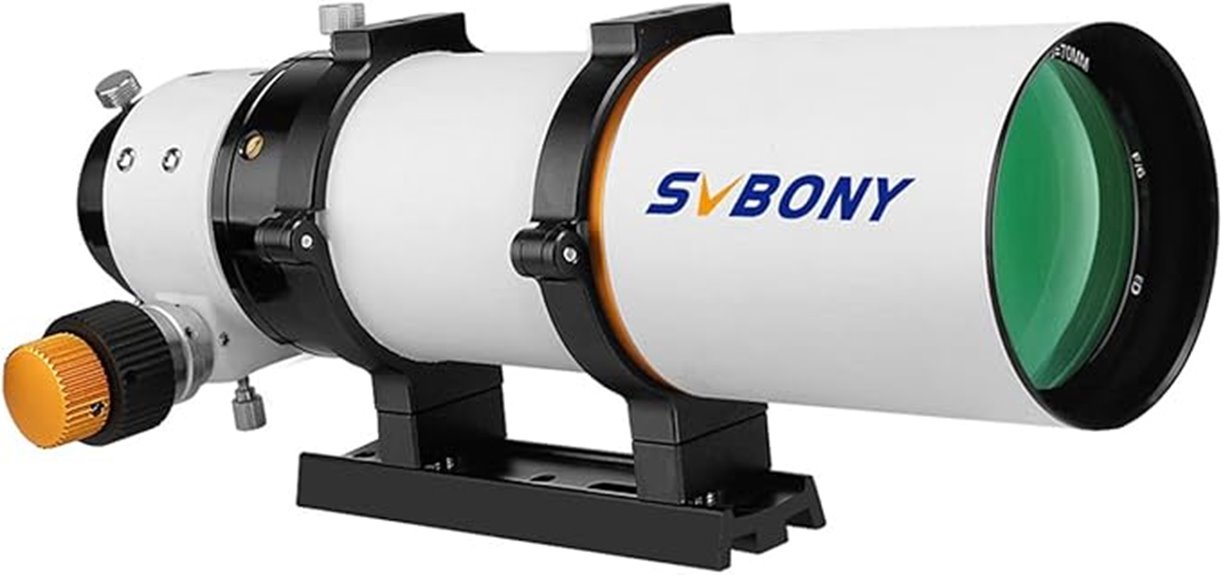
The SVBONY SV503 Portable Telescope Tube is an excellent choice for amateur astronomers and experienced observers who prioritize high image quality and portability. Its high-quality optics feature an S-FPL51 ED glass element, virtually eliminating chromatic aberration, and a doublet air-spaced achromatic objective that delivers sharp, high-contrast images perfect for detailed viewing and astrophotography. The micro-reduction RAP focuser allows precise focusing and supports heavy accessories. Its lightweight, portable design makes it ideal for travel and outdoor use, enabling observation of the moon, nebulae, galaxies, and other celestial objects. This versatile OTA suits both beginners and seasoned astronomers seeking reliable, high-performance optics.
Best For: amateur astronomers and experienced observers seeking high-quality, portable optics for astrophotography and celestial observation.
Pros:
- High-quality S-FPL51 ED glass element virtually eliminates chromatic aberration for clear images
- Micro-reduction RAP focuser allows precise focusing and supports heavy photographic accessories
- Lightweight and portable design ideal for travel and outdoor use
Cons:
- May require additional accessories for optimal use with certain telescopes or mounts
- Performance depends on proper handling and setup, which might be challenging for absolute beginners
- Limited to optical tube assembly; additional components needed for complete telescope system
SVBONY Focal Reducer for SV503 102mm ED Telescope
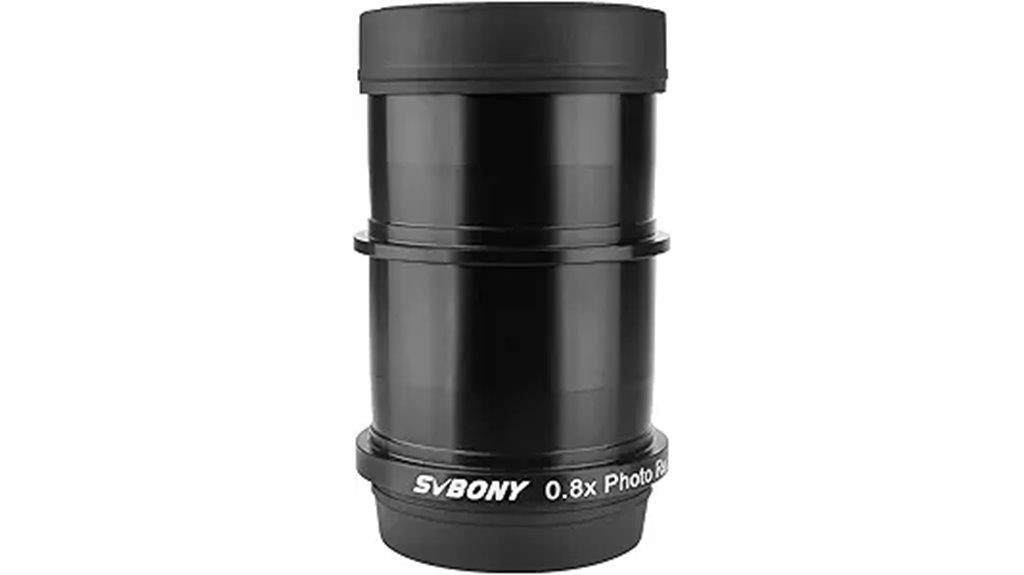
Designed specifically for the SV503 102mm ED refractor telescope, the SVBONY Focal Reducer offers a 0.8x reduction ratio that’s ideal for astrophotographers seeking wider sky views and sharper star points. It effectively reduces focus length, boosting the signal-to-noise ratio for detailed celestial images. The multi-coated optics ensure maximum light transmission, while the high-polish, durable aluminum construction keeps the reducer lightweight yet sturdy. Compatible with standard 2-inch filters and M48 threaded connections, it integrates seamlessly with various accessories. This reducer is perfect for capturing stunning, distortion-free astrophotos with consistent star point integrity across the entire frame.
Best For: astrophotographers using the SV503 102mm ED refractor telescope who want wider sky views and high-quality, distortion-free celestial images.
Pros:
- Provides a 0.8x reduction ratio for wider field of view and better framing of celestial objects
- Maintains star point quality across the entire frame, avoiding edge distortions
- Multi-coated optics maximize light transmission for brighter, clearer images
Cons:
- Compatible primarily with SV503 102mm ED telescopes, limiting versatility with other models
- May require careful alignment to achieve optimal focus and reduction effects
- Slightly added weight and complexity could impact quick setup or portability
SVBONY SV503 Refractor Telescope with Built-in Field Flattener and SV305C Pro Telescope Camera

If you’re looking for a refractor telescope that delivers sharp, distortion-free images across the entire field of view, the SVBONY SV503 with its built-in field flattener is an excellent choice. Its flat-field correction eliminates field curvature, providing wide, clear views of galaxies, nebulae, and star clusters. The F/6.78 focal ratio and 70mm aperture produce bright, detailed images with minimal chromatic aberration, thanks to ED glass. Paired with the SV305C Pro camera, which offers high sensitivity and low noise, this system captures stunning planetary and deep-sky images. It’s perfect for both detailed astrophotography and precise observation.
Best For: amateur astronomers and astrophotographers seeking sharp, wide-field, distortion-free images of celestial objects with minimal chromatic aberration.
Pros:
- Flat-field correction with built-in field flattener ensures wide, distortion-free views across the entire field of view
- High sensitivity and low noise of the IMX662 camera capture detailed planetary and deep-sky images even in low-light conditions
- Bright, sharp images with minimal chromatic aberration thanks to ED glass and advanced optical design
Cons:
- May require additional mounting or accessories for optimal stability and alignment
- The system’s complexity could be daunting for absolute beginners without prior experience
- Limited aperture size (70mm) may restrict some high-magnification planetary observations compared to larger telescopes
Factors to Consider When Choosing Field Flatteners for Refractor Telescopes
When selecting a field flattener, I consider how well it matches my telescope’s specifications and optical quality standards to guarantee sharp images across the field. Ease of installation and focal length adjustment also matter, making setup straightforward and versatile. Finally, I keep my budget in mind to find a solution that balances performance with affordability.
Compatibility With Telescope
Choosing the right field flattener for your refractor telescope requires careful attention to compatibility factors that guarantee seamless integration and peak performance. First, verify the threaded connections match your telescope’s focuser and camera adapters, like M48 or 2-inch fittings, to prevent installation issues. Confirm the flattener is compatible with your telescope’s optical design and focal ratio to avoid vignetting or image distortion. It’s also essential to check if the flattener is designed specifically for your telescope’s aperture size and optical specs, ensuring ideal correction. Additionally, verify that the back focus distance aligns with your telescope’s focus travel to maintain proper focus. Finally, consider whether the flattener supports your imaging setup, including filters, cameras, and accessories, for smooth and reliable operation.
Optical Quality Standards
Ever wonder how to guarantee your field flattener delivers crisp, distortion-free images across the entire field? The key lies in meeting strict optical quality standards. High-quality flatteners use ED or low-dispersion glass to minimize chromatic aberration, ensuring true color fidelity. Multi-coated optics boost light transmission and contrast, reducing glare and reflections that can compromise image clarity. Precise manufacturing tolerances are essential; they keep the flat field distortion-free, especially at the edges. Optical performance standards often define parameters like field curvature correction, star point size, and light transmission efficiency. By focusing on these factors, I can select a flattener that preserves sharpness, detail, and color accuracy from center to edge, giving me consistently stunning images every time I observe or photograph through my refractor.
Focal Length Adjustment
Have you considered how focal length adjustment impacts your astrophotography or observation experience? Using a focal reducer or flattener allows you to shorten the telescope’s effective focal length, broadening your field of view. This is especially useful for capturing larger celestial objects or landscapes. Proper adjustment helps optimize the image scale and magnification, letting you tailor your setup to specific targets. Additionally, reducing the focal length can make your system faster, enabling shorter exposure times, which is a huge advantage in astrophotography. However, compatibility is key; choosing an accessory that works seamlessly with your refractor prevents issues like vignetting or distortion. Ultimately, focal length adjustment gives you more flexibility, helping you achieve sharper, more detailed images tailored to your observing or imaging goals.
Ease of Installation
When selecting a field flattener for your refractor telescope, ease of installation should be a top consideration. Compatibility with your telescope’s threading and connection types is vital to avoid the hassle of adapters or modifications. Look for models that include built-in or compatible rotators and filter cavities, simplifying setup and adjustments. A lightweight, compact design makes attaching and detaching the flattener quick and straightforward, saving time during setup. Clear instructions and well-labeled components are essential, helping you align and install the device correctly without confusion. Some flat-field correctors are designed to be self-contained or integrated directly into the telescope, reducing assembly steps. Overall, choosing a flatener with these features can make your imaging sessions smoother and more enjoyable.
Price and Budget
Choosing a field flattener often comes down to balancing cost with the features you need. Basic models start around $50, offering decent performance but often sacrificing build quality or compatibility. Higher-end options can cost over $500, providing superior optical quality and durability, which are worth it if you’re serious about imaging. Keep in mind, additional accessories like adapters or rotation mechanisms can increase the total expense. It’s important to match your budget with your telescope’s focal length and aperture to ensure compatibility and ideal results. While investing in a more expensive flattener typically yields better images and longevity, a budget-friendly option might suffice if your needs are modest. Ultimately, weigh your imaging goals against your budget to make the best choice.
Frequently Asked Questions
How Do Field Flatteners Impact Astrophotography Image Quality?
Field flatteners considerably improve my astrophotography by reducing edge distortion and ensuring sharp, clear images across the entire frame. They correct field curvature, which often causes stars to look blurry or elongated at the edges. With a good flattener, I notice more precise star points and better overall image quality, making my shots look more professional and detailed. It’s a game-changer for capturing stunning, accurate celestial images.
Can I Use a Single Flattener Across Multiple Telescope Models?
Sure, you can try using a single flattener across multiple telescopes, but it’s like fitting a one-size-fits-all hat—probably won’t work perfectly. Each telescope’s optical design differs, so a flattener optimized for one might introduce aberrations in another. I recommend matching flatteners to specific models for best results. Trust me, your images will thank you when they’re crisp and free of distortions.
What Is the Typical Lifespan of a Field Flattener?
A typical field flattener lasts around 3 to 5 years with proper care, but this can vary based on usage and environmental factors. I recommend regularly inspecting your flattener for dust, scratches, or any signs of deterioration. Clean it gently and store it in a safe, dry place when not in use. Replacing it when optical quality declines guarantees I always get sharp, pinpoint stars in my astrophotography.
Are There Specific Field Flatteners Recommended for Planetary Imaging?
Yes, I recommend using a field flattener designed specifically for planetary imaging, like the Tele Vue 0.8x or the William Optics 0.8x reducer/flattener. These help correct field curvature and improve image sharpness across the entire frame. When choosing, I look for models with proven compatibility with my telescope and camera setup to make certain of crisp, detailed planetary images every time I shoot.
How Do I Determine the Best Flattener for My Astrophotography Needs?
Honestly, choosing the best flattener is simple—just pick the one that promises perfect images. But in reality, I start by considering my telescope’s specifications, like focal length and aperture, then read reviews and user experiences. I also test a few options if I can. Remember, a good flattener matches your setup, so don’t just go for the most expensive; find what works best for your unique needs.
Conclusion
Choosing the right field flattener can truly transform your astrophotography, making your images sharper than a laser beam. With options like the SVBONY SV503 and Sky-Watcher Evolux, you’ll never miss a detail in your cosmic adventures. Don’t settle for blurry stars or distorted landscapes—equip yourself with the best, and watch your photos reach legendary status. Trust me, once you experience perfect focus, you’ll wonder how you ever shot without it!