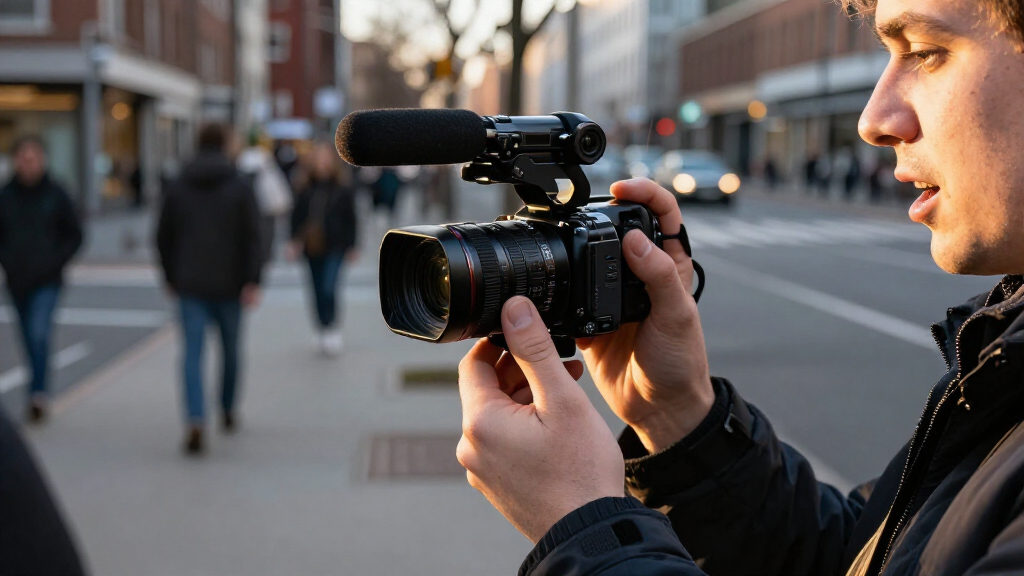
For most mobile journalists, I’d start with the DJI Osmo Pocket 3: its 1-inch sensor, 4K recording, and compact gimbal design make it the strongest all-around match here for steady, publishable footage. The Canon VIXIA HF R800 is a more traditional choice for extended handheld coverage, while the 4K Mini Body Camera with 6-Axis EIS suits hands-free documentation when a conventional camera would get in the way. The tradeoffs are clear: pocket size and stabilization can come at the expense of zoom and controls, while camcorders are easier to hold for long stretches but less discreet. I compare all 15 options by field usefulness, handling, and likely limitations, so continue reading for the full breakdown and guidance on choosing for your reporting style.

Get everyday essentials delivered free with Prime
- Fast, free delivery on millions of items
- Prime Video, Amazon Music and more included
- Member-only deals all year
Key Takeaways
- The DJI Osmo Pocket 3 leads for general mobile reporting: its 1-inch sensor, 4K video, and gimbal form factor combine image quality and stabilization in a compact kit.
- The Canon VIXIA HF R800 favors sustained handheld coverage: its camcorder design is a more natural fit for long interviews or events than tiny rotating-lens cameras.
- Body cameras serve a different reporting need: the 6-axis EIS mini body camera and the AviaryEye A18 prioritize hands-free recording, not flexible framing or interview control.
- Rotating-lens vlogging models trade control for convenience: options such as the Kaysunlink 1080p camera and Molegar make self-framing easier, but their listed resolution and feature sets vary.
- Accessory bundles and headline photo counts are not proof of newsroom readiness: across the camcorder-style options, audio inputs, recording limits, stabilization, and file workflow matter more than add-ons alone.
| Kaysunlink 1080p Pocket Vlogging Camera with 270° Rotatable Lens, Touchscreen, Wi-Fi, and 64GB Card |  | Best for Long, Lightweight Standups | Video: 1080p at 30 fps | Lens rotation: 270° horizontal and 130° vertical | Display: 1.33-inch touchscreen | VIEW LATEST PRICE | See Our Full Breakdown |
| 4K Mini Body Camera with 6-Axis EIS Stabilization |  | Best for Hands-Free Field Footage | Video: 4K at 30 fps | Stabilization: 6-axis electronic image stabilization | Lens: Wide angle | VIEW LATEST PRICE | See Our Full Breakdown |
| Molegar Mini Vlogging Camera with 180° Rotating Lens |  | Best for Simple Self-Framed Clips | Camera type: Action camera | Sensor: CMOS | Lens rotation: 180° manual | VIEW LATEST PRICE | See Our Full Breakdown |
| 4K Vlogging Camera with 330° Rotating Lens and Face Tracking |  | Best for Solo Reporters and Standups | Video: 4K (2160p) at 30 fps | Lens rotation: 330° automatic horizontal; 180° manual vertical | Focus: Autofocus; listed close-range distance 10 cm to 2 m | VIEW LATEST PRICE | See Our Full Breakdown |
| Canon VIXIA HF R800 Full HD Camcorder |  | Best for Distant Subjects and Optical Zoom | Video: 1080p Full HD | Sensor: CMOS | Optical zoom: 57x advanced zoom | VIEW LATEST PRICE | See Our Full Breakdown |
| Uytya X70 5K Video Camera Camcorder with 64MP Photos, 3-Inch Rotatable Touchscreen, Night Vision, 16x Zoom, Wi-Fi, and Creator Accessories |  | Best Accessory-Rich Field Kit | Video: 5K at 20 fps; 4K at 60 fps | Photo resolution: 64MP | Display: 3-inch IPS touchscreen; 270° rotation | VIEW LATEST PRICE | See Our Full Breakdown |
| 4K Pocket Vlogging Camera with 75MP Photos and Rotating Lens |  | Best for Solo Stand-Ups | Video: 4K at 30 fps | Photo resolution: 75MP | Lens rotation: 330° horizontally; 180° vertically | VIEW LATEST PRICE | See Our Full Breakdown |
| AviaryEye A18 Mini Body Camera with 1080p Video, Night Vision, Audio, and 64GB Card |  | Best for Hands-Free Documentation | Video: 1080p | Audio: Audio recording supported | Night vision: Infrared, up to 15 feet | VIEW LATEST PRICE | See Our Full Breakdown |
| DJI Osmo Pocket 3 Vlogging Camera with 1-Inch CMOS Sensor and 4K Video |  | Best Overall for Run-and-Gun Reporting | Sensor: 1-inch CMOS | Video: 4K; 4K/120 fps available in Slow Motion mode | Display: 2-inch rotating touchscreen | VIEW LATEST PRICE | See Our Full Breakdown |
| Lmzour 4K Vlogging Camera with 330° Rotating Lens |  | Best Simple Kit for Casual Field Clips | Video: 4K (2160p) at 30 fps | Photo resolution: 75MP | Lens rotation: 330° | VIEW LATEST PRICE | See Our Full Breakdown |
| Kaysunlink A18 Mini Body Camera with 64GB Memory Card |  | Best for Hands-Free Field Notes | Video resolution: 1080p | Weight: 42 g | Included memory card: 64GB | VIEW LATEST PRICE | See Our Full Breakdown |
| 4K Vlogging Camera with 330° Rotating Lens and Face Tracking | | Best for Solo Video Reporting | Video resolution: 4K (2160p) at 30 fps | Lens rotation: 330° horizontal; 180° manual vertical adjustment | Face tracking: Video mode only | VIEW LATEST PRICE | See Our Full Breakdown |
| ZYDIIE 4K UHD 64MP Camcorder with 18x Digital Zoom, Rotating Touchscreen, Night Vision, Remote, 32GB Card, and 2 Batteries |  | Best for Night Assignments | Video resolution: 4K | Effective still resolution: 64 MP | Digital zoom: 18x | VIEW LATEST PRICE | See Our Full Breakdown |
| eudic DV11 Handheld Vlogging Camera |  | Best for Magnetic Mounting | Camera type: Action camera | Video resolution: 1080p | Video format: MP4 | VIEW LATEST PRICE | See Our Full Breakdown |
| Kimire Full HD 1080P Camcorder with 16x Digital Zoom and Two Batteries |  | Best for Fixed-Position Recording | Video resolution: 1080p at 15 fps | Still image resolution: 24 MP (6000 × 4500) | Zoom: 16x digital | VIEW LATEST PRICE | See Our Full Breakdown |
| portable video cameras for journalism | Display | Video | Weight |
|---|---|---|---|
| Kaysunlink 1080p Pocket Vloggi | 1.33-inch touchscreen | 1080p at 30 fps | 3.31 ounces |
| 4K Mini Body Camera with 6-Axi | 1.5-inch HD screen | 4K at 30 fps | 35 g (1.23 oz) |
| Molegar Mini Vlogging Camera w | 1.97 inches; listed maximum resolution 240 pixels | — | 5.28 ounces |
| 4K Vlogging Camera with 330° R | — | 4K (2160p) at 30 fps | — |
| Canon VIXIA HF R800 Full HD Ca | 3-inch capacitive touch panel LCD | 1080p Full HD | 8.48 ounces |
| Uytya X70 5K Video Camera Camc | 3-inch IPS touchscreen; 270° rotation | 5K at 20 fps; 4K at 60 fps | 2.5 pounds |
| 4K Pocket Vlogging Camera with | 1.72-inch touchscreen | 4K at 30 fps | — |
| AviaryEye A18 Mini Body Camera | — | 1080p | 0.19 oz |
| DJI Osmo Pocket 3 Vlogging Cam | 2-inch rotating touchscreen | 4K; 4K/120 fps available in Slow Motion mode | — |
| Lmzour 4K Vlogging Camera with | 1.72 inches | 4K (2160p) at 30 fps | 0.36 kg |
| Kaysunlink A18 Mini Body Camer | — | — | 42 g |
| 4K Vlogging Camera with 330° R | 1.72-inch IPS touch screen | — | — |
| ZYDIIE 4K UHD 64MP Camcorder w | — | — | — |
| eudic DV11 Handheld Vlogging C | — | — | — |
| Kimire Full HD 1080P Camcorder | 3-inch LCD with 270° rotation | — | 0.54 kg |
More Details on Our Top Picks
Kaysunlink 1080p Pocket Vlogging Camera with 270° Rotatable Lens, Touchscreen, Wi-Fi, and 64GB Card
The Kaysunlink suits reporters who need a simple pocket camera for short interviews, standups, or day-long recording without carrying a full camcorder. Its stated five-hour battery life is longer than the 4K Mini Body Camera’s limit of up to 150 minutes, while the included 64GB card means basic storage is ready to go. The 270° horizontal and 130° vertical manual lens rotation helps with self-facing framing, though it takes a hand to reposition; the 4K Vlogging Camera with Face Tracking can adjust its horizontal lens automatically and adds autofocus. Kaysunlink’s 1080p/30fps ceiling is a clear compromise for editors who crop or need more detail, and no water resistance limits use in exposed field conditions. I’d choose it for uncomplicated, lightweight reporting rather than demanding image quality or hands-free shooting.
Pros:- Weighs 3.31 ounces, making it easy to carry between reporting locations.
- 270° horizontal and 130° vertical manual lens movement supports flexible self-framing.
- Includes a 64GB Micro SD card and Wi-Fi app connectivity for playback and downloads.
- Lists approximately five hours of battery life, exceeding the 4K Mini Body Camera’s stated runtime.
Cons:- Records only 1080p at 30 fps, below the 4K options in this roundup.
- Lens repositioning is manual, unlike the automatic horizontal rotation on the 4K Vlogging Camera with Face Tracking.
- Not water resistant, so exposed outdoor reporting calls for extra protection.
Best for: Solo reporters who need a lightweight camera for planned standups and interviews, with enough stated battery life for a long assignment.
Not ideal for: Journalists covering rain-prone events, fast-moving scenes, or assignments where 4K detail and automatic subject tracking matter.
- Video:1080p at 30 fps
- Lens rotation:270° horizontal and 130° vertical
- Display:1.33-inch touchscreen
- Battery:1400 mAh; approximately 5 hours
- Included storage:64GB Micro SD card
- Connectivity:Wi-Fi and USB
- Weight:3.31 ounces
- Water resistance:Not water resistant
Our verdict“Choose the Kaysunlink for lightweight, planned reporting where longer stated runtime matters more than 4K resolution or automatic framing.”
4K Mini Body Camera with 6-Axis EIS Stabilization
For journalists who need footage while their hands are occupied, this wearable camera has a clearer reporting role than the handheld vlogging models: mount it and record a hands-free point of view. Its 4K/30fps capture and six-axis electronic stabilization are useful when moving through a scene, although stabilization cannot replace deliberate framing or a separate interview camera. At 35 g, it is far lighter than the 5.28-ounce Molegar Mini Vlogging Camera, and its included mounts and waterproof case give it more field flexibility. The tradeoff is endurance: up to 150 minutes falls well short of the Kaysunlink’s stated five hours, making battery planning necessary on longer shifts. I’d treat it as a supplemental angle, not a sole camera for interviews or carefully composed standups; the small screen and wearable format make monitoring and precise framing less natural.
Pros:- Records 4K video at 30 fps for more detail and cropping room than the 1080p Kaysunlink.
- Six-axis electronic stabilization helps reduce shake in moving POV footage.
- At 35 g, it is lighter than the Molegar Mini Vlogging Camera.
- Includes a waterproof case and several mounting accessories for varied field setups.
Cons:- Up to 150 minutes of recording is shorter than the Kaysunlink’s stated five-hour battery life.
- Wearable mounting makes framing and monitoring less direct than with a handheld camera.
- The supplied information does not establish real-world performance beyond the listed specifications.
Best for: Field reporters and documentary crews who need a lightweight mounted POV angle while walking, demonstrating an event, or keeping both hands free.
Not ideal for: Journalists who need a primary interview camera, extended recording without battery changes, or close control over composition and on-camera monitoring.
- Video:4K at 30 fps
- Stabilization:6-axis electronic image stabilization
- Lens:Wide angle
- Sensor:1/2.3-inch CMOS
- Display:1.5-inch HD screen
- Battery life:Up to 150 minutes
- Connectivity:2.4 GHz Wi-Fi and Bluetooth
- Weight:35 g (1.23 oz)
- Included accessories:Waterproof case, rotating clip, cycling mount, helmet mount, and ski mount
Our verdict“Pick this as a lightweight supplemental POV camera for mobile reporting, not as the main tool for interviews or long recording days.”
Molegar Mini Vlogging Camera with 180° Rotating Lens
The Molegar is a basic pocket option for reporters who want to switch between filming a subject and addressing the camera without carrying a larger camcorder. Its 180° manually rotating lens offers a useful framing change, and the built-in fill light may help in dim indoor settings. Compared with the Kaysunlink, the Molegar lists a larger 2000mAh battery and a larger 1.97-inch display, but it does not provide a stated runtime, so battery planning is less certain. Its fixed-focus lens is the more serious reporting limitation: it suits a consistent distance better than interviews where subjects move or scenes change quickly. The 4K Vlogging Camera with Face Tracking offers autofocus and 4K capture, making it a stronger choice for varied subjects, while the Molegar stays simpler and includes a 64GB card. It is not water resistant, and the listed display resolution is only 240 pixels.
Pros:- Manual 180° lens rotation lets a solo operator reframe between self-facing and outward-facing shots.
- Includes a 64GB Micro SD card for recording without sourcing a card separately.
- Built-in fill light can add illumination in dim indoor situations.
- 2000mAh rechargeable battery capacity is larger than the Kaysunlink’s listed 1400mAh capacity.
Cons:- Fixed focus is less adaptable to changing subject distances than the autofocus on the 4K Vlogging Camera with Face Tracking.
- The supplied product data does not specify video resolution or battery runtime.
- Not water resistant, and the listed display resolution is only 240 pixels.
Best for: New or occasional reporters recording short, mostly stationary standups and indoor clips who value a built-in light and included storage.
Not ideal for: Journalists filming moving subjects, changing distances, outdoor assignments in wet weather, or work that needs clearly specified high-resolution video.
- Camera type:Action camera
- Sensor:CMOS
- Lens rotation:180° manual
- Focus:Fixed focus
- Image stabilization:Electronic
- Display:1.97 inches; listed maximum resolution 240 pixels
- Battery:One 2000mAh rechargeable battery
- Included storage:64GB Micro SD card
- Weight:5.28 ounces
Our verdict“Choose the Molegar for straightforward, short self-framed clips, but skip it for moving subjects or assignments that demand dependable focus and specified video resolution.”
4K Vlogging Camera with 330° Rotating Lens and Face Tracking
This is the most self-directed handheld option in this group for reporters who regularly appear on camera. Its 330° automatic horizontal lens rotation, face tracking, and autofocus can help keep a solo presenter framed without repeatedly adjusting the camera. Compared with the Kaysunlink, it adds 4K/30fps capture and automatic tracking, while the Canon VIXIA HF R800 is the more conventional choice for controlled zoomed shots, thanks to its 57x optical zoom and larger 3-inch screen. The listed 32GB storage and up to three hours of battery life are workable for shorter assignments but less generous than the Kaysunlink’s included 64GB card and stated five-hour runtime. Face tracking works only in video mode, and the camera is not water resistant. Its specified close-range focus range also makes it a less natural fit for subjects at greater distances.
Pros:- 4K/30fps video provides more detail and cropping flexibility than the 1080p Kaysunlink.
- Automatic horizontal lens rotation and face tracking can reduce the need for a second operator.
- Autofocus supports quick changes in framing and subject distance within its listed range.
- Wi-Fi supports app control and file transfers.
Cons:- Face tracking is available only in video mode.
- Up to three hours of battery life and listed 32GB storage may constrain longer assignments.
- Not water resistant, and the listed close-range focus range is 10 cm to 2 m.
Best for: Solo journalists producing standups, short interviews, and presenter-led field updates who want automatic framing and 4K capture in a compact camera.
Not ideal for: Reporters covering long shifts without access to charging or extra storage, filming in wet conditions, or regularly recording distant subjects.
- Video:4K (2160p) at 30 fps
- Lens rotation:330° automatic horizontal; 180° manual vertical
- Focus:Autofocus; listed close-range distance 10 cm to 2 m
- Screen:1.72-inch IPS touchscreen
- Battery:2400 mAh; up to 3 hours
- Listed storage:32GB microSD
- Connectivity:Wi-Fi and USB
- Image stabilization:Digital
- Water resistance:Not water resistant
Our verdict“Choose this camera for 4K solo standups with automatic framing, but favor the Canon for optical reach or the Kaysunlink for longer stated runtime.”
Canon VIXIA HF R800 Full HD Camcorder
The Canon VIXIA HF R800 is the strongest fit here when a journalist needs to record a subject from across a room, a press event, or a roped-off area. Its 57x advanced optical zoom gives it a practical advantage over the digital zoom-free compact options listed here: distant action can fill the frame without relying solely on digital enlargement. SuperRange Optical Image Stabilizer helps steady handheld footage, and the 3-inch touchscreen is more comfortable for framing and playback than the smaller displays on the Kaysunlink and Molegar. The tradeoffs are a 1080p ceiling and manual focus, which make it less suited to quick, close-range solo standups than the 4K Vlogging Camera with Face Tracking. Clean HDMI output also gives it a useful path for webcam setups. It is lightweight for a camcorder, but not water resistant, so field protection remains necessary.
Pros:- 57x advanced optical zoom helps frame distant subjects without relying on digital zoom.
- SuperRange Optical Image Stabilizer helps reduce handheld camera shake.
- 3-inch capacitive touchscreen offers a larger viewing area than the pocket cameras in this batch.
- Clean HDMI output supports use in a webcam setup.
Cons:- Records Full HD rather than 4K, unlike the 4K Mini Body Camera and face-tracking vlogging camera.
- Manual focus demands more operator attention than the autofocus on the 4K Vlogging Camera with Face Tracking.
- Not water resistant, and its camcorder form is less suited to wearable POV recording.
Best for: Journalists covering press events, public meetings, or other assignments where subjects may be distant and optical reach matters more than 4K capture.
Not ideal for: Solo reporters who need autofocus, automatic framing, a wearable hands-free viewpoint, or a camera for wet-weather work.
- Video:1080p Full HD
- Sensor:CMOS
- Optical zoom:57x advanced zoom
- Image stabilization:SuperRange Optical Image Stabilizer
- Display:3-inch capacitive touch panel LCD
- Recording format:MPEG-4
- Connectivity:HDMI
- Weight:8.48 ounces
- Battery life:3 hours
Our verdict“Pick the Canon when optical zoom and a larger screen matter most; choose a compact 4K model instead for solo standups or hands-free footage.”
Uytya X70 5K Video Camera Camcorder with 64MP Photos, 3-Inch Rotatable Touchscreen, Night Vision, 16x Zoom, Wi-Fi, and Creator Accessories
The X70 is a flexible starter kit for reporters who need a camera, basic audio gear, and power in one package. Its included external microphone, tripod, two batteries, and 32GB card mean fewer essentials to source before a field assignment. The 3-inch screen rotates for low or self-facing angles, while IR night vision offers a way to record in very dim settings. Compared with the more polished, stabilized footage of the DJI Osmo Pocket 3, this camcorder puts more emphasis on bundled accessories and manual control. That control comes with a cost: manual focus can slow a reporter reacting to a changing scene, and 5K is limited to 20 fps. At 2.5 pounds and without water resistance, it is less suited to long handheld walks or wet-weather reporting.
Pros:- External microphone, tripod, two batteries, and 32GB memory card are included
- 3-inch touchscreen rotates 270° for flexible framing
- IR night vision supports recording in dark settings
- Records 4K at 60 fps and supports Wi-Fi and webcam use
Cons:- Manual focus takes more attention during changing scenes
- 5K recording is limited to 20 fps
- Weighs 2.5 pounds and is not water resistant
Best for: Field reporters who want a bundled tripod, microphone, spare battery, and card for planned stand-ups or interviews.
Not ideal for: Mobile journalists who need quick autofocus, a genuinely pocketable camera, or reliable recording in rain.
- Video:5K at 20 fps; 4K at 60 fps
- Photo resolution:64MP
- Display:3-inch IPS touchscreen; 270° rotation
- Zoom:16x
- Focus:Manual
- Night vision:IR
- Weight:2.5 pounds
- Included kit:32GB Class 10 card, two 1800mAh batteries, tripod, external microphone, remote control, lens hood
Our verdict“Choose the X70 for its ready-to-go accessory bundle, but pick the DJI Osmo Pocket 3 for lighter, more stabilized run-and-gun footage.”
4K Pocket Vlogging Camera with 75MP Photos and Rotating Lens
This camera’s rotating lens makes it easier for a solo reporter to switch between a self-facing introduction and a forward-facing scene without repositioning the whole camera. Face tracking can help keep a presenter framed during a straightforward stand-up, and the option to record while charging is useful for longer desk-side or interview setups. Compared with the Lmzour 4K Vlogging Camera, it offers a similar compact, rotating-lens approach but adds face tracking and a larger 2400mAh battery. That battery is rated for only about 1.5–2 hours, though, and tracking may falter in crowds or with fast movement. The 4x zoom is digital, so it cannot replace optical reach when a reporter must stay back from a subject.
Pros:- Lens rotates 330° horizontally and 180° vertically for flexible framing
- Face tracking can help keep a solo presenter in frame
- Can record while charging
- Wi-Fi transfer and creative recording modes are available
Cons:- Battery life is approximately 1.5–2 hours
- Face tracking may struggle with crowds or fast movement
- 4x digital zoom offers no optical reach
Best for: Solo reporters filming short stand-ups, explainers, and controlled interviews who want flexible framing and face tracking.
Not ideal for: Journalists covering fast-moving crowds or distant action who need dependable subject tracking, longer runtime, or optical zoom.
- Video:4K at 30 fps
- Photo resolution:75MP
- Lens rotation:330° horizontally; 180° vertically
- Display:1.72-inch touchscreen
- Zoom:4x digital
- Battery:2400mAh; approximately 1.5–2 hours
- Connectivity:Wi-Fi and USB
- Dimensions:1.6 × 1.38 × 6.3 inches
Our verdict“Pick this model for short, self-operated stand-ups; the Lmzour is a similar alternative if face tracking is not a priority.”
AviaryEye A18 Mini Body Camera with 1080p Video, Night Vision, Audio, and 64GB Card
The A18 serves a different reporting need from handheld cameras: it clips to clothing for hands-free documentation while a reporter moves through a scene. Its 1080p video includes audio, and the 64GB card and up-to-five-hour runtime support longer recording without frequent storage or battery changes. Infrared night vision is rated to 15 feet, a practical aid for poorly lit spaces, while timestamps and loop recording help organize footage. Compared with the DJI Osmo Pocket 3, it gives up image refinement, framing control, and mechanical stabilization in exchange for discreet, wearable capture. The clip-on design is also not a substitute for a camera operator’s composed interview shot, and the unit is not water resistant. Reporters should check local rules and consent requirements before recording people.
Pros:- Lightweight shirt-clip design supports hands-free recording
- Records 1080p video with audio
- Includes a 64GB microSD card and supports up to five hours of recording
- IR night vision, loop recording, motion detection, and timestamping
Cons:- 1080p footage offers less detail than the 4K options in this lineup
- Clip-on placement gives limited control over framing and camera movement
- Not water resistant
Best for: Reporters needing a lightweight, clip-on camera for hands-free scene documentation or timestamped recording.
Not ideal for: Journalists who need polished interviews, deliberate framing, stabilized handheld footage, or recording in wet conditions.
- Video:1080p
- Audio:Audio recording supported
- Night vision:Infrared, up to 15 feet
- Battery life:Up to five hours
- Included storage:64GB microSD card
- Maximum storage:128GB
- Weight:0.19 oz
- Mount:Shirt clip
Our verdict“Choose the A18 for wearable documentation, not as your main camera for composed interviews or broadcast-style footage.”
DJI Osmo Pocket 3 Vlogging Camera with 1-Inch CMOS Sensor and 4K Video
For reporters moving between locations, the Pocket 3 makes the strongest case for dependable handheld video in a compact package. Its three-axis mechanical stabilization helps smooth walking footage, while the 1-inch sensor and 10-bit D-Log M provide more room to work with image quality and color than the basic pocket cameras here. ActiveTrack 6.0 can follow a subject, and the rotating screen supports both horizontal and vertical framing. Compared with the accessory-heavy Uytya X70, the DJI is more focused on stabilization, tracking, and audio integration, including direct connection to two compatible DJI transmitters. The tradeoff is a less ready-to-record kit: microSD storage is required, the charger is sold separately, and 4K/120 fps is available only in Slow Motion mode. It also costs extra setup time to add the card and audio gear.
Pros:- Three-axis mechanical stabilization supports smoother handheld movement
- 1-inch CMOS sensor and 10-bit D-Log M offer flexible image capture
- Rotating 2-inch touchscreen supports horizontal and vertical framing
- Connects directly to two compatible DJI Mic 2 or Mic Mini transmitters
Cons:- MicroSD card is required and not included in the listed package
- Battery charger is sold separately
- 4K/120 fps is limited to Slow Motion mode
Best for: Mobile journalists who prioritize stabilized walking footage, compact carry, and flexible audio options for interviews and field reports.
Not ideal for: Buyers who need a complete out-of-box kit with memory card and charger, or who require 4K/120 fps for standard-speed footage.
- Sensor:1-inch CMOS
- Video:4K; 4K/120 fps available in Slow Motion mode
- Display:2-inch rotating touchscreen
- Stabilization:3-axis mechanical
- Tracking:ActiveTrack 6.0
- Color profile:10-bit D-Log M
- Audio:Stereo recording; direct connection to two DJI Mic 2 or Mic Mini transmitters
- Storage:MicroSD card required; not listed among included items
Our verdict“Choose the Pocket 3 as the most capable compact reporting camera here if you are prepared to supply a memory card and charger.”
Lmzour 4K Vlogging Camera with 330° Rotating Lens
The Lmzour is an approachable choice for reporters who need a small camera for short clips, basic stand-ups, or everyday documentation rather than demanding field coverage. Its 330° rotating lens and autofocus simplify solo framing, and Wi-Fi can move files to a smartphone without a wired transfer. The included 16GB card, mini tripod, and carrying bag make the package more immediately useful than the DJI Osmo Pocket 3, which requires a separately supplied microSD card. But that convenience comes with less capability for mobile reporting: its battery is rated for about 1.5 hours, it lacks the DJI’s three-axis mechanical stabilization, and no water resistance is specified. At 0.36 kg, it is portable but not as unobtrusive as a body camera. I would keep it to controlled shoots rather than fast-moving assignments.
Pros:- 330° rotating lens helps solo operators frame themselves and the scene
- Autofocus reduces the need for manual focus adjustment
- Includes a 16GB microSD card, mini tripod, and carrying bag
- Wi-Fi supports wireless transfers to a smartphone
Cons:- Battery life is listed at approximately 1.5 hours
- No three-axis mechanical stabilization is specified
- Not water resistant
Best for: Beginning or occasional reporters making short, controlled clips who want a rotating lens and basic accessories included.
Not ideal for: Journalists filming long days, moving handheld shots, or assignments where weather protection and advanced stabilization matter.
- Video:4K (2160p) at 30 fps
- Photo resolution:75MP
- Lens rotation:330°
- Display:1.72 inches
- Focus:Autofocus
- Connectivity:USB and Wi-Fi
- Battery life:Approximately 1.5 hours
- Weight:0.36 kg
Our verdict“Choose the Lmzour for short, straightforward clips with a useful included kit, but favor the DJI Osmo Pocket 3 for stabilized mobile reporting.”
Kaysunlink A18 Mini Body Camera with 64GB Memory Card
The Kaysunlink A18 suits journalists who need a small, body-worn camera for documenting interviews, walk-throughs, or events without holding a camcorder. At 42 g, it is far easier to wear discreetly than the 0.54 kg Kimire, and its included 64GB card means there is storage ready to go. Loop and motion recording offer simple ways to capture activity, while charging during recording can help when power is available.
Its limits matter for field reporting: the 4–6-hour battery rating may not cover a long shift, and it is not water resistant. Unlike the handheld ZYDIIE, it is not suited to deliberate framing or zooming in on a subject. I’d choose it for lightweight, hands-free documentation, not as a main camera for polished interviews or wet-weather assignments.
Pros:- Light 42 g body-worn design is easy to carry hands-free.
- Records 1080p video with audio.
- Includes a 64GB memory card.
- Loop and motion recording modes, plus recording while charging.
Cons:- Rated battery life of 4–6 hours may fall short on extended assignments.
- Not water resistant.
- Body-worn framing offers less control than a handheld camcorder.
Best for: Reporters who need a lightweight, body-worn camera for short assignments, observational footage, or hands-free recording.
Not ideal for: Journalists covering long shifts, rainy locations, or sit-down interviews that need deliberate framing and camera control.
- Video resolution:1080p
- Weight:42 g
- Included memory card:64GB
- Battery capacity:1000 mAh
- Recording modes:Loop and motion detection
- Video format:AVI
- Water resistance:Not water resistant
Our verdict“Choose the A18 for lightweight, hands-free documentation, but use a handheld camcorder when framing control or longer coverage matters.”
4K Vlogging Camera with 330° Rotating Lens and Face Tracking
For a journalist working alone, this camera’s video-mode face tracking and 330° rotating lens address a practical problem: keeping yourself in frame while speaking to camera. Its 4K recording gives it a resolution advantage over the 1080p Kaysunlink A18, while the 1.72-inch touch screen and Wi-Fi add convenient framing and file-sharing options. The compact form and stated battery life of up to three hours suit short stand-ups, explainers, and quick field updates.
This is still a vlogging-oriented choice, not a rugged news camera. Face tracking applies only to video, stabilization is digital, and the camera is not water resistant. Storage details are inconsistent in the listing, which mentions both 16GB and 32GB, so I would verify what is supplied before relying on it for an assignment. Compared with the ZYDIIE camcorder, it favors self-recording convenience over a larger screen and bundled spare batteries.
Pros:- Records 4K video at 30 fps.
- Face tracking can keep a solo presenter centered in video.
- 330° horizontal lens rotation supports flexible framing.
- Wi-Fi, USB, and a touch screen support file sharing and camera control.
Cons:- Face tracking works only in video mode.
- Storage listing conflicts between 16GB and 32GB.
- Not water resistant, and stabilization is digital.
Best for: Solo reporters and mobile journalists recording short on-camera updates who want face tracking and flexible lens positioning.
Not ideal for: Journalists who need dependable, clearly specified storage, weather protection, or long continuous recording away from power.
- Video resolution:4K (2160p) at 30 fps
- Lens rotation:330° horizontal; 180° manual vertical adjustment
- Face tracking:Video mode only
- Display:1.72-inch IPS touch screen
- Battery capacity:2400 mAh
- Connectivity:Wi-Fi and USB
- Image stabilization:Digital
Our verdict“Pick this camera for short solo stand-ups where face tracking and rotating framing help more than ruggedness or confirmed storage capacity.”
ZYDIIE 4K UHD 64MP Camcorder with 18x Digital Zoom, Rotating Touchscreen, Night Vision, Remote, 32GB Card, and 2 Batteries
The ZYDIIE is the most assignment-oriented handheld option here for reporting that may continue after dark. Its infrared night vision records black-and-white video in low light, and the box includes a 32GB card and two batteries—useful when a reporter needs to start recording without assembling a separate kit. The rotating 3-inch touchscreen, remote, and webcam support add flexibility for stand-ups, interviews, and fixed-position coverage.
Its 4K label does not remove the limitations of a fixed-focus lens and 18x digital zoom; digital enlargement can reduce detail, so I would not rely on zoom for distant evidence or action. Compared with the 4K face-tracking camera, this one offers night vision and spare batteries but lacks listed face tracking. It is also not weatherproof, so it is a poor fit for exposed outdoor reporting.
Pros:- 4K video recording with infrared black-and-white night vision.
- Includes two batteries and a 32GB microSD card.
- Rotating 3-inch touchscreen supports flexible framing.
- Remote control and webcam use provide additional recording options.
Cons:- 18x zoom is digital rather than optical.
- Fixed-focus lens limits control over focus distance.
- Not water resistant.
Best for: Local reporters covering evening events or dim interiors who want a handheld camera with infrared recording and bundled batteries.
Not ideal for: Journalists who need optical zoom, adjustable focus, weather protection, or dependable detail from distant subjects.
- Video resolution:4K
- Effective still resolution:64 MP
- Digital zoom:18x
- Screen:3-inch touchscreen with 270° rotation
- Night vision:Infrared, black-and-white video
- Focus type:Fixed focus
- Included storage:32GB microSD card
- Included batteries:2
Our verdict“Choose the ZYDIIE for dim-location reporting with bundled batteries, but skip it if optical zoom or focus control is part of the assignment.”
eudic DV11 Handheld Vlogging Camera
The eudic DV11’s defining advantage is its handheld, magnetic, and mounted use, making it a compact option for reporters who need to place a camera on a compatible surface or change position quickly. Its 180° rotating lens supports front-facing updates and alternate angles without requiring a larger camcorder. Compared with the Kaysunlink A18, the DV11 is a handheld action-camera style device rather than a body-worn recorder; that gives the journalist more flexibility in where to point it, but less hands-free wearability.
The supplied details specify 1080p video but do not list a memory card as included, and its battery is described as nonstandard. That makes spare-power planning and storage checks part of the purchase decision. The short listed warranty and lack of water-resistance information also leave fewer reassurances for demanding field work. I’d treat it as a portable angle-gathering camera, not a primary camera for critical interviews.
Pros:- Compact handheld design supports easy transport.
- 180° rotating lens helps with alternate shooting angles.
- Supports handheld, magnetic, and mounted recording.
- Records 1080p video in MP4 format.
Cons:- Uses a nonstandard battery, which may complicate replacement and spares.
- Micro SD support is listed, but included storage is not specified.
- Warranty is listed as six months.
Best for: Mobile reporters who want a small camera for quick mounted angles, desk-side updates, or travel footage and can manage separate storage.
Not ideal for: Journalists who need included storage, easy-to-source spare batteries, or a clearly specified weather-resistant camera.
- Camera type:Action camera
- Video resolution:1080p
- Video format:MP4
- Display size:1.97 inches
- Lens rotation:180°
- Memory card type:Micro SD
- Battery:One nonstandard battery included
- Warranty:6 months
Our verdict“Pick the DV11 for flexible mounted angles and compact carry, but confirm storage and plan around its nonstandard battery before assigning it as a main camera.”
Kimire Full HD 1080P Camcorder with 16x Digital Zoom and Two Batteries
The Kimire’s rotating 3-inch LCD, pause function, and webcam mode make it easier to set up for a seated interview, briefing, or fixed-position recording than the body-worn Kaysunlink A18. It also includes two batteries and can record while charging, giving it more power flexibility than the eudic DV11, whose battery is nonstandard. The 16x digital zoom may help reframe a shot from a stationary position, though it does not provide the detail-preserving reach of optical zoom.
The main limitation is fundamental for journalism: its 1080p recording is only 15 fps, which can look less fluid than standard-motion footage. Rated battery life is around 60–90 minutes, and the SD card is not included. At 0.54 kg, it is also much heavier than the 42 g A18. I’d choose it for controlled, powered setups rather than fast-moving field coverage.
Pros:- Rotating 3-inch LCD helps with framing from different positions.
- Includes two NP-FV5 batteries.
- Supports recording while charging and pausing recordings.
- Webcam function and AV output provide connection options.
Cons:- 1080p video is limited to 15 fps.
- SD card is not included.
- Weighs 0.54 kg and is rated for around 60–90 minutes of battery life.
Best for: Reporters recording seated interviews, briefings, or webcam segments from a stable position with access to power and a separate SD card.
Not ideal for: Journalists covering moving subjects, long handheld assignments, or work where fluid motion footage and light carry matter.
- Video resolution:1080p at 15 fps
- Still image resolution:24 MP (6000 × 4500)
- Zoom:16x digital
- Display:3-inch LCD with 270° rotation
- Included batteries:Two NP-FV5 batteries
- Storage:SD/SDHC cards up to 128GB; card not included
- Weight:0.54 kg
Our verdict“Choose the Kimire for controlled, fixed-position recording, but avoid it for moving field coverage because its low frame rate and weight work against that use.”
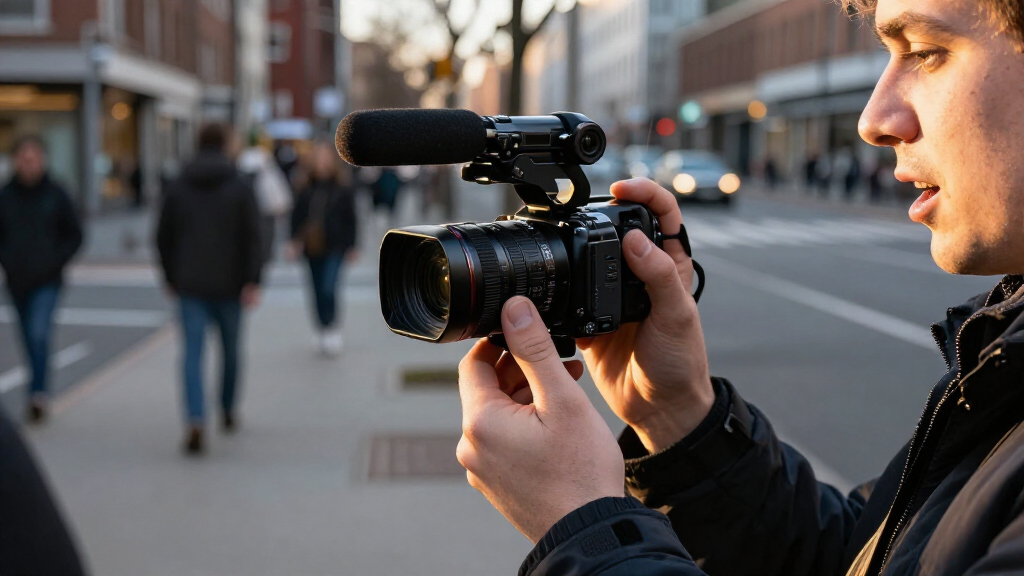
How We Picked
I ranked these cameras by how well their stated design and features match reporting tasks: recording interviews, covering events, filming while moving, capturing hands-free evidence, and carrying gear between locations. I put particular weight on stabilization, sensor and video specifications, practical framing controls, and whether the form factor supports steady operation. Audio and workflow matter just as much in journalism, but the supplied product details do not establish professional microphone connections, recording limits, or file-handling performance; I treat those as points buyers should verify rather than assume.
The order gives priority to products with a clearer combination of portable handling and useful video capability, not to the biggest advertised number or longest accessory list. That places the DJI Osmo Pocket 3 first for broad use, with the Canon VIXIA HF R800 and stabilization-focused body camera serving distinct reporting styles. Compact vlogging cameras and lesser-documented models rank lower where their listed details leave more uncertainty or suggest meaningful limits, such as 1080p recording or digital rather than optical zoom. The list includes two similarly named 330-degree face-tracking cameras; I treat them as separate listings, but buyers should confirm the exact model and specifications before purchase.
Factors to Consider When Choosing Portable Video Cameras For Journalism
For journalism, a camera is only as useful as the footage and sound it can capture under deadline and in changing conditions. I’d choose around the reporting assignment first, then check whether the device supports the workflow: interviews need clear audio and deliberate framing, while moving coverage demands stabilization and accessible controls.
Start With the Assignment, Not the Resolution Label
A 4K label can help when you need room to crop or deliver high-resolution footage, but it does not tell you whether the camera handles motion, low light, or skin tones well. For a static interview, stable framing and dependable audio can matter more than extra pixels. For a fast-moving scene, stabilization and responsive controls may save more usable footage than a higher resolution setting. Check which frame rates and recording formats are actually supported, not just the headline resolution. A common mistake is buying for the most demanding imagined assignment and carrying a camera that is awkward for everyday reporting. Match the camera to the work you expect to do most often, and keep a phone or second camera as a fallback where appropriate.
Treat Audio as a Separate Buying Decision
Built-in microphones can capture a quick scene, but they may also pick up wind, handling noise, and surrounding conversations. Before choosing a camera for interviews, confirm whether it has a microphone input, what connector it uses, and whether it can monitor sound with headphones. A compact camera that lacks these connections may still work with a separate recorder, though that adds setup and synchronization steps. Do not infer audio capability from Wi-Fi, a touchscreen, or a supplied memory card. For run-and-gun reporting, a reliable small microphone and wind protection can improve usable results more than a camera upgrade. Factor the full audio kit into your carry plan and budget.
Compare Stabilization With the Way You Move
Optical or gimbal stabilization can produce smoother handheld movement, while electronic stabilization may crop the image or behave differently in low light. For walking stand-ups, moving footage, or quick follow shots, stabilization can matter more than a long zoom range. Body cameras offer a hands-free angle but limit control over framing and can record an unflattering or obstructed viewpoint if mounted poorly. For a seated interview, a tripod or simple support may be more effective than paying for advanced stabilization. Read the exact stabilization method and check how it affects field of view at the settings you plan to use. Also think about whether you can correct the camera’s position quickly when a scene changes.
Do Not Mistake Digital Zoom for Reach
Digital zoom enlarges a portion of the image rather than bringing distant subjects closer optically, which can make footage look softer. This matters at press events, public meetings, or on assignment where you cannot move nearer to the subject. A compact camera with a rotating screen may be easier to frame at arm’s length, but that convenience does not replace genuine telephoto reach. If distance is part of your routine, confirm whether a model has optical zoom and how its focus performs at the long end. For a fixed interview, getting closer and using a wider composition may be preferable to zooming digitally. Choose a zoom range based on real access restrictions, not the largest number printed in a listing.
Plan for Power, Storage, and File Handoffs
A supplied card or extra battery is useful only if its capacity, speed, and compatibility match your recording settings. Check battery runtime under video recording, charging options, and whether the camera can run from an external power source. Long hearings and event coverage can outlast a small battery even when the camera is compact. Confirm card type and maximum capacity, then estimate how much storage your chosen resolution and frame rate will consume. Journalism also brings a handoff question: can you transfer files quickly to a phone or laptop, and can the camera record while files move? Build a simple backup plan before assignments where lost or delayed footage would matter.
Check Reliability and Handling Before Buying
Small cameras are easy to carry, but tiny controls and screens can be difficult to operate outdoors, with gloves, or under deadline pressure. Look for clear information about recording limits, heat behavior, file segmentation, weather resistance, and warranty support; these details affect field reliability more than accessory bundles do. A camcorder grip may be more comfortable during a long event, while a pocket camera is easier to keep ready for spontaneous moments. Body cameras can record discreetly, but their use raises consent, privacy, and local policy questions that journalists must handle responsibly. If a listing leaves core specifications unclear, verify them with the seller or manufacturer before relying on it for paid work. When reliability is the priority, a known format and a tested backup workflow may be worth more than extra advertised features.
Frequently Asked Questions
Is a pocket camera or a camcorder better for interviews on location?
For a fixed interview, either can work, but the deciding factors are audio connections, stable support, and accessible controls. The Canon VIXIA HF R800 has a familiar camcorder shape that can be easier to hold during extended coverage, while a pocket camera like the DJI Osmo Pocket 3 is easier to carry between locations. Check microphone input and headphone monitoring before choosing either, since the listed camera features alone do not confirm those capabilities. If the interview is seated, a tripod can reduce the handling advantage of a camcorder. Prioritize the camera that fits your audio setup and framing routine.
Can a body camera replace a handheld camera for news reporting?
A body camera can record hands-free footage when a reporter needs both hands available, but it is not a full replacement for a camera with deliberate framing and interview controls. Its viewpoint depends on where it is mounted, and it may capture blocked, tilted, or overly wide footage. The 4K Mini Body Camera with 6-Axis EIS is the stronger listed fit for movement-focused hands-free recording, while the AviaryEye A18 emphasizes 1080p video and night vision. Neither listing establishes professional audio connections or a full production workflow. I’d use one as a supplementary angle when appropriate, not as the sole camera for every assignment.
Does 4K matter more than low-light performance for journalism?
Not by itself. 4K can provide room to crop and can suit high-resolution delivery, but it does not guarantee clean footage in a dim press room or evening scene. Sensor size, lens brightness, stabilization, and recording settings all affect the result, and many listings do not provide enough detail to compare them fully. The DJI Osmo Pocket 3’s stated 1-inch sensor gives it a clearer specification advantage over models that list resolution without sensor information. If much of your work happens indoors or after dark, seek independent sample footage before treating a resolution label as decisive.
Should I rely on a camera’s built-in Wi-Fi for sending footage on deadline?
Wi-Fi can help move clips to a phone, but transfer speed, app reliability, file compatibility, and battery use vary by model. A wireless connection is not the same as a dependable newsroom handoff, especially when footage is large or the network is poor. Before an assignment, check whether the camera supports direct cable transfer or removable-card copying as a fallback. Test the complete path from recording to editing device, including whether timestamps and filenames remain usable. For urgent delivery, carry a card reader or cable rather than depending on a wireless feature alone.
How should I choose between a listed 16x or 18x digital zoom and a compact gimbal camera?
Choose based on subject distance and movement, but do not treat digital zoom as equivalent to optical reach. The Kimire Full HD camcorder and ZYDIIE 4K UHD camcorder list digital zoom, which enlarges the image and can reduce detail. The DJI Osmo Pocket 3 is a better fit for stabilized close-to-medium-range footage and portable movement, not distant subjects. If you regularly film from the back of a room or behind a barrier, confirm optical zoom specifications or consider a camera with a genuine telephoto lens. When you can move closer, stabilization and image quality may matter more than a large digital-zoom figure.
Conclusion
For an all-around portable journalism camera, I’d choose the DJI Osmo Pocket 3 for its combination of 1-inch sensor, 4K video, and gimbal-style stabilization. The Canon VIXIA HF R800 is my pick for buyers who prefer a conventional camcorder for sustained handheld coverage, while the 4K Mini Body Camera with 6-Axis EIS is better for hands-free documentation. For beginners, a rotating-screen model with straightforward controls may be easier to frame, but I would verify audio connections and recording limits before relying on it for interviews. The most value-conscious choice depends on the assignment: a simpler Full HD camcorder can suit basic coverage, while a body camera fills a specific hands-free role. No listing here establishes a complete professional audio workflow, so check that capability before purchase and choose a separate microphone or recorder if needed.
Halloween Picks

Govee Outdoor Halloween Projector Light, 3D Dynamic Visual Holiday Decor

12-Foot Inflatable Pumpkin Halloween Archway with LED Lights

Panefright Halloween Window Projector – Scary Projector for Spooky Decor
As an affiliate, we earn on qualifying purchases.