
Choosing between a projector and a TV for your living room depends on your space, lighting, and how big you want your screen. Projectors offer a larger, theater-like experience but work best in dark environments and need proper setup. TVs are more convenient, perform well in bright rooms, and are easier to install. If you want to discover which option suits your needs best, keep exploring the details below.

Get everyday essentials delivered free with Prime
- Fast, free delivery on millions of items
- Prime Video, Amazon Music and more included
- Member-only deals all year
Key Takeaways
- Projectors offer larger screen sizes for an immersive, cinema-like experience, ideal for spacious, dark rooms.
- TVs provide brighter images suitable for well-lit environments and smaller spaces.
- Projectors often require external sound systems and proper placement, while TVs have integrated speakers and easier setup.
- Maintenance for projectors includes bulb replacements; TVs generally need less ongoing upkeep.
- Choice depends on room size, lighting conditions, desired screen size, and convenience of installation.

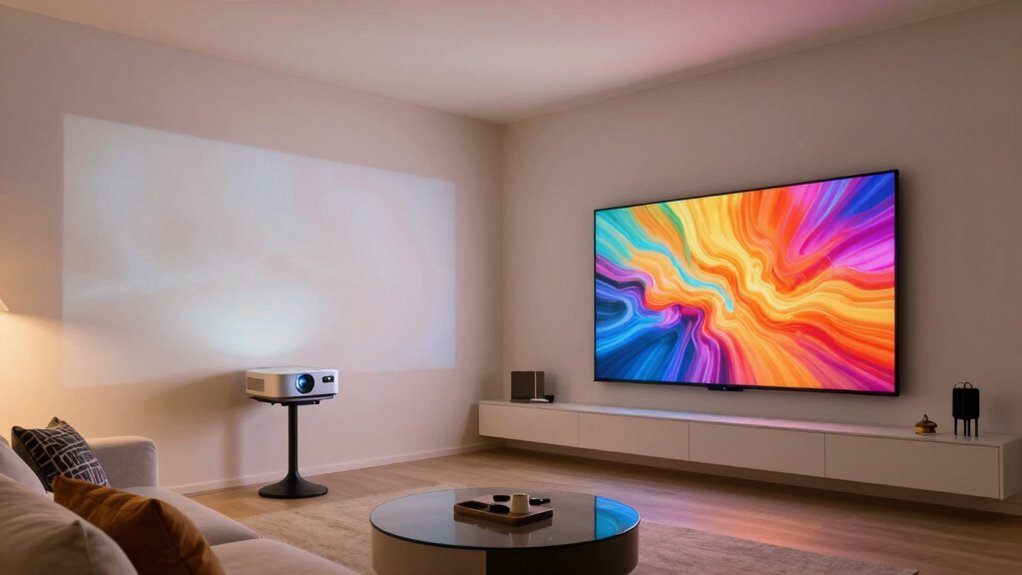
When choosing between a projector and a TV for your living room, understanding their differences can help you make the best decision for your space and viewing preferences. One of the most noticeable differences is screen size. Projectors can deliver a much larger image, often exceeding 100 inches diagonally, making them ideal if you want a cinema-like experience. TVs, on the other hand, are limited by the size of their screens, typically ranging from 55 to 85 inches for most models, though larger options exist at a premium. If you have a spacious room and crave an immersive, big-screen experience, a projector might be your best bet. But if you prefer a more straightforward setup that fits comfortably in a smaller space, a TV could be more suitable.
Projectors offer larger screens for immersive experiences, while TVs are better suited for smaller, more convenient setups.
Audio quality is another critical factor to evaluate. While many projectors come with built-in speakers, their sound performance tends to be basic, often requiring an external sound system like a soundbar or home theater setup for better audio. TVs generally have better integrated speakers, providing decent sound quality that’s suitable for everyday viewing. However, if you’re serious about sound, both options can be enhanced with external audio equipment. Keep in mind that a projector’s placement might influence your audio setup, especially if you want immersive sound, whereas a TV’s built-in speakers are more conveniently integrated into your room’s layout.
The lighting environment in your living room also plays a role in your choice. Projectors perform best in darker rooms because ambient light can wash out the image, diminishing picture clarity and contrast. If your space has ample natural light or bright overhead lighting, a high-quality TV with excellent brightness capabilities might serve you better. You’ll enjoy a crisp, vibrant picture without the need to darken the room, making TVs a more flexible choice for multi-purpose living spaces. Additionally, weatherproof tool storage can be beneficial for protecting electronic equipment like projectors and TVs from environmental elements if installed outdoors or in less controlled environments.
Ease of installation and maintenance is another aspect to weigh. TVs are straightforward—simply mount or place them where you want, and you’re set. Projectors require a bit more setup, including proper placement, potential screen installation, and ensuring minimal light interference. Additionally, projectors may need bulb replacements over time, which adds to maintenance costs. Proper projector placement is essential for achieving the best image quality and uniformity in your setup. If convenience and minimal setup are priorities, a TV could be the easier option.
Ultimately, your decision hinges on your room size, lighting conditions, audio preferences, and how much effort you’re willing to put into installation and maintenance. Understanding these factors helps you choose the best device to elevate your living room experience.
best 4K projector for living room
As an affiliate, we earn on qualifying purchases.
As an affiliate, we earn on qualifying purchases.
Frequently Asked Questions
Which Option Offers Better Sound Quality?
A TV generally offers better sound quality because it has built-in speakers optimized for sound clarity, making dialogue and effects more distinct. With a projector, you rely more on external speakers since built-in ones are usually weaker. Speaker placement matters a lot; positioning quality speakers correctly around your living room enhances sound clarity, whether you choose a TV or projector. For the best experience, consider adding a dedicated sound system.
How Do Projectors Perform in Daylight?
In daylight, projectors struggle to perform well. Ambient light washes out the image, making it hard to see details clearly. The screen contrast diminishes as bright surroundings overpower the projected image, reducing vibrancy and sharpness. To get the best picture, you’ll need a darkened room or a high-brightness projector designed for daylight use. Otherwise, your viewing experience might leave you feeling disappointed when sunlight takes over.
What Is the Typical Lifespan of a Projector Bulb?
A projector bulb typically lasts between 1,500 and 3,000 hours of lamp life, depending on the model and usage. You’ll need to plan for bulb replacement once it reaches the end of its lifespan to maintain picture quality. Keep an eye on your projector’s performance and replace the bulb when it dims or shows signs of wear, ensuring you enjoy clear images without interruptions.
Can a Projector Be Used Outdoors Effectively?
Yes, you can use a projector outdoors effectively if it has adequate outdoor brightness and screen durability. Choose a projector with high lumens to combat ambient light, ensuring a clear image. Also, use a weather-resistant screen or a portable, protective cover to prevent damage from the elements. Proper setup and timing, like during dusk or night, enhance your outdoor viewing experience, making it as enjoyable as indoor entertainment.
Which Setup Is More Energy-Efficient?
You’ll find that TVs are generally more energy-efficient than projectors, consuming about 2-3 times less power on average. With energy consumption playing a key role, a modern LED TV offers better power efficiency, saving you money on electricity bills. While projectors can have higher power consumption due to brighter bulbs, they’re often preferred for larger displays. Overall, if you prioritize energy efficiency, a TV is the smarter choice.
As an affiliate, we earn on qualifying purchases.
Conclusion
Ultimately, choosing between a projector and a TV for your living room is like picking between a cozy campfire and a bright city street. Both offer unique experiences, but it depends on your space, budget, and viewing habits. If you want a cinematic feel that transforms your room into a private theater, a projector might be your perfect match. Whatever you choose, make sure it feels just right—like a warm hug after a long day.
As an affiliate, we earn on qualifying purchases.
As an affiliate, we earn on qualifying purchases.
Halloween Picks
halloween
As an affiliate, we earn on qualifying purchases.