
If you’re looking for the best wide-field lenses for Milky Way shots in 2025, I recommend the AstrHori 6mm F2.8 for its stunning 220° circular images, the compact Sony E 16mm F2.8 for portability and sharpness, and the VILTROX 75mm f/1.2 for incredible low-light performance. Each offers unique advantages, from ultra-wide views to excellent light gathering. Keep exploring to discover how these options can help you capture breathtaking night skies with ease.
Key Takeaways
- Ultra-wide lenses like AstrHori 6mm F2.8 provide immersive, full 220° sky coverage ideal for capturing expansive Milky Way scenes.
- Large apertures such as VILTROX 75mm f/1.2 enhance low-light performance, revealing detailed and vibrant night sky images.
- Compact, lightweight options like Sony E 16mm F2.8 offer portability and sharpness with minimal distortion, perfect for travel astrophotography.
- Balancing wide field of view with minimal distortion and high optical quality ensures natural, sharp star images.
- Compatibility, manual focus capabilities, and lens size are key factors for effective, practical Milky Way night sky photography in 2025.

AstrHori 6mm F2.8 Circular Fisheye Lens
- Ultra-Wide 220° Field of View: Creates immersive circular images for various scenes
- F2.8 Large Aperture: Excellent low-light performance and background separation
- True Circular Fisheye Effect: Produces iconic spherical images with dramatic distortion
As an affiliate, we earn on qualifying purchases.
AstrHori 6mm F2.8 Circular Fisheye Lens for Nikon Z Mount

If you’re serious about capturing the Milky Way with an immersive, panoramic view, the AstrHori 6mm F2.8 Circular Fisheye Lens for Nikon Z Mount is an excellent choice. Its 220° ultra-wide perspective produces complete circular images, delivering bold, spherical effects that truly showcase the night sky. Perfect for astrophotography, it excels in low-light conditions thanks to its large F2.8 aperture, ensuring sharpness and clarity even in challenging lighting. Its durable all-metal build makes it travel-friendly, and manual focus allows precise control. Whether you’re photographing the Milky Way or creating artistic content, this lens offers unique, dramatic visuals that stand out.
Best For: astrophotographers, landscape and cityscape enthusiasts, and creative content creators seeking immersive, spherical images in low-light or night sky scenes.
Pros:
- Captures a 220° ultra-wide, full-frame perspective for dramatic visuals
- Excellent low-light performance with a large F2.8 aperture for sharp, clear images in dark conditions
- Durable all-metal construction combined with a compact, travel-friendly design
Cons:
- Manual focus requires precise adjustments and may be less convenient for quick shots
- Only compatible with Nikon Z full-frame mirrorless cameras, limiting versatility with other systems
- Produces significant edge distortion, which may require post-processing for certain applications

Sony E 16mm F2.8 Wide-Angle Prime Lens (SEL16F28) | Compact Pancake Design, Lightweight Travel |Filter Kit, Cap Keeper, Cleaning Kit, and More
- Authorized Sony USA Product: Includes filter kit and accessories
- Ultra-Compact Wide-Angle Lens: Measures 22.5mm, weighs 67g
- Ideal for Travel and Street Photography: Fits APS-C E-mount cameras, 24mm equivalent
As an affiliate, we earn on qualifying purchases.
Sony E 16mm F2.8 Wide-Angle Prime Lens (SEL16F28)
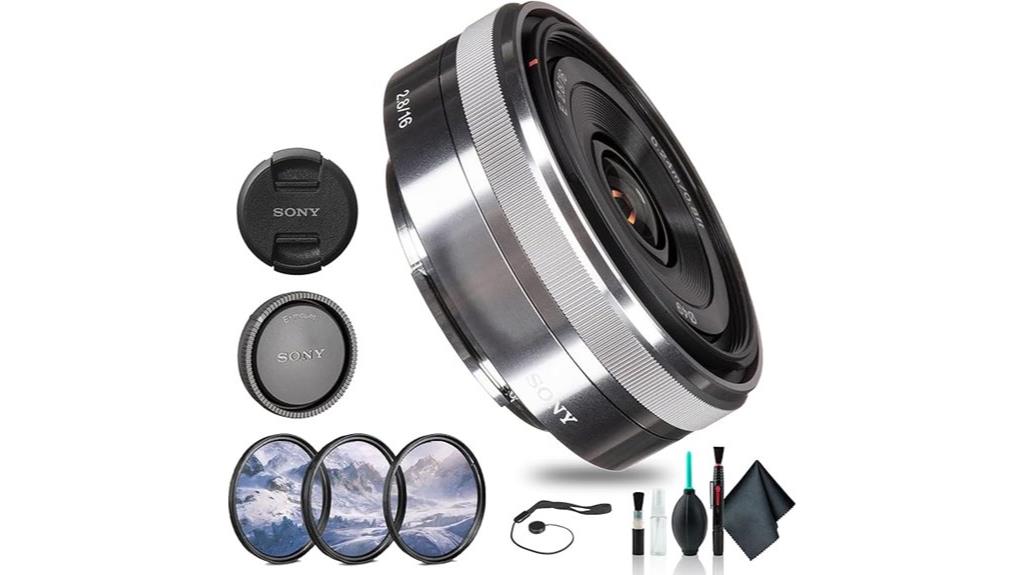
The Sony E 16mm F2.8 Wide-Angle Prime Lens is an excellent choice for astrophotographers who prioritize portability without sacrificing image quality. Weighing only 67 grams and measuring just 22.5 mm long, it’s incredibly travel-friendly and easy to carry. Its pancake design makes it perfect for capturing wide-angle shots of the Milky Way, and compatibility with conversion lenses adds creative flexibility. Despite its size, it delivers sharp images with minimal distortion, thanks to aspherical elements. The responsive autofocus and close focusing distance of 0.24 meters make it versatile for both wide shots and close-ups, making it a valuable addition to any night sky photography kit.
Best For: travel enthusiasts, street photographers, and astrophotographers seeking a compact, lightweight lens that delivers sharp wide-angle images and creative versatility.
Pros:
- Ultra-compact and lightweight design for easy portability and travel convenience
- High-quality optics with minimal distortion and spherical aberrations
- Responsive autofocus and close focusing distance ideal for creative wide-angle shots and astrophotography
Cons:
- Fixed focal length limits versatility compared to zoom lenses
- No optical image stabilization, which may affect handheld shooting in low light
- Limited aperture range (f/2.8) may require higher ISO settings in challenging lighting conditions

VILTROX 75mm f/1.2 F1.2 EF PRO EF Lens for Sony E-Mount Ultra Wide Angle APS-C Auto Focus Prime Lens Compatible with Sony E-Mount Mirrorless Cameras A7M/R/S Series A7Cc A9 A1 A6x00 Fs5
- Large F/1.2 Aperture: Ideal for low-light conditions
- Fast, Precise Autofocus: Includes eye, face, and animal modes
- High-Resolution Image Quality: 16 elements in 11 groups for sharp images
As an affiliate, we earn on qualifying purchases.
VILTROX 75mm f/1.2 EF Lens for Sony E-Mount Cameras
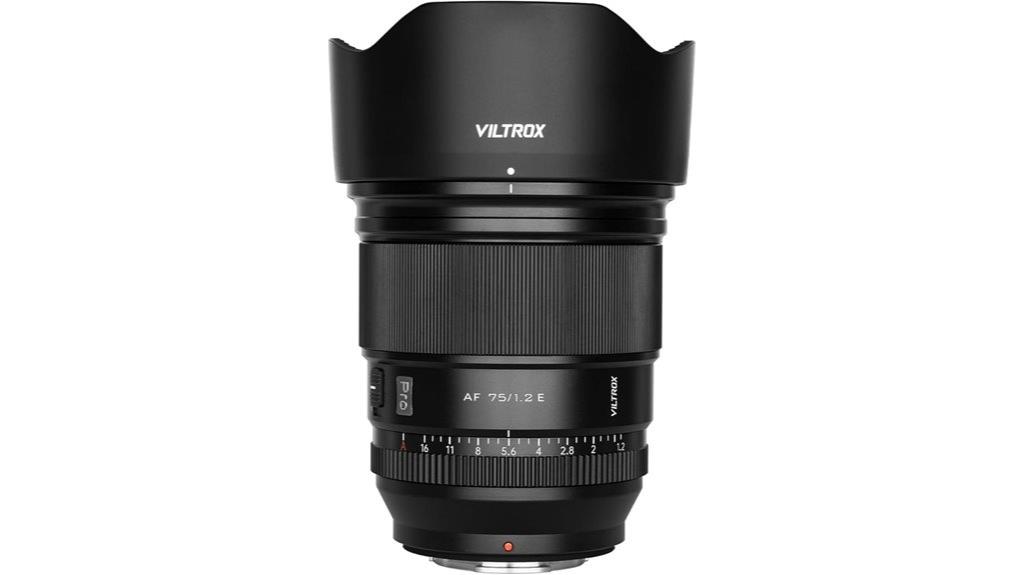
Photographers seeking exceptional low-light performance will find the VILTROX 75mm f/1.2 EF lens an excellent choice, especially for capturing the Milky Way. Its ultra-large f/1.2 aperture lets in maximum light, enabling sharp, detailed images even in dark skies. Designed for Sony E-mount cameras, it offers fast autofocus with an advanced STM motor, supporting eye, face, and animal tracking. The optical design includes 16 elements in 11 groups, ensuring high resolution and minimal aberrations. Ideal for both stills and video, this lens combines versatility and high performance, making it a powerful tool for night sky photography.
Best For: photography enthusiasts and professionals seeking exceptional low-light and portrait capabilities with versatile autofocus for both stills and video.
Pros:
- Ultra-large f/1.2 aperture delivers excellent low-light performance and beautiful background blur
- Fast, precise autofocus with eye, face, and animal tracking features
- High-quality optical design with 16 elements in 11 groups ensures sharp, detailed images
Cons:
- Heavier and potentially bulkier compared to smaller prime lenses
- Higher price point may be a consideration for budget-conscious users
- Limited compatibility outside Sony E-mount systems
Factors to Consider When Choosing Wide-Field Lenses for Milky Way Photography

When choosing a wide-field lens for Milky Way photography, I consider factors like field of view, aperture size, and low-light performance to guarantee sharp, bright images. Controlling distortion and balancing size and portability are also important for practical shooting. These points help me find a lens that performs well in dark sky conditions while being easy to carry.
Field of View
Choosing the right wide-field lens means paying close attention to its field of view, which determines how much of the night sky and Milky Way you’ll capture in a single shot. A wider field of view allows you to include more sky, enhancing the sense of scale and immersion. Ultra-wide lenses, typically between 8mm and 20mm, are ideal for astrophotography because they cover a broad perspective. The field of view is measured in degrees; larger degrees mean wider coverage, with fisheye lenses reaching up to 220°, creating a panoramic effect. Keep in mind, wider angles can introduce distortion at the edges, adding drama but sometimes requiring correction. Your choice depends on whether you want a sweeping sky view or a more focused composition that balances sky and landscape.
Aperture Size
A larger aperture, indicated by a smaller f-number, is essential for capturing the faint details of the Milky Way in low-light conditions. It allows more light to reach the sensor, which is vital for night sky photography. I recommend lenses with an aperture of f/2.8 or wider—like f/2.0 or f/1.4—to maximize light intake and reduce exposure times. Wider apertures also help achieve better background separation and sharper images by minimizing diffraction and aberrations. Smaller apertures, with higher f-numbers, let in less light, making them less suitable for dark conditions. Additionally, choosing a lens with a large aperture enables faster shutter speeds, which helps prevent star trailing and motion blur during long exposures. Overall, aperture size is a key factor in capturing clear, detailed night sky images.
Low-Light Performance
To excel in low-light conditions, selecting a wide-field lens with excellent optical design is essential. A large aperture, like f/2.8 or wider, allows more light to reach the sensor, making it easier to capture faint stars and the Milky Way. The lens’s optical quality also matters; well-designed lenses minimize internal reflections and flare, ensuring the night sky remains clear and detailed. Fast apertures enable shorter exposure times, reducing star trails caused by Earth’s rotation. Additionally, high-quality lenses with minimal chromatic and spherical aberrations keep the faint details sharp and vibrant. Manual focus capability is vital since autofocus can struggle in darkness. Overall, choosing a lens optimized for low-light performance helps you get brighter, clearer, and more detailed astrophotos.
Distortion Control
Since wide-field lenses cover large portions of the sky, controlling distortion becomes essential to prevent stars from appearing warped or misshapen. High-quality lenses with low distortion produce more natural, consistent images of the night sky, making editing easier later. Some lenses naturally introduce barrel distortion, which can be minimized through advanced optical design or software correction. Proper distortion control also ensures that straight lines, like the horizon, stay straight, preserving the scene’s realism. Balancing a wide field of view with minimal distortion is key to capturing expansive Milky Way scenes without sacrificing image integrity. By choosing lenses that manage distortion effectively, I can achieve sharp, true-to-life star images and maintain the overall accuracy of my astrophotography.
Size and Portability
When selecting a wide-field lens for Milky Way photography, size and portability often influence my choice just as much as optical quality. Compact, lightweight lenses are much easier to carry and set up in remote outdoor locations, saving time and effort during night shoots. Smaller lenses reduce the overall gear load, which is ideal for extended sessions or travel adventures. They also tend to have simplified designs, allowing for quick adjustments and minimal setup, so I can focus more on capturing the night sky. Additionally, travel-friendly lenses with a small form factor are less conspicuous, making spontaneous shots more convenient. However, I also consider how size impacts stability, as larger lenses can be more vibration-sensitive, affecting image sharpness.
Compatibility and Mount
Choosing a wide-field lens for Milky Way photography begins with guaranteeing it’s compatible with your camera’s mount. You need to check that the lens mount matches your camera system, whether it’s Nikon Z, Sony E-mount, or another. Full-frame sensors are perfect for capturing wide, detailed night skies, so verify the lens’s compatibility with full-frame bodies. Consider whether the lens offers manual or autofocus, depending on your shooting style; manual focus often works better in low light. Also, guarantee the aperture is wide enough, ideally at F2.8 or wider, for excellent low-light performance. Lastly, see if you need any adapters or converters to fit the lens to your camera. Proper compatibility ensures seamless operation and better astrophotography results.
Frequently Asked Questions
How Do Lens Aperture Sizes Affect Milky Way Astrophotography?
Aperture size directly impacts my ability to capture the Milky Way clearly. A wider aperture, like f/2.8 or lower, lets in more light, making stars brighter and reducing exposure time. This helps me avoid star trails and captures sharper, more detailed night skies. Smaller apertures require longer exposures, increasing the risk of movement. So, I always look for lenses with large apertures for stunning astrophotography.
What Is the Ideal Focal Length for Capturing the Milky Way?
I find that an ideal focal length for capturing the Milky Way is between 14mm and 24mm. This range lets me get a wide, stunning view of the night sky while maintaining sharpness and minimizing distortion. With a wide lens, I can include more of the galaxy in my shot without sacrificing detail. It’s perfect for creating breathtaking, immersive astrophotography images that truly showcase the night sky’s beauty.
How Important Is Lens Distortion Correction for Wide-Field Shots?
Think of lens distortion correction as the compass guiding your night sky adventure. It’s pretty important because it keeps stars sharp and true, preventing them from stretching or warping into strange shapes. Without it, your stunning Milky Way shots can look off, like a world turned upside down. Correcting distortion makes your images more natural and immersive, helping you truly capture the awe of the cosmos.
Can Filters Improve Milky Way Images With These Lenses?
Yes, filters can definitely improve your Milky Way images with wide-field lenses. I often use light pollution filters to cut down on unwanted glow and enhance the stars’ clarity. Additionally, ND and UV filters can protect your lens and help manage exposure. I recommend experimenting with different filters to see how they impact your shots, especially in areas with light pollution or when aiming for more vivid night sky details.
Are There Any Low-Light Performance Differences Between These Lenses?
Did you know that some lenses transmit up to 25% more light than others? When it comes to low-light performance, I’ve noticed differences between these lenses. Cheaper models often struggle with sharpness and increased chromatic aberration in dark conditions, while premium lenses excel with wider apertures and better glass elements. For capturing the Milky Way, I recommend investing in lenses with wide apertures like f/2.8 or faster for ideal results.
Conclusion
Choosing the right wide-field lens is like finding the perfect window to the night sky—each one offers a unique view. Whether you prefer the immersive fisheye, sharp wide-angle, or bright telephoto, these lenses unveil stunning Milky Way shots. Trust me, with the right gear, capturing breathtaking night skies becomes as effortless as catching fireflies on a summer evening. So, pick your lens and let the stars tell their story!