For a dependable home alert, I’d start with the Midland WR120B, whose dedicated weather-alert role sets it apart from the lineup’s many charging-focused radios. The Kaito KA500RED stands out for its range of power options, while the 12,000mAh hand-crank and solar models suit people who want more backup capacity for phones and lights. The main tradeoff is between a radio built to receive alerts reliably and a multipurpose unit built to keep working when power is scarce. I’d also weigh battery type, alert setup, and how much maintenance you’re willing to do. Read on for the full comparison and recommendations by need.

Get everyday essentials delivered free with Prime
- Fast, free delivery on millions of items
- Prime Video, Amazon Music and more included
- Member-only deals all year
Key Takeaways
- The Midland WR120B is the clearest alert-first choice: it has a dedicated NOAA alert role, while many rivals emphasize charging and lighting features.
- The Kaito KA500RED offers the broadest power flexibility: its multiple power methods make it a strong fit when backup sources matter more than a large built-in battery.
- Several radios list 10,000mAh or 12,000mAh batteries: those capacities can support charging needs, but battery size alone does not tell you how well a radio receives or signals an alert.
- Simple portable models fill a different job: the PRUNUS J161 and Midland WR120B make more sense for straightforward listening or alerts than feature-heavy emergency kits.
- Hand cranks, solar panels, and sirens add resilience with limits: they can help during an outage, but their usefulness depends on exposure, effort, and whether the radio is ready before a storm.
| WVL Emergency Weather Radio with Solar Charging, Hand Crank, Flashlight, Reading Lamp, Phone Charger, and SOS Siren |  | Best Compact Pick | Radio bands: AM, FM, and NOAA weather | Power sources: Hand crank, solar panel, and built-in rechargeable Li-ion battery | Battery capacity: 7400mWh | VIEW LATEST PRICE | See Our Full Breakdown |
| Kaito KA500RED 5-Way Powered Emergency AM/FM/SW Weather Alert Radio |  | Best for Broader Radio Coverage | Model: KA500RED | Radio bands: AM, FM, shortwave, and 7-band weather | Power: Solar powered with built-in batteries | VIEW LATEST PRICE | See Our Full Breakdown |
| NOAA Weather AM/FM Portable Radio with AC Adapter and 3 D-Cell Battery Power |  | Best for Simple Home Listening | Radio bands: AM, FM, and NOAA weather | Frequency range: Weather: 162.40–162.55 MHz; FM: 87–108 MHz; AM: 520–1710 kHz | Power: 3 D-cell batteries (not included) or AC power cord | VIEW LATEST PRICE | See Our Full Breakdown |
| NOAA Weather Radio with 12,000mAh Battery, Hand Crank and Solar Charging | 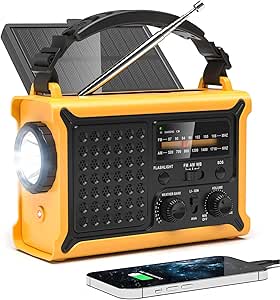 | Best for High-Capacity Backup | Battery capacity: 12,000mAh | Radio bands: AM, FM, and 7 NOAA weather channels | Power options: USB-C, solar, hand crank, or 3 AAA batteries | VIEW LATEST PRICE | See Our Full Breakdown |
| Emergency Weather Radio with Solar Panel and 12,000 mAh Battery | 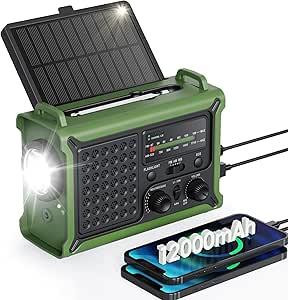 | Best Weather-Resistant Pick | Battery capacity: 12,000mAh | Radio bands: AM/FM and 7 NOAA bands | Charging methods: Built-in battery, USB-C, solar panel, hand crank, or AAA batteries | VIEW LATEST PRICE | See Our Full Breakdown |
| Emergency Radio with Hand Crank, Solar Charging, NOAA Weather Band, AM/FM, and 12,000mAh Battery |  | Best for Long Power Outages | Battery capacity: 12,000mAh | Radio bands: NOAA weather, AM/FM | Charging options: Solar, hand crank, USB-C | VIEW LATEST PRICE | See Our Full Breakdown |
| Raynic Emergency Weather Radio with 5000mAh Battery, Solar Charging, and Hand Crank |  | Best for Automatic Alerts | Battery capacity: 5,000mAh / 18,500mWh | Radio bands: AM, FM, SW, NOAA | Charging options: Rechargeable battery, AC adapter, USB, hand crank, solar panel, 3 AAA batteries (not included) | VIEW LATEST PRICE | See Our Full Breakdown |
| Leaton Hand Crank Emergency Radio with NOAA, AM/FM, and 10,000mAh Battery |  | Best Compact High-Capacity Pick | Battery capacity: 10,000mAh | Radio bands: AM 520–1710kHz, FM 87–108MHz, NOAA 162.400–162.550MHz | Charging methods: USB-C, solar, hand crank | VIEW LATEST PRICE | See Our Full Breakdown |
| Midland WR120B NOAA Emergency Weather Alert Radio |  | Best for Home Alert Monitoring | Model: WR120B | Radio bands: 1-band | Frequency: 108 MHz (as listed) | VIEW LATEST PRICE | See Our Full Breakdown |
| RunningSnail Hand Crank Emergency Radio with Flashlight |  | Best Lightweight Backup | Battery capacity: 2,000mAh (7,400mWh) | Radio bands: AM/FM/NOAA | Power sources: Hand crank, solar panel, rechargeable battery | VIEW LATEST PRICE | See Our Full Breakdown |
| Esky Emergency Hand Crank Weather Radio with 2000mAh Battery and LED Flashlight |  | Best Compact All-in-One | Radio bands: AM/FM/WB | Battery capacity: 2000mAh | Charging methods: USB-C, solar panel, hand crank | VIEW LATEST PRICE | See Our Full Breakdown |
| FosPower A1 NOAA Emergency Weather Radio with Solar and Hand Crank |  | Best for Power-Outage Lighting | Radio bands: AM/FM/NOAA weather | Power sources: Solar, hand crank, power bank, 4 AAA batteries | Power bank capacity: 7400 mWh (2000 mAh) | VIEW LATEST PRICE | See Our Full Breakdown |
| Portable NOAA AM/FM Weather Radio with 12,000 mAh Battery |  | Best for Extended Outages | Radio bands: NOAA, FM, AM | Battery capacity: 12,000 mAh lithium battery | Charging options: Solar panel, hand crank, USB-C input (5V/2A) | VIEW LATEST PRICE | See Our Full Breakdown |
| PRUNUS J161 Portable NOAA Weather Radio with AM/FM Tuner |  | Best Simple Battery-Powered Pick | Weather band: 162.40–162.55 MHz (7 NOAA bands) | FM range: 87–108 MHz | AM range: 520–1710 kHz | VIEW LATEST PRICE | See Our Full Breakdown |
| NITIGO Emergency Weather Radio with 10,000 mAh Battery |  | Best for Flexible Emergency Power | Battery capacity: 10,000 mAh | Tuner: AM/FM/WB/NOAA | Power sources: Rechargeable battery, hand crank, solar charging, USB | VIEW LATEST PRICE | See Our Full Breakdown |
| weather radios for emergencie | Radio bands | Dimensions | Battery capacity | Water resistance |
|---|---|---|---|---|
| WVL Emergency Weather Radio wi | AM, FM, and NOAA weather | 5.9 × 3.07 × 2.4 in (130 × 50 × 60 mm) | 7400mWh | — |
| Kaito KA500RED 5-Way Powered E | AM, FM, shortwave, and 7-band weather | 8 × 2.5 × 5 in | — | Water resistant; rating not specified |
| NOAA Weather AM/FM Portable Ra | AM, FM, and NOAA weather | — | — | Not water resistant |
| NOAA Weather Radio with 12,000 | AM, FM, and 7 NOAA weather channels | 4.7 × 2.9 × 6.8 in | 12,000mAh | — |
| Emergency Weather Radio with S | AM/FM and 7 NOAA bands | — | 12,000mAh | IPX6 waterproof |
| Emergency Radio with Hand Cran | NOAA weather, AM/FM | 6.81 × 2.91 × 4.76 in | 12,000mAh | IPX6 |
| Raynic Emergency Weather Radio | AM, FM, SW, NOAA | 6.8 × 3.7 × 2.9 in | 5,000mAh / 18,500mWh | IPX3 |
| Leaton Hand Crank Emergency Ra | AM 520–1710kHz, FM 87–108MHz, NOAA 162.400–162.550MHz | 6.3 × 3.5 × 3.1 in | 10,000mAh | IPX6 |
| Midland WR120B NOAA Emergency | 1-band | 2 × 5.3 × 6.1 in | — | — |
| RunningSnail Hand Crank Emerge | AM/FM/NOAA | 5 × 1.8 × 2.4 inches | 2,000mAh (7,400mWh) | Water repellent |
| Esky Emergency Hand Crank Weat | AM/FM/WB | 5 × 1.8 × 2.4 inches | 2000mAh | — |
| FosPower A1 NOAA Emergency Wea | AM/FM/NOAA weather | — | — | Water resistant |
| Portable NOAA AM/FM Weather Ra | NOAA, FM, AM | 6.8 × 2.9 × 4.7 inches | 12,000 mAh lithium battery | Water resistant |
| PRUNUS J161 Portable NOAA Weat | — | 4.7 × 2.8 × 1.2 inches | — | — |
| NITIGO Emergency Weather Radio | — | — | 10,000 mAh | Water resistant |
More Details on Our Top Picks
WVL Emergency Weather Radio with Solar Charging, Hand Crank, Flashlight, Reading Lamp, Phone Charger, and SOS Siren
For a small emergency kit, the WVL combines AM/FM/NOAA reception with hand-crank, solar, and rechargeable battery power in a 231 g body. Its flashlight, motion-sensor reading lamp, and SOS siren give it more utility during a blackout than a basic radio. Compared with the larger Kaito KA500RED, it is easier to pack and adds a reading light, but the Kaito receives shortwave and has broader radio-band coverage. The WVL’s 2000mAh phone charger is best treated as a limited backup for a small top-up, not a way to restore a drained phone. The supplied data also gives no reception or runtime results, so buyers who need dependable alert monitoring should weigh that uncertainty carefully.
Pros:- Hand-crank, solar, and rechargeable battery power provide several ways to keep it running.
- Compact 231 g design is easy to store or carry.
- Combines a flashlight, motion-sensor reading lamp, and SOS siren.
- Receives AM, FM, and NOAA weather broadcasts.
Cons:- The 2000mAh phone charging capacity is limited.
- No reception or runtime results are provided.
- No water resistance is specified.
Best for: People building a lightweight home or camping emergency kit who want a radio, basic lighting, and a way to send a brief SOS.
Not ideal for: Buyers who need substantial phone charging or documented reception and runtime performance.
- Radio bands:AM, FM, and NOAA weather
- Power sources:Hand crank, solar panel, and built-in rechargeable Li-ion battery
- Battery capacity:7400mWh
- Phone charger capacity:2000mAh
- Lighting:1.5W LED flashlight and motion-sensor reading lamp
- SOS:SOS siren
- Dimensions:5.9 × 3.07 × 2.4 in (130 × 50 × 60 mm)
- Weight:231 g
Our verdict“Choose the WVL for a compact, multi-function kit radio if modest phone backup is enough.”
Kaito KA500RED 5-Way Powered Emergency AM/FM/SW Weather Alert Radio
The Kaito KA500RED suits listeners who want more than local weather and broadcast stations: it also receives shortwave, while its seven-band weather coverage and alert feature add emergency-specific utility. That broader tuning gives it an edge over the WVL Emergency Weather Radio, which is lighter and includes a reading lamp but lists only AM, FM, and NOAA bands. Solar power and a built-in battery offer useful options when household power is unavailable, and the flashlight adds basic illumination. The tradeoff is a 1.5 lb plastic body that is less convenient to carry than the WVL, plus unclear frequency and voltage details that may complicate setup. Its water-resistant description is helpful, but no protection rating is provided.
Pros:- Receives AM, FM, shortwave, and seven-band weather broadcasts.
- Includes a weather alert feature.
- Solar power can operate the radio and charge its built-in batteries.
- Water resistance is listed.
Cons:- At 1.5 lb, it is heavier than the compact WVL.
- Frequency and voltage details may be unclear for tuning.
- Plastic enclosure and unspecified water-resistance rating leave durability details uncertain.
Best for: Emergency-kit owners who want weather alerts plus shortwave listening and are comfortable setting up a multi-band radio.
Not ideal for: Buyers prioritizing a very light kit, precise tuning documentation, or a specified water-resistance rating.
- Model:KA500RED
- Radio bands:AM, FM, shortwave, and 7-band weather
- Power:Solar powered with built-in batteries
- Connectivity:USB
- Display:LED
- Water resistance:Water resistant; rating not specified
- Dimensions:8 × 2.5 × 5 in
- Weight:1.5 lb
Our verdict“Pick the Kaito if shortwave and wide weather-band coverage matter more than low carry weight.”
NOAA Weather AM/FM Portable Radio with AC Adapter and 3 D-Cell Battery Power
This radio is a straightforward choice for someone who wants to tune into NOAA, AM, or FM broadcasts at home without relying on a rechargeable emergency-radio design. Its AC power cord and three D-cell option make it easy to use from an outlet and keep running during an outage if batteries are on hand. The stated battery-life estimate—up to about 36 days at two hours of listening daily—also gives buyers a concrete planning reference. Unlike the Kaito KA500RED, it has no weather alert feature, so it will not automatically notify you of an approaching warning. Its analog display and simple controls may appeal to listeners who prefer direct tuning, but the radio is not water resistant and lacks the hand-crank or solar backup found on several other picks.
Pros:- Runs from an AC power cord or three D-cell batteries.
- Receives AM, FM, and NOAA weather broadcasts.
- 3W speaker, carrying handle, and headphone jack support flexible listening.
- Provides a stated battery-life estimate for planning.
Cons:- Does not automatically notify users of NOAA alerts.
- D-cell batteries are not included.
- Not water resistant and has no solar or hand-crank power.
Best for: Households seeking a simple indoor radio with AC operation and the option to use replaceable D-cell batteries during outages.
Not ideal for: People who need automatic NOAA alert notifications, weather protection, or solar and hand-crank charging.
- Radio bands:AM, FM, and NOAA weather
- Frequency range:Weather: 162.40–162.55 MHz; FM: 87–108 MHz; AM: 520–1710 kHz
- Power:3 D-cell batteries (not included) or AC power cord
- Battery life:Up to about 36 days at 2 hours of listening per day
- Speaker output:3 W
- Headphone jack:3.5 mm
- Display:Analog
- Water resistance:Not water resistant
Our verdict“Choose this model for simple home weather listening with AC and D-cell options, but skip it if you need automatic alerts.”
NOAA Weather Radio with 12,000mAh Battery, Hand Crank and Solar Charging
Among these picks, this radio puts the strongest emphasis on stored power: its 12,000mAh battery is backed by USB-C, solar, hand-crank, and three AAA battery options. That combination makes it a more substantial backup hub than the WVL Emergency Weather Radio, whose listed battery is smaller and whose phone charging capacity is only 2000mAh. A 5W speaker, flashlight, reading light, and SOS siren extend its usefulness when the power is out. For weather alerts, though, the radio must be on and tuned to the weather band; it is not a set-and-forget alert monitor. The included USB-C cable helps, but the absent wall adapter means buyers need a compatible source for initial charging.
Pros:- 12,000mAh battery plus USB-C, solar, hand-crank, and AAA power options.
- Receives AM, FM, and seven NOAA weather channels.
- Includes a 300-lumen flashlight, reading light, and SOS siren.
- Maximum speaker output is 5 watts.
Cons:- NOAA alerts require the radio to be on and tuned to the weather band.
- Wall adapter is not included.
- Larger body may be less convenient to pack than the WVL.
Best for: Households wanting a high-capacity emergency radio with several backup power methods and lighting for an extended outage.
Not ideal for: People who need automatic alert monitoring while the radio is off, or buyers without access to a compatible USB-C wall adapter.
- Battery capacity:12,000mAh
- Radio bands:AM, FM, and 7 NOAA weather channels
- Power options:USB-C, solar, hand crank, or 3 AAA batteries
- Flashlight:300 lumens; range up to 70 m
- Reading light:250 lumens
- SOS siren:115 dB
- Maximum speaker output:5 watts
- Dimensions:4.7 × 2.9 × 6.8 in
Our verdict“Pick this model for versatile, high-capacity outage power if you can keep it tuned to the weather channel for alerts.”
Emergency Weather Radio with Solar Panel and 12,000 mAh Battery
The standout here is its IPX6 waterproof rating, which gives this radio a clearer case for wet-weather use than the NOAA Weather Radio with 12,000mAh Battery, whose supplied specs do not list water resistance. The B0F4XKLQDK also covers practical outage needs with AM/FM and seven NOAA bands, a 12,000mAh battery, and USB-C, solar, hand-crank, or AAA power. Its flashlight, reading lamp, SOS alarm, and phone charging add useful backup functions. That versatility comes with a tradeoff: the available description does not specify alert behavior, so buyers should not assume it will notify them while switched off or tuned elsewhere. The three AAA batteries are required only for that power option, but they are another supply to keep on hand.
Pros:- IPX6 waterproof rating suits use around rain and splashing.
- 12,000mAh battery with USB-C, solar, hand-crank, and AAA charging options.
- Receives AM/FM and seven NOAA bands.
- Includes adjustable-beam flashlight, reading lamp, SOS alarm, and phone charging.
Cons:- Alert behavior while the radio is off or on another band is not specified.
- Three AAA batteries are needed for the AAA power option.
- No runtime or reception results are provided.
Best for: Campers and households in wet-weather areas who want a weather-resistant radio with several power options and emergency lighting.
Not ideal for: Buyers who need clearly documented automatic alert behavior or do not want to maintain separate AAA batteries.
- Battery capacity:12,000mAh
- Radio bands:AM/FM and 7 NOAA bands
- Charging methods:Built-in battery, USB-C, solar panel, hand crank, or AAA batteries
- Solar panel:8500 mm² monocrystalline
- Lighting:5W adjustable-beam flashlight and 12-LED reading lamp
- Water resistance:IPX6 waterproof
- Connectivity:USB
- Batteries required:3 AAA batteries
Our verdict“Choose this radio for wet-weather preparedness and multiple backup power choices, provided its alert behavior fits your needs.”
Emergency Radio with Hand Crank, Solar Charging, NOAA Weather Band, AM/FM, and 12,000mAh Battery
For a household that wants a weather radio to do more than receive alerts, this model pairs 12,000mAh of battery capacity with solar, hand-crank, and USB-C charging. That gives it more staying power and charging flexibility than the smaller RunningSnail radio, whose 2,000mAh battery is better treated as a limited backup. The NOAA, AM, and FM bands cover weather broadcasts and general radio listening, while the flashlight, reading lamp, and phone-charging output add practical uses during a blackout. Its IPX6 water resistance suits wet outdoor conditions better than the Raynic’s IPX3 rating. The tradeoff is that NOAA broadcasts require the radio to be on and tuned manually, so it will not provide the automatic alert scanning offered by Raynic. At 1.6 pounds, it is also less appealing for a minimal go-bag.
Pros:- 12,000mAh battery and three charging methods provide flexible backup power
- IPX6 water resistance suits exposure to spray and heavy splashes
- Flashlight, reading lamp, and SOS alarm serve distinct emergency needs
- USB output can provide backup charging for a phone
Cons:- NOAA broadcasts require manual tuning; automatic alert scanning is not specified
- At 1.6 pounds, it is heavier than the compact RunningSnail
- Solar charging depends on available sunlight
Best for: Households preparing for multi-day outages who want a high-capacity radio that can also support lighting and emergency phone charging
Not ideal for: Hikers prioritizing a light pack or buyers who need automatic NOAA alert scanning while the radio is unattended
- Battery capacity:12,000mAh
- Radio bands:NOAA weather, AM/FM
- Charging options:Solar, hand crank, USB-C
- Water resistance:IPX6
- Flashlight:5W
- SOS alarm:120dB
- Dimensions:6.81 × 2.91 × 4.76 in
- Weight:1.6 lb
Our verdict“Choose this model for a home emergency kit where battery capacity, multiple charging options, and water resistance matter more than compact size or automatic alerts.”
Raynic Emergency Weather Radio with 5000mAh Battery, Solar Charging, and Hand Crank
Among the portable picks here, Raynic is the clearest choice for someone who wants the radio to watch for weather alerts: it offers automatic NOAA alert scanning and an LCD display. That changes the role of the radio from a receiver you must remember to tune, as with the Leaton, to a more convenient alert station for a home or campsite. Its six listed power options—including AC, USB, hand crank, solar, rechargeable battery, and three AAA cells—also give it unusual flexibility when one source is unavailable. The 5,000mAh battery is smaller than the 12,000mAh unit in the first product, so it is less suited to extended phone charging. Its IPX3 rating offers only limited water protection, and the AAA option requires batteries that are not included. It is a capable alert-focused compromise, not the toughest or highest-capacity choice.
Pros:- Automatically scans for NOAA weather and emergency alerts
- Six listed charging options include AC adapter and optional AAA battery power
- LCD display and headphone jack support convenient monitoring and private listening
- Includes a flashlight, reading lamp, and SOS alarm
Cons:- IPX3 water resistance offers limited protection from water
- 5,000mAh capacity is below the 12,000mAh radio in this lineup
- Three AAA batteries for one power option are not included
Best for: Campers and households who want NOAA alerts scanned automatically and value several backup power options
Not ideal for: Buyers expecting strong rain protection or substantial phone charging during a long outage
- Battery capacity:5,000mAh / 18,500mWh
- Radio bands:AM, FM, SW, NOAA
- Charging options:Rechargeable battery, AC adapter, USB, hand crank, solar panel, 3 AAA batteries (not included)
- Display:LCD
- Water resistance:IPX3
- Connectivity:USB Type-C, 3.5 mm headphone jack
- Dimensions:6.8 × 3.7 × 2.9 in
- Weight:1.2 lb
Our verdict“Pick Raynic if automatic NOAA scanning and flexible power sources outweigh the need for high battery capacity or stronger water protection.”
Leaton Hand Crank Emergency Radio with NOAA, AM/FM, and 10,000mAh Battery
Leaton makes a strong case for a compact emergency kit: its 10,000mAh battery and IPX6 water resistance come in a 1.1-pound body, lighter than the 12,000mAh radio earlier in this list. Solar, hand-crank, and USB-C charging cover the main off-grid scenarios, while the flashlight has high, low, and SOS modes and the built-in compass adds a basic navigation aid. These features make it better suited to someone packing for a car or outdoor kit than the larger model. The important limitation is alerting: NOAA reception requires manual tuning, and there are no automatic or location-based alerts. Raynic is a better fit for hands-off alert monitoring, and its headphone jack also serves listeners who want private audio. Leaton’s IPX6 rating addresses splashes and spray, not immersion.
Pros:- 10,000mAh battery in a 1.1-pound portable body
- USB-C, solar, and hand-crank charging support off-grid use
- IPX6 water resistance and multiple flashlight modes suit emergency-kit use
- Built-in compass adds a simple navigation reference
Cons:- NOAA broadcasts require manual tuning; automatic and location-based alerts are not supported
- No headphone jack for private listening
- IPX6 protection does not mean the radio is suitable for immersion
Best for: Drivers and campers who want a lighter emergency kit radio with substantial battery capacity and basic navigation
Not ideal for: People who need automatic, location-based alerts or want to listen through headphones
- Battery capacity:10,000mAh
- Radio bands:AM 520–1710kHz, FM 87–108MHz, NOAA 162.400–162.550MHz
- Charging methods:USB-C, solar, hand crank
- USB output:5V/1A
- Water resistance:IPX6
- NOAA alerts:Manual tuning; no automatic or location-based alerts
- Dimensions:6.3 × 3.5 × 3.1 in
- Weight:1.1 lb (500g)
Our verdict“Choose Leaton for a lighter, high-capacity kit radio if you are comfortable tuning NOAA broadcasts yourself.”
Midland WR120B NOAA Emergency Weather Alert Radio
For a fixed home location, the Midland WR120B prioritizes targeted alerts over portability and backup charging. Its NOAA Weather Scan and S.A.M.E. programming let you select up to 25 counties, helping reduce irrelevant alerts while keeping local hazards in view. The color-coded indicators and alert override give you at-a-glance information when a warning arrives. That makes it more purpose-built for household monitoring than Leaton, which offers a larger rechargeable battery and lights but requires manual tuning and has no automatic alerts. Midland runs from an AC adapter or six AAA batteries, so it can keep alerting through a power cut if you have batteries on hand. It lacks the solar, crank, and phone-charging features of the other portable radios, and its listed 1-band reception is narrower. The listed 108 MHz frequency also merits checking against the intended broadcast service before purchase.
Pros:- S.A.M.E. programming supports alerts for up to 25 selected counties
- NOAA Weather Scan and alert override support unattended alert monitoring
- Color-coded indicators help distinguish alert information at a glance
- AC adapter and six AAA batteries provide two power sources
Cons:- No solar or hand-crank charging for extended off-grid use
- Battery operation requires six AAA batteries
- Listed as a 1-band radio, with narrower reception than the AM/FM/NOAA portable models
Best for: Households that want localized NOAA alerts for selected counties from a radio kept in one place
Not ideal for: Campers or outage planners who need solar or hand-crank charging, a flashlight, or phone charging
- Model:WR120B
- Radio bands:1-band
- Frequency:108 MHz (as listed)
- Programmable counties:Up to 25
- Alert types:60+
- Power source:AC adapter or 6 AAA batteries
- Dimensions:2 × 5.3 × 6.1 in
- Weight:16 oz
- Warranty:1 year parts and labor
Our verdict“Choose the WR120B for localized, automatic home alerts if you do not need a portable radio with off-grid charging features.”
RunningSnail Hand Crank Emergency Radio with Flashlight
At 0.5 pound, RunningSnail is the easiest of these five radios to tuck into a small emergency kit or glove compartment. Its hand crank, solar panel, and rechargeable battery give it fallback power, while AM, FM, and NOAA reception cover local broadcasts and weather information. The 1W LED flashlight and USB output add useful backup functions, but the 2,000mAh battery is modest: compared with Leaton’s 10,000mAh capacity, it is a much less convincing choice for charging a phone or powering longer listening sessions. The product description does not specify automatic NOAA alert scanning, so buyers should expect to tune in for broadcasts rather than rely on it as a dedicated alert station like the Midland. Its water-repellent construction is also less clearly protective than the IPX6 radios. This is a portable backup, not a full-featured outage hub.
Pros:- Lightweight 0.5-pound design fits compact kits and glove compartments
- Hand crank, solar panel, and rechargeable battery provide three power sources
- Receives AM, FM, and NOAA broadcasts
- Built-in 1W LED flashlight and USB output add basic emergency utility
Cons:- 2,000mAh capacity offers limited backup phone charging compared with Leaton
- Water resistance is described as water repellent, without an IP rating
- Automatic NOAA alert scanning is not specified
Best for: Drivers and hikers who want a very light radio with a basic flashlight for short-term emergencies
Not ideal for: Households preparing for extended outages or buyers relying on substantial phone charging or automatic weather alerts
- Battery capacity:2,000mAh (7,400mWh)
- Radio bands:AM/FM/NOAA
- Power sources:Hand crank, solar panel, rechargeable battery
- Flashlight:1W LED
- USB output:5V
- Water resistance:Water repellent
- Dimensions:5 × 1.8 × 2.4 inches
- Weight:0.5 lb
Our verdict“Choose RunningSnail as a lightweight radio and flashlight backup for a compact kit, not as your main power source for a prolonged outage.”
Esky Emergency Hand Crank Weather Radio with 2000mAh Battery and LED Flashlight
The Esky ES-CR01 suits an emergency kit where a radio, light, and backup power need to fit in a small space. Its USB-C, solar, and hand-crank charging give you several ways to replenish the 2000mAh battery, while the SOS alarm adds a way to signal for help. At 7.55 ounces, it is easier to carry than the larger Portable NOAA AM/FM Weather Radio with 12,000 mAh Battery, but that larger radio offers substantially more battery capacity. Esky’s stated radio runtime is about nine hours per charge, so it is better for checking forecasts and short outages than continuous listening. The 140-lumen flashlight is useful in a blackout, though regular charging before storage matters if you want the battery ready when an emergency arrives.
Pros:- USB-C, solar, and hand-crank charging provide multiple ways to replenish the battery.
- Combines AM, FM, and weather-band reception with an SOS alarm and flashlight.
- At 7.55 ounces, it is light enough for a backpack or compact emergency kit.
- The flashlight is rated at 140 lumens with an approximately 20-hour runtime.
Cons:- The approximately nine-hour radio runtime may be limiting during extended outages.
- The 2000mAh battery needs regular charging while stored.
- Its battery capacity is far below that of larger emergency radios in the lineup.
Best for: People building a lightweight go-bag who want weather reception, a flashlight, and several backup charging methods in one device.
Not ideal for: Households that need long radio listening between charges or a large battery for repeated phone charging.
- Radio bands:AM/FM/WB
- Battery capacity:2000mAh
- Charging methods:USB-C, solar panel, hand crank
- Flashlight:3 LEDs, 140 lumens
- Radio runtime:Approximately 9 hours
- Flashlight runtime:Approximately 20 hours
- Dimensions:5 × 1.8 × 2.4 inches
- Weight:7.55 ounces
Our verdict“Choose the Esky if portability and multiple charging methods matter more to you than long listening time or a high-capacity backup battery.”
FosPower A1 NOAA Emergency Weather Radio with Solar and Hand Crank
The FosPower A1 is a practical pick for outages where lighting around the room matters as much as catching weather broadcasts. Alongside AM, FM, and NOAA reception, it has a flashlight and four-LED reading light, so you can illuminate a path and keep a book or work area visible. Its solar panel, hand crank, rechargeable power bank, and four AAA batteries offer useful flexibility; compared with the PRUNUS J161, it brings lights and charging options but is less compact and requires more setup. The 2000mAh power bank can provide emergency USB power, though its capacity is limited for charging devices. Water resistance adds some protection, but this is better suited to a home kit or campsite than someone prioritizing the lightest carry.
Pros:- Receives AM, FM, and NOAA weather broadcasts.
- Flashlight and four-LED reading light serve different outage tasks.
- Solar, hand-crank, power-bank, and AAA battery power options add flexibility.
- USB port can provide emergency power to a phone or small tablet.
Cons:- The 2000mAh power bank has limited capacity for charging other devices.
- Four AAA batteries are needed when the other power sources are unavailable.
- At 310 g and 6.2 inches long, it is bulkier than a basic battery-powered radio.
Best for: Households and campers who want NOAA access plus separate light sources for navigating and reading during an outage.
Not ideal for: Backpackers who need a very compact radio, or buyers counting on the radio to recharge a phone repeatedly.
- Radio bands:AM/FM/NOAA weather
- Power sources:Solar, hand crank, power bank, 4 AAA batteries
- Power bank capacity:7400 mWh (2000 mAh)
- Flashlight:1 W LED
- Reading light:4 LEDs
- Maximum speaker output:2 W
- Water resistance:Water resistant
- Dimensions and weight:6.2 × 2.1 × 2.9 inches; 310 g
Our verdict“Pick the FosPower A1 if you want a versatile outage radio with both task lighting and a reading light, and can accept modest device-charging capacity.”
Portable NOAA AM/FM Weather Radio with 12,000 mAh Battery
For readers who expect an outage to last, this radio’s 12,000mAh battery makes it the strongest capacity-focused choice in this batch. It also receives NOAA, AM, and FM broadcasts and adds USB-C, solar, hand-crank, and three AAA battery power, plus a flashlight and reading lamp. Compared with the smaller Esky ES-CR01, it is less pocketable but is better equipped for longer stretches between charges. Its 5-watt speaker gives it a higher stated output than the FosPower A1’s 2-watt speaker, though speaker output alone does not establish reception quality. The analog tuner may take more care to tune accurately than a digital tuner, and the listed instructions call for checking the battery level and fully charging it before first use.
Pros:- The 12,000mAh battery offers more capacity than the Esky and FosPower models in this batch.
- Solar, hand-crank, USB-C, and three AAA batteries provide multiple power routes.
- Flashlight and reading lamp support both movement and close-up tasks.
- Receives NOAA, AM, and FM broadcasts.
Cons:- The analog tuner may be less precise to set than a digital tuner.
- Its 6.8 × 2.9 × 4.7-inch body is larger than compact emergency radios.
- The battery level should be checked and the unit fully charged before first use.
Best for: Households preparing for prolonged outages who want a high-capacity radio with several backup power sources and built-in lights.
Not ideal for: Buyers who prioritize precise digital tuning, a small pocket-sized radio, or a device ready to use without an initial charge check.
- Radio bands:NOAA, FM, AM
- Battery capacity:12,000 mAh lithium battery
- Charging options:Solar panel, hand crank, USB-C input (5V/2A)
- Additional power:3 included AAA batteries
- Lighting:Flashlight and reading lamp, each with two brightness levels
- Speaker output:5 watts
- Water resistance:Water resistant
- Dimensions:6.8 × 2.9 × 4.7 inches
Our verdict“Choose this model for its larger battery and lighting options if you can accept a bigger radio and manual analog tuning.”
PRUNUS J161 Portable NOAA Weather Radio with AM/FM Tuner
The PRUNUS J161 keeps the emergency-radio job simple: tune in manually, listen through its speaker or headphone jack, and power it with two AA batteries. It receives seven NOAA weather bands as well as AM and FM, making it useful when internet access is down and replaceable batteries are easier to store than a rechargeable unit. Compared with the FosPower A1, it gives up solar charging, a hand crank, and built-in lighting in exchange for a smaller, lighter package and fewer controls to manage. That simplicity has a significant limit for severe-weather readiness: NOAA alerts are not automatic, so you must tune in and monitor broadcasts yourself. AA batteries are not stated as included, so buyers should keep spares with the radio.
Pros:- Compact 4.7 × 2.8 × 1.2-inch design weighs 0.24 lb excluding batteries.
- Receives seven NOAA weather bands plus AM and FM.
- Runs on replaceable AA batteries that can be kept as spares.
- Built-in speaker and headphone jack allow different listening setups.
Cons:- NOAA alerts are not automatic, so listeners must monitor broadcasts.
- Requires two AA batteries, which are not stated as included.
- Has no listed flashlight, reading light, hand crank, or solar charging.
Best for: People who want a small backup receiver for an emergency kit and are comfortable manually checking weather broadcasts.
Not ideal for: Households that need automatic NOAA alerts, built-in emergency lighting, or several ways to recharge without replacement batteries.
- Weather band:162.40–162.55 MHz (7 NOAA bands)
- FM range:87–108 MHz
- AM range:520–1710 kHz
- Power source:2 AA batteries
- Audio:Built-in speaker; headphone jack
- Controls:Power/volume, tuning, and band selection
- Dimensions:4.7 × 2.8 × 1.2 inches
- Weight:0.24 lb excluding batteries
Our verdict“Pick the PRUNUS J161 as a lightweight, straightforward receiver if manual weather monitoring and separate lighting are acceptable to you.”
NITIGO Emergency Weather Radio with 10,000 mAh Battery
The NITIGO balances a substantial 10,000mAh battery with solar, hand-crank, and USB charging, making it a flexible option for a home kit or campsite. Its AM, FM, weather-band, and NOAA reception is paired with an adjustable antenna, while USB and USB-C connections can supply emergency power to compatible devices. For extra utility in a blackout, it adds a flashlight, a rotating reading lamp, and an SOS alarm. Compared with the Portable NOAA AM/FM Weather Radio with 12,000 mAh Battery, NITIGO has less listed battery capacity but still offers a large reserve and the same broad mix of lights and charging methods. The supplied information does not specify runtime, dimensions, or tuner type, so buyers have less detail for judging endurance and portability.
Pros:- 10,000mAh battery is paired with hand-crank, solar, and USB charging.
- Receives AM, FM, weather-band, and NOAA broadcasts.
- USB and USB-C connectivity supports emergency charging for compatible devices.
- Flashlight, rotating reading lamp, and SOS alarm add outage utility.
Cons:- Battery capacity is lower than the 12,000mAh model in this batch.
- Runtime and physical dimensions are not provided in the product data.
- The available description does not specify how the tuner or antenna performs in weak-signal conditions.
Best for: Campers and households who want a large battery, multiple charging options, and emergency phone power in one radio.
Not ideal for: Buyers who need documented runtime, precise size and weight information, or clear evidence about real-world performance before choosing.
- Battery capacity:10,000 mAh
- Tuner:AM/FM/WB/NOAA
- Power sources:Rechargeable battery, hand crank, solar charging, USB
- Battery requirement:2 included lithium-ion batteries
- Connectivity:USB, USB Type-C, 3.5 mm audio jack
- Additional features:LED flashlight, rotating reading lamp, SOS alarm
- Water resistance:Water resistant
- Enclosure material and color:ABS; red-black
Our verdict“Choose the NITIGO if you want a large battery and flexible emergency charging, provided the missing runtime and size details do not affect your decision.”
How We Picked
I ranked these radios around the job implied by this roundup: receiving useful weather information during an emergency and remaining usable when normal power is unavailable. I gave more weight to a clearly defined NOAA alert function, practical power options, and simple operation than to a long feature list. Battery capacity, charging methods, lighting, and phone charging mattered as supporting tools, but they could not by themselves make a model the strongest weather radio.
The order reflects the differences among the listed products and their stated features: alert-focused units rise for home preparedness, while multi-power radios suit outages and portable kits. Models with overlapping solar, crank, and battery features are separated by their listed capacities and specific extras, not by claims about reception or durability that the product information does not establish. A buyer should confirm local alert compatibility, power requirements, and operating details before relying on any radio.
Factors to Consider When Choosing Weather Radios For Emergencies
I’d choose an emergency radio by deciding what job it must do first. A household warning device, an outage companion, and a compact radio for a go bag have different priorities, even when their feature lists look similar.
Choose alerting before extras
Decide whether you need a radio that stays ready to receive alerts or one you’ll turn on when you want updates. A dedicated alert model is often easier to assign a permanent place in a home, while a portable AM/FM and weather-band radio can be more flexible for travel. Check whether alert features require setup, a plugged-in power source, or particular settings. A NOAA label alone does not tell you how alerts behave during standby. Avoid choosing on the number of bands or lights if the main purpose is waking your household for warnings.
Treat backup power as a plan
Hand crank, solar, replaceable batteries, and rechargeable batteries each solve a different outage problem. A crank can provide a backup when stored power runs low, but it takes effort and should not be treated as an effortless recharge source. Solar charging depends on usable light and may be slow, especially indoors or during storm conditions. Replaceable cells can be stored separately, though they need periodic replacement and the correct size. Before buying, check which power methods operate the radio itself and which are intended to charge another device.
Match battery capacity to what you will power
A larger built-in battery can be useful if you expect to charge a phone, but the listed capacity does not translate directly into the amount of usable phone charge. Conversion losses and the phone’s own battery size affect the result. If emergency communication is the goal, keep a separate power bank or spare phone battery rather than assuming the radio will cover both needs. For a radio used mainly for weather updates, a smaller battery with a dependable alternate power source may be easier to carry. Compare capacity with weight, charging method, and how often you can top it up.
Plan for the place you will use it
A home radio can stay plugged in near a sleeping area, while a go-bag radio needs to be light enough to carry and simple to operate under stress. Think about whether you need a flashlight, reading light, or siren, and whether each feature replaces gear you already pack. A siren may help signal for attention, but it does not replace a whistle, phone, or local emergency plan. Controls should be easy to identify in low light, and the radio should be stored where everyone in the household can find it. A feature is only useful if you can reach and operate it quickly.
Check local reception and alert setup
NOAA Weather Radio coverage varies by location, terrain, and building construction, so a model’s label cannot guarantee reception in your room or campsite. Look up the transmitters serving your area and test the radio from its intended storage spot. If the model supports location or alert configuration, set it up before an emergency and confirm that the settings are retained after power loss. Keep the radio’s instructions nearby if the setup process is unfamiliar. A small trial run can reveal the need to move the radio closer to a window or use a different power arrangement.
Budget for upkeep, not just purchase
Rechargeable radios need occasional charging, and solar panels may need a clear, accessible place when not in storage. Radios that use disposable cells need the right batteries on hand, with a routine for checking their condition. Test lights, charging ports, alert settings, and the crank mechanism as part of a household preparedness check. A radio with many features can require more setup than a simple model, so consider who will maintain it. Choose the least complicated option that still covers the warning and backup-power needs you identified.
Frequently Asked Questions
Should I choose an alert radio or a hand-crank radio for home emergencies?
If the main need is getting warnings while you are asleep or away from the radio, prioritize a model with a dedicated alert function, such as the Midland WR120B in this lineup. A hand-crank model is more useful when you want a portable radio with a way to add some power during an outage. These functions solve different problems, so a household with greater needs may keep an alert radio in the home and a crank radio in a go bag. Check how the alert mode is powered and set up before relying on it. A crank feature does not by itself mean the radio will monitor alerts while switched off.
Is a 12,000mAh emergency radio enough to keep my phone working?
It can provide a useful backup charge, but the printed capacity is not the same as the charge delivered to a phone. Energy is lost during conversion, and phone size and battery condition affect how much you gain. Treat the radio’s charging port as a reserve for a short communication need, not a replacement for a charged phone and a separate power bank. If you expect to rely on phone charging, check the radio’s output specifications and carry the cable your phone uses. Keep the radio’s own charge available for receiving weather updates.
Can I count on solar charging when severe weather knocks out power?
Solar is a useful secondary source when the panel can receive strong light, but storm clouds, indoor storage, and limited daylight can reduce its usefulness. It works best as part of a routine that keeps the radio charged before bad weather arrives. A crank or replaceable batteries provide another option if sunlight is unavailable. Look at solar as a way to extend readiness, not as a guarantee of rapid charging during a storm. Keep the radio accessible and know how to use its other power methods.
Should I buy a radio with more features for a family emergency kit?
Extra lights, phone charging, and a siren can reduce the number of separate items in a kit, but they also add controls and power demands. For a family, the most useful device is one everyone can locate and operate without searching through a manual. An alert-focused radio may serve the home better, while a multi-feature model can be more practical in a portable kit. Assign each device a clear role so family members know which one carries weather alerts and which one supplies light or charging. Review the kit together and check that its accessories fit the radio.
How do I know whether a weather radio will receive alerts where I live?
Check the NOAA Weather Radio coverage information for your area and identify the transmitter serving your location. Then test the radio where you plan to keep it, since hills, distance, and building materials can affect reception. If the device offers location or alert settings, configure them and confirm that the selected alerts match your needs. A portable model may work better near a window, while a home alert unit needs a suitable permanent spot. Repeat the check after moving or changing the radio’s power arrangement.
Conclusion
For a household focused on warnings, I’d choose the Midland WR120B as best overall because its dedicated alert role addresses the core emergency-radio job. The Kaito KA500RED is my best value for power flexibility, with several ways to keep it going when outlets are unavailable. Beginners who want a radio-first setup can start with the PRUNUS J161 and its straightforward AM/FM and weather-band focus, while buyers who want a multi-purpose outage kit should compare the 12,000mAh solar and crank models. For a compact backup with simpler needs, the Esky or RunningSnail may fit better than a larger charging-focused unit. Pick based on whether alerts, portable power, or ease of use matters most in your emergency plan.
Halloween Picks
halloween
As an affiliate, we earn on qualifying purchases.