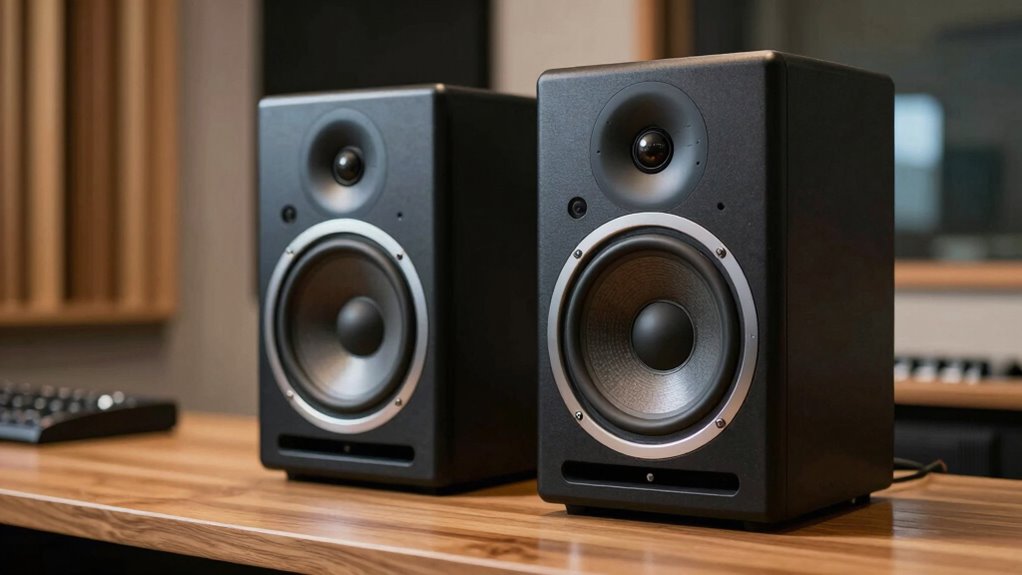

Studio monitor speakers are designed to produce accurate sound so you can hear every detail clearly. To get the best results, place them at ear level, forming an equal triangle with your listening spot, and keep them a few inches from walls. Proper room setup, treatment, and choosing the right monitors help improve sound accuracy. If you want to learn how to set them up perfectly and get professional-quality sound, there’s more to discover.
Key Takeaways
- Studio monitors are specialized speakers designed for accurate sound reproduction, essential for mixing and audio production.
- Proper placement at ear level and forming an equilateral triangle with your listening position ensures optimal sound clarity.
- Room acoustics and treatments, like carpets and acoustic panels, significantly improve monitor accuracy and reduce unwanted reflections.
- Selecting monitors based on their frequency range and how they interact with your room helps achieve better sound fidelity.
- Using measurement tools and adjusting placement helps optimize the setup for accurate, detailed audio playback.

Equally important is speaker placement, which can make or break your listening experience. To get the most accurate sound, you need to position your monitors thoughtfully. Start by placing them at ear level, forming an equilateral triangle with your listening position. Keep the speakers a few inches away from the walls to avoid reflections that can color the sound. The distance from your ears to each speaker should be equal, ensuring that sound reaches both ears simultaneously, creating a balanced stereo image. Experimenting with angle and distance helps you find the sweet spot where the sound feels natural and detailed. Proper placement minimizes room acoustics issues like standing waves or reflections that can distort frequency response. Additionally, understanding the environmental impact of tissue paper can inspire eco-friendly choices for soundproofing or acoustic treatment materials. Beyond positioning, consider the room’s acoustics. Soft furnishings like curtains and carpets absorb excess sound energy, reducing echo and reverb that can interfere with your monitor’s clarity. If you’re working in a space with reflective surfaces, adding acoustic panels or diffusers can help tame these reflections, resulting in a more accurate listening environment. When selecting your studio monitors, pay attention to their sound frequency range and how they interact with your room’s acoustics. Using measurement tools can help you analyze and optimize your setup for the best sound reproduction. Proper room treatment also plays a crucial role in achieving an accurate sound environment, ensuring your mixes translate well across different listening systems. Incorporating soundproofing techniques can further improve your setup by reducing external noise interference. Considering the room’s size and shape can also influence how sound behaves in your space, impacting overall sound clarity.

PreSonus Eris 3.5 Powered Studio Monitors, Pair — 3.5” Active Near
TRUSTED STUDIO-QUALITY SOUND: True studio sound for music production, gaming, movies, streaming, and everyday audio. Sold as a…
As an affiliate, we earn on qualifying purchases.
As an affiliate, we earn on qualifying purchases.
Frequently Asked Questions
How Do Studio Monitor Speakers Differ From Regular Home Speakers?
Studio monitor speakers differ from regular home speakers because they provide a more accurate sound frequency response, so you hear music exactly as it is intended. They also have higher power handling, allowing them to reproduce sound at higher volumes without distortion. This precision helps you make better mixing and recording decisions, unlike home speakers which often emphasize bass or treble to enhance listening pleasure but may distort the true sound.
What Is the Ideal Size for a Home Studio Monitor Speaker?
Imagine a cozy room where your speakers sit perfectly—about 5 to 8 inches away from walls—helping you hear every detail clearly. The ideal size for a home studio monitor speaker is typically 5 to 8 inches, balancing sound accuracy and space. Good room acoustics and proper speaker placement enhance your listening experience, preventing sound muddiness or harshness and making your mixes sound professional.
Can I Use Studio Monitors for Casual Music Listening?
Yes, you can use studio monitors for casual music listening, but keep in mind that their speaker quality is designed for accuracy rather than warmth or bass enhancement. While they provide clear, detailed sound, they might lack the richness you find in consumer speakers meant for relaxed listening. If you prioritize precise audio, studio monitors are great, but for a more enjoyable casual experience, consider speakers tailored for everyday music enjoyment.
How Do I Know if My Studio Monitors Are Accurately Calibrated?
You can tell if your studio monitors are accurately calibrated by checking their frequency response and sound accuracy. Use a calibration microphone and software to measure how flat the frequency response is across the spectrum. If the sound remains clear, balanced, and true to the original recording, your monitors are well-calibrated. Regularly calibrate them to guarantee consistent sound accuracy, especially when room acoustics or placement change.
Are Expensive Studio Monitors Worth the Investment?
Price comparison and brand reputation suggest that expensive studio monitors can be worth it if you prioritize precision and professional sound. While costlier options often deliver clearer, more consistent performance, they’re an investment that pays off for serious sound engineers. If you’re serious about studio sound accuracy and trust reputable brands, spending more might be worthwhile. Otherwise, a budget-friendly pair can still provide decent quality for beginners or casual creators.

18 Pack Black Acoustic Panels 12"X12"X 0.4"Sound Absorbing Panel Wall Decoration Soundproof Wall Panels High-Density Sound Deadening Panels Acoustic Treatment Panel For Home Studio
[Material Safety] The wall sound proof panels is made of polyester fiber, which has better ductility and wear…
As an affiliate, we earn on qualifying purchases.
As an affiliate, we earn on qualifying purchases.
Conclusion
Think of studio monitor speakers as your guiding stars in the vast night of sound. They illuminate every detail, revealing the true essence of your music, much like a lighthouse guiding ships safely home. With the right monitors, you’re not just creating sound—you’re charting a course through an ocean of possibilities, ensuring your art reaches its destination with clarity and purpose. Embrace them, and let your creative journey shine bright and true.

Decibel Meter, Tadeto Digital Sound Level Meter Portable SPL Meter 30dB to 130dB(5 Measurement Range) Backlight LCD Display, MAX/MIN Noise Measurement, Audible and Visual Alarms,Data Hold, A/C Mode
【Accurate Measurement】 The measuring range of the decibel meter is 30dB to 130dB and shifting function(5 adjustable measurement…
As an affiliate, we earn on qualifying purchases.
As an affiliate, we earn on qualifying purchases.

Vondynote Pair Studio Monitor Stands 32.6"-50.9" Base Floor Speaker Stands
The 9×9 inch top plate provides ample support for a wide range of speakers. 2mm foam pad on…
As an affiliate, we earn on qualifying purchases.
As an affiliate, we earn on qualifying purchases.