
If you’re looking for the best graphics cards for 4K gaming in 2026, I recommend considering the ASUS TUF RTX 5070 with 12GB, the ASUS TUF RTX 5080 with 16GB, a compact ASUS GeForce RTX 5070 option, and a budget-friendly VBESTLIFE RX 580 with 8GB. These models offer excellent performance, durability, and future-proof features. Keep in mind that cooling, VRAM, and system compatibility are key, and I’ll share more insights if you stay tuned.
Key Takeaways
- Prioritize high VRAM (12GB+) and advanced architectures like NVIDIA Blackwell or AMD RDNA 4 for future-proof 4K gaming.
- Ensure robust cooling solutions and thermal management to maintain high performance during extended gaming sessions.
- Select power supplies of at least 650W with compatible PCIe connectors for stable operation of high-end GPUs.
- Opt for cards supporting HDMI 2.1 and DisplayPort 2.1 for optimal 4K resolution and refresh rates.
- Consider compact or budget-friendly options that balance performance, compatibility, and system upgrade potential.

ASUS TUF GeForce RTX™ 5070 12GB GDDR7 OC Edition Graphics Card, NVIDIA, Desktop (PCIe® 5.0, HDMI®/DP 2.1, 3.125-Slot, Military-Grade Components, Protective PCB Coating, Axial-tech Fans)
Powered by the NVIDIA Blackwell architecture and DLSS 4
As an affiliate, we earn on qualifying purchases.
ASUS TUF RTX 5070 12GB Gaming Graphics Card
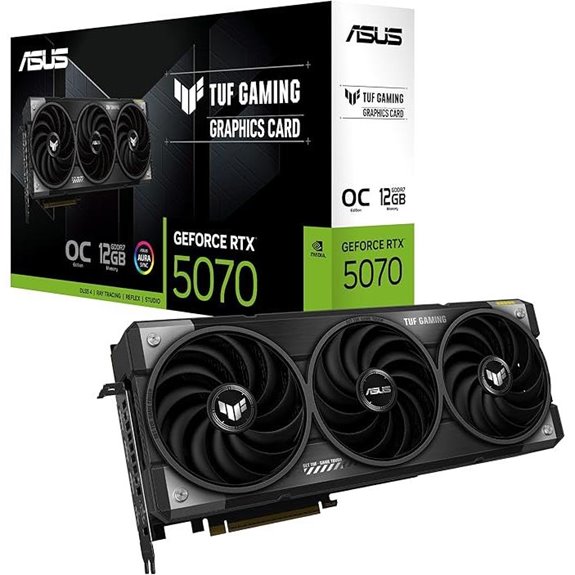
If you’re serious about 4K gaming in 2026, the ASUS TUF RTX 5070 12GB Gaming Graphics Card is an excellent choice, especially thanks to its NVIDIA Blackwell architecture and support for DLSS 4. This card features PCIe 5.0, axial-tech fans, and a massive fin array for ideal cooling. Built with military-grade components and a protective PCB coating, it’s designed for durability and long-term reliability. The phase-change thermal pad improves heat dissipation, while ASUS GPU Guard and bracket minimize risks of damage. With GPU Tweak III software for tuning and monitoring, this card delivers high performance, stability, and longevity under heavy loads.
Best For: gamers and high-performance PC builders seeking a durable, high-end graphics card optimized for 4K gaming and future-proof performance.
Pros:
- Supports NVIDIA Blackwell architecture and DLSS 4 for enhanced gaming performance and visuals
- Equipped with military-grade components and protective PCB coating for superior durability
- Advanced cooling features including phase-change thermal pad and axial-tech fans for optimal thermal management
Cons:
- 3.125-slot design may require larger cases and enhanced airflow considerations
- Premium components and features could result in a higher price point
- Heavy and potentially bulky, requiring secure mounting and adequate case space

ASUS The SFF-Ready Prime GeForce RTX™ 5070 Graphics Card, NVIDIA (PCIe® 5.0, 12GB GDDR7, HDMI®/DP 2.1, 2.5-Slot, Axial-tech Fans, Dual BIOS)
Powered by the NVIDIA Blackwell architecture and DLSS 4
As an affiliate, we earn on qualifying purchases.
ASUS GeForce RTX 5070 12GB Graphics Card
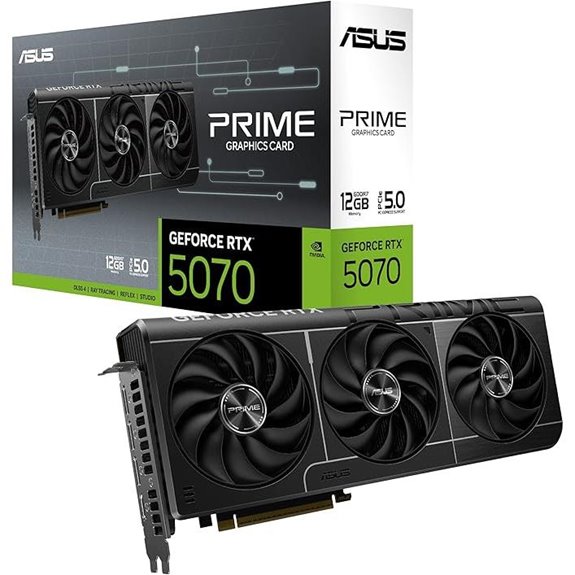
The ASUS GeForce RTX 5070 12GB Graphics Card stands out as an ideal choice for small-form-factor builds aiming to deliver top-tier 4K gaming performance in 2026. Its compact 2.5-slot design fits easily into tight spaces without sacrificing cooling or performance. Powered by NVIDIA’s Blackwell architecture with DLSS 4 support, it offers smooth, high-quality visuals. The card’s 12GB GDDR7 memory ensures crisp textures, while PCIe 5.0 provides fast data transfer. With HDMI and DisplayPort 2.1 outputs, you get versatile display options. Advanced axial-tech fans and thermal pads keep temperatures low, maintaining performance during extended gaming sessions.
Best For: gamers and PC enthusiasts seeking powerful 4K performance in compact, small-form-factor builds in 2026.
Pros:
- Compact 2.5-slot design ideal for space-constrained systems
- Powered by NVIDIA Blackwell architecture with DLSS 4 support for enhanced visuals
- High-speed PCIe 5.0 interface and versatile HDMI 2.1 and DisplayPort 2.1 outputs
Cons:
- May require a compatible small-form-factor case for optimal fit
- Slightly higher power consumption due to advanced features
- Limited availability or higher price point compared to larger models

VBESTLIFE RX 580 Graphics Card, 8GB GDDR5 256Bit Gaming Graphics Card, PCI Express 3.0x16, 3 DisplayPort DVI, Air Cooling PC Video Cards, 4K Displays Support
8GB GDDR5 MEMORY: The RX 580 graphics card has powerful graphics processing power with 1284MHz GPU speed and...
As an affiliate, we earn on qualifying purchases.
VBESTLIFE RX 580 8GB Gaming Graphics Card
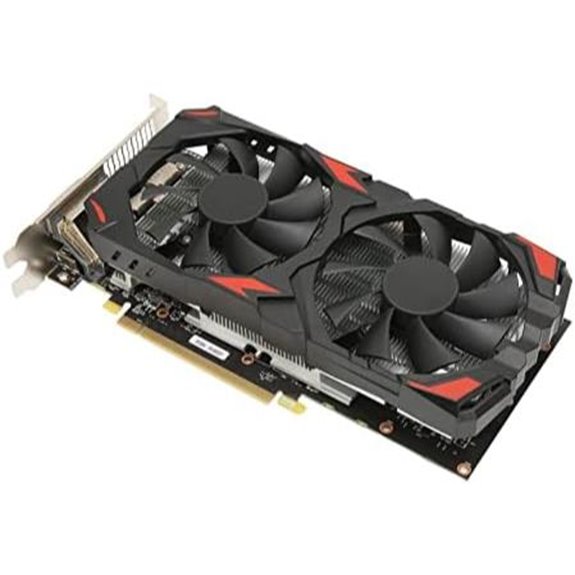
For gamers seeking reliable 4K performance without breaking the bank, the VBESTLIFE RX 580 8GB Graphics Card offers a compelling option. With 8GB of GDDR5 memory and a 256-bit memory interface, it delivers smooth visuals and quick data transfer. The GPU runs at 1284MHz, supported by high-performance memory up to 7000 MHz and 2048 stream processors for efficient processing. It supports 4K at 60Hz and includes HDMI and DVI-D outputs for multiple displays. Its dual-fan cooling system keeps temperatures low, ensuring quiet, stable operation. This card is perfect for gaming, content creation, and professional applications on a budget.
Best For: gamers and content creators seeking reliable 4K performance and multi-monitor support on a budget.
Pros:
- Supports 4K resolution at 60Hz for crisp visuals and smooth gameplay
- Equipped with 8GB GDDR5 memory and 2048 stream processors for efficient processing
- Dual cooling fans maintain low temperatures and quiet operation
Cons:
- Limited to PCI Express 3.0×16, which may slightly affect future upgrade options
- Basic video outputs (HDMI and DVI-D) may require adapters for certain setups
- Designed primarily for gaming and multimedia; not ideal for high-end professional rendering

ASUS TUF GeForce RTX™ 5080 16GB GDDR7 OC Edition Graphics Card, NVIDIA, Desktop (PCIe® 5.0, HDMI®/DP 2.1, 3.6-Slot, Military-Grade Components, Protective PCB Coating, Axial-tech Fans, Vapor Chamber)
Powered by the NVIDIA Blackwell architecture and DLSS 4
As an affiliate, we earn on qualifying purchases.
ASUS TUF RTX 5080 16GB Gaming Graphics Card
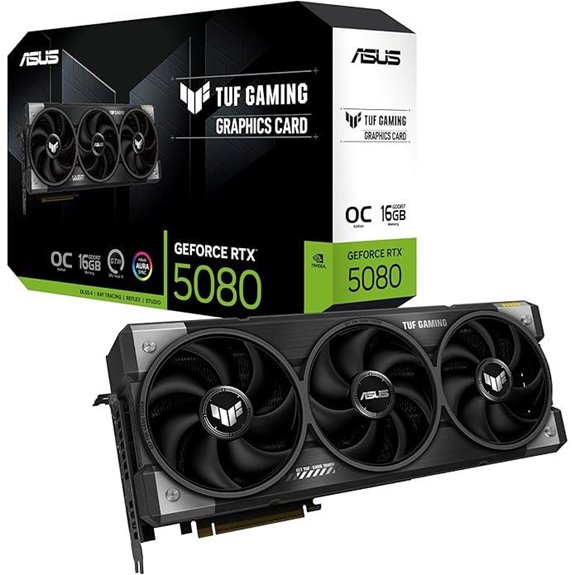
Designed to handle demanding 4K gaming sessions seamlessly, the ASUS TUF RTX 5080 16GB offers exceptional performance thanks to its NVIDIA Blackwell architecture and DLSS 4. It’s equipped with 16GB of GDDR7 memory, ensuring smooth gameplay and high-quality visuals. The card supports PCIe® 5.0, HDMI®, and DisplayPort 2.1, providing fast data transfer and versatile display options. Its 3.6-slot design features a massive fin array with axial-tech fans and vapor chamber cooling, delivering superior thermal management. Built with military-grade components and protected by a PCB coating, this card is durable, reliable, and perfect for extended, heavy gaming sessions.
Best For: gamers and content creators seeking high-performance 4K gaming experiences with reliable thermal management and durability.
Pros:
- Equipped with advanced NVIDIA Blackwell architecture and DLSS 4 for enhanced graphics performance and efficiency
- 16GB GDDR7 memory provides smooth gameplay and high-quality visuals at high resolutions
- Robust cooling system with vapor chamber and axial-tech fans ensures thermal stability during extended gaming sessions
Cons:
- Large 3.6-slot design may require ample space in the PC case
- High-end features and components can lead to a higher price point
- Power consumption might be significant, requiring a strong power supply and good ventilation
Factors to Consider When Choosing a Graphics Card for 4K Gaming
When selecting a graphics card for 4K gaming, I consider its overall performance and how well it fits with my system’s compatibility. I also look at cooling solutions and thermal management to prevent overheating during intense gaming sessions. Additionally, I evaluate memory capacity and power requirements to guarantee smooth gameplay and reliable operation.
Graphics Card Performance
Choosing a powerful graphics card for 4K gaming depends on several key performance factors. First, I look for at least 8GB of VRAM, but 12GB or more is ideal for handling detailed textures and ensuring future-proofing. The GPU architecture, like NVIDIA’s Blackwell or AMD’s latest chips, greatly influences rendering speed and efficiency at high resolution. Support for advanced technologies such as DLSS 4 or FidelityFX Super Resolution can boost frame rates and enhance visual quality, which is essential for smooth gameplay. To achieve a fluid experience, I aim for a card that can maintain 60 FPS or higher in demanding titles. Finally, a robust cooling system and high thermal performance are critical to sustain performance during extended gaming sessions without overheating.
Compatibility With System
To make certain your new 4K gaming setup runs smoothly, it’s vital to verify that your system’s components are compatible with the graphics card you choose. First, check that your motherboard supports PCIe 4.0 or higher to maximize data transfer speeds. Guarantee your power supply provides enough wattage and the necessary connectors, as high-end cards often demand significant power. Measure your case’s space to confirm it can accommodate larger, multi-slot cards and allows proper airflow for cooling. Additionally, verify that your CPU won’t bottleneck performance; a balanced system is key for 4K gaming. Finally, confirm your monitor supports 4K resolution and has compatible input ports like HDMI 2.1 or DisplayPort 2.1 to get the best visual output.
Cooling and Thermal
Effective cooling solutions are essential for maintaining ideal GPU temperatures during demanding 4K gaming sessions. Advanced cooling methods like axial-tech fans and vapor chambers efficiently dissipate heat, guaranteeing the GPU stays within safe thermal limits. Phase-change thermal pads markedly enhance heat transfer, extending the card’s lifespan and improving thermal management. Proper airflow design, including fin arrays and barrier rings on fans, prevents overheating by promoting efficient heat dissipation. Balancing thermal performance with noise levels is also critical; good cooling can reduce fan noise during intense gaming. Reliable thermal management prevents thermal throttling, maintaining consistent performance and high frame rates. Ultimately, choosing a graphics card with robust cooling solutions ensures your system stays cool, quiet, and ready to handle the most demanding 4K titles.
Memory Capacity
When selecting a graphics card for 4K gaming, memory capacity plays a crucial role in delivering smooth performance and high-quality visuals. For 4K, I recommend at least 8GB of VRAM to handle detailed textures and complex scenes effectively. Larger capacities, like 12GB or more, give extra headroom for future titles and demanding applications, ensuring your system stays relevant longer. Adequate VRAM prevents stuttering and frame drops by enabling the GPU to quickly access and store large assets during gameplay. Besides capacity, memory bandwidth also affects performance, influencing how fast data moves between VRAM and the GPU core. Choosing a card with ample VRAM not only improves current gameplay but also prepares you for the increasingly detailed and resource-intensive games coming in the future.
Power Supply Needs
Choosing the right power supply is key to guaranteeing your 4K gaming setup runs smoothly and reliably. For high-performance graphics cards, I recommend at least a 650W power supply to handle the load comfortably. Make sure your power supply has the necessary 8-pin or 6-pin PCIe connectors compatible with your GPU. A quality unit with an 80 Plus Gold or higher efficiency rating ensures stable power delivery, which is vital during demanding gaming sessions. It’s also wise to choose a power supply with enough headroom to prevent system instability and accommodate future upgrades. In conclusion, verify that all cables and connectors match your graphics card to avoid compatibility issues. Investing in a reliable power supply helps maximize your GPU’s performance and protects your entire system.
Future Upgrade Potential
To make certain your 4K gaming setup stays relevant in the future, it’s essential to contemplate a graphics card’s upgrade potential. A card with higher VRAM, like 12GB or more, offers better headroom for demanding titles and future software updates. Support for the latest architecture and technologies, such as DLSS 4 and PCIe 5.0, ensures compatibility with upcoming hardware and features. Modular designs with accessible components and multiple PCIe slots make future upgrades easier. Additionally, advanced thermal management and durable components can extend the card’s lifespan, helping it handle rising performance demands. Compatibility with emerging display outputs and high-bandwidth interfaces also guarantees your setup remains relevant as display technology evolves. Prioritizing these factors can safeguard your investment and keep your gaming experience cutting-edge.
Frequently Asked Questions
How Do Driver Updates Impact 4K Gaming Performance?
Driver updates greatly impact my 4K gaming experience. They often include performance improvements, bug fixes, and new features that optimize how my graphics card handles demanding games. Regular updates ensure I get the latest enhancements, reducing lag and preventing crashes. I always keep my drivers current because it boosts frame rates, improves image quality, and ensures compatibility with the newest games, making my gaming smoother and more immersive.
What Is the Expected Lifespan of High-End 4K Gaming GPUS?
Like a fine wine, high-end 4K gaming GPUs can last around 5 to 7 years with proper care. I’ve found that their lifespan depends on how well you maintain them and keep up with software updates. As technology evolves, these GPUs remain relevant longer if you’re willing to upgrade or tweak settings. Ultimately, investing in quality today means you’ll enjoy smooth gaming for years to come.
How Does Ray Tracing Affect Overall Gaming Experience at 4K?
Ray tracing really enhances my 4K gaming experience by delivering more realistic lighting, shadows, and reflections. It creates a immersive environment, making scenes look more lifelike and detailed. While it can impact performance, modern GPUs handle it well, especially with DLSS or similar tech. Overall, ray tracing makes my gameplay more visually stunning, pulling me deeper into the game world and elevating my 4K experience to new heights.
Are There Specific Cooling Solutions Recommended for 4K GPUS?
For 4K GPUs, I recommend high-quality cooling solutions like liquid cooling or premium air coolers. These keep temperatures low during intense gaming sessions, preventing thermal throttling and noise. I personally prefer custom liquid cooling setups for peak performance and quieter operation. Make sure your case has excellent airflow and enough space for larger coolers. Proper cooling is essential to maintain GPU longevity and get the best 4K gaming experience.
How Important Is VRAM Size for Future 4K Gaming Titles?
VRAM size is absolutely essential for future 4K gaming. Think of it like a massive storage tank; the bigger it is, the more high-resolution textures and complex assets it can hold without hiccups. As games become more detailed and demanding, I’d say you’ll want at least 12GB or more to keep gameplay smooth and stunning. Skimp on VRAM, and you might find yourself stuck with choppy frames and reduced visual quality.
Conclusion
Choosing the right graphics card can feel overwhelming, but with these top picks, you’re armed to conquer 4K gaming like a true champion. Whether you opt for the powerhouse ASUS TUF RTX 5080 or the reliable ASUS GeForce RTX 5070, each card delivers stunning visuals and smooth gameplay. Trust me, with these GPUs, your gaming experience will be so incredible, it’ll feel like stepping into another universe—so gear up and get ready to dominate!