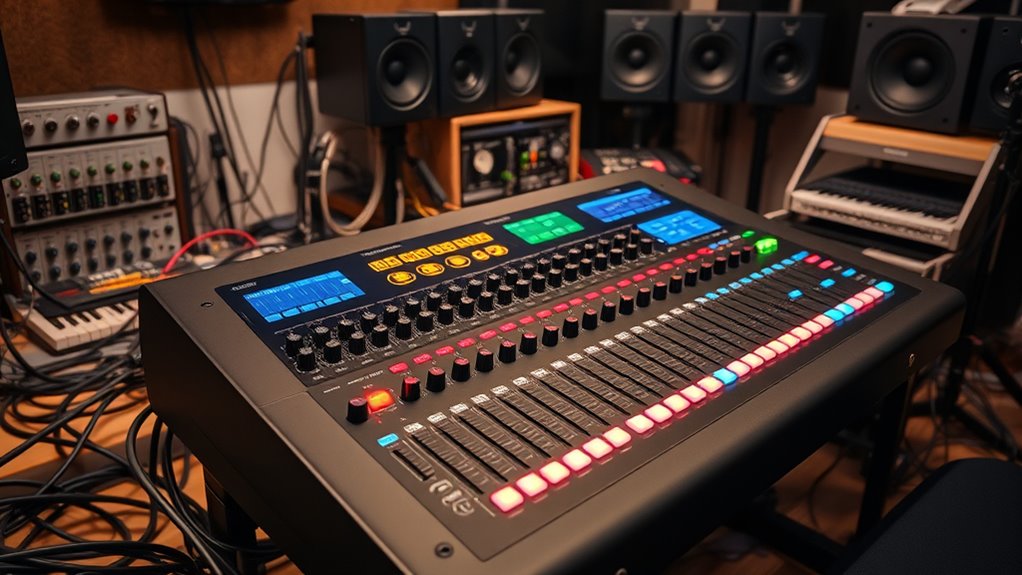

When searching for digital mixers, the main challenge is balancing features, usability, and budget. The StudioLive Series III SE 16 stands out as the best overall choice, offering professional-grade sound and extensive control. For those prioritizing portability, the Behringer FLOW 8 delivers solid performance with Bluetooth and app control at an accessible price. Meanwhile, the Allen & Heath Qu-5 caters to larger setups with its 38 channels. Choosing the right digital mixer depends on your specific needs—whether it’s live sound, recording, or streaming. Continue reading for a detailed breakdown of these options and how they compare.
Key Takeaways
- Top picks balance ease of use with advanced features, appealing to both beginners and pros.
- Connectivity options, like Bluetooth and app control, significantly influence versatility and convenience.
- Channel count varies widely, with larger mixers suited for complex setups and smaller units ideal for quick gigs.
- Build quality and brand reputation often correlate with higher price points but can impact longevity and reliability.
- Tradeoffs between affordability and professional features are central—more features often mean higher complexity and cost.
| StudioLive Series III SE 16 Digital Console Mixer with Fender Studio Pro |  | Best Overall for Professional Studios and Live Sound | Channels: 40 | Mix Buses: 26 | Connectivity: AVB audio networking, USB 2.0, Ethernet | VIEW ON AMAZON | See Our Full Breakdown |
| Behringer FLOW 8 8-Input Digital Mixer with Bluetooth and App Control |  | Best for Beginners and Mobile Performers | Inputs: 8 | Bluetooth: Yes | App Control: Yes | VIEW ON AMAZON | See Our Full Breakdown |
| Allen & Heath Qu-5 38-channel Digital Mixer |  | Best for Complex Live and Studio Applications | Channels: 38-in/24-out | Sample Rate: 96kHz | Touchscreen: 7-inch capacitive | VIEW ON AMAZON | See Our Full Breakdown |
| PreSonus StudioLive Classic 16.0.2 USB Digital Console Mixer |  | Best for Versatile Live and Recording Applications | Number of channels: 16 | Mono channels: 8 | Stereo channels: 4 | VIEW ON AMAZON | See Our Full Breakdown |
| Behringer X AIR XR16 16-Input Digital Mixer for iPad/Android Tablets |  | Best for Remote Control and Compact Live Use | Number of channels: 16 | Connectivity Technology: USB, Wi-Fi | Power Source: Corded Electric | VIEW ON AMAZON | See Our Full Breakdown |
| YAMAHA MG10XU 10-Input Stereo Mixer with Effects |  | Best Overall Compact Mixer for Versatile Sound Control | Channels: 10 | Effects: SPX digital effects | Input Noise: 128 dBu | VIEW ON AMAZON | See Our Full Breakdown |
| Behringer X AIR XR18 18-Channel Digital Mixer for iPad/Android Tablets |  | Best Wireless Digital Mixer for Remote Control | Channels: 18 | Bus: 12 | Preamp: 16 MIDAS-designed | VIEW ON AMAZON | See Our Full Breakdown |
| Yamaha DM3 Standard 22-Channel Digital Mixing Console |  | Best Small-Scale Digital Console with Touchscreen | Channels: 22 | Sample Rate: 96kHz | Pre-Amps: 16 Yamaha professional | VIEW ON AMAZON | See Our Full Breakdown |
| Soundcraft Ui16 Digital Mixer |  | Best Remote-Controlled Mixer with Advanced Processing | Inputs: 8 XLR combo, 4 XLR, 2 instrument | Outputs: 4 XLR Aux, 2 headphone, main stereo | Built-in Effects: Lexicon Reverb, Delay, Chorus | VIEW ON AMAZON | See Our Full Breakdown |
| ALTO TMD16 16-Channel Digital Mixer with Bluetooth |  | Best Compact Live Mixer with Wireless and Scene Recall | Channels: 16 | Mic Preamps: 10 | Display: 7-inch color | VIEW ON AMAZON | See Our Full Breakdown |
| Behringer XR18 Digital Mixer with Klark Teknik, X AIR |  | Best for Versatile Remote Control and Compact Live Use | Number of Channels: 18 | Connectivity Technology: USB | Power Source: Corded Electric | VIEW ON AMAZON | See Our Full Breakdown |
More Details on Our Top Picks
StudioLive Series III SE 16 Digital Console Mixer with Fender Studio Pro
The StudioLive Series III SE 16 stands out for its extensive channel count and advanced networking capabilities, making it ideal for large-scale live setups and professional studios. Compared with the Allen & Heath Qu-5, it offers more inputs and a broader feature set, but that comes with a more complex setup process and higher price. Its integrated recording, remote software control, and versatile EQ options provide a seamless workflow for experienced users. The main tradeoff is that it may be overwhelming for beginners or smaller setups where simplicity is preferred.
Pros:- 40 channels provide extensive routing options for complex setups
- Integrated recording and AVB networking streamline workflows
- Remote control via software enhances flexibility
Cons:- Setup can be complicated for those unfamiliar with digital networking
- Higher price point may be prohibitive for casual users
Best for: Large live sound teams and professional recording studios needing extensive routing and advanced networking
Not ideal for: Solo musicians or small venues with limited technical staff, due to its complexity and cost
- Channels:40
- Mix Buses:26
- Connectivity:AVB audio networking, USB 2.0, Ethernet
- Included Software:PreSonus Capture multitracking software
- Remote Control:Universal Control app
Our verdict“This mixer is best suited for professionals requiring maximum flexibility and features in demanding environments.”
Behringer FLOW 8 8-Input Digital Mixer with Bluetooth and App Control
The Behringer FLOW 8 offers a compact, user-friendly solution with Bluetooth streaming and app control, making it perfect for musicians on the go or small venues. While it has only 8 inputs compared to larger models like the Allen & Heath Qu-5, its simplicity and wireless control make it accessible for users new to digital mixers. The high-quality Midas preamps and low-noise design ensure professional sound quality, but its limited input count restricts larger setups. The reliance on a mobile device for control can be a drawback for those seeking dedicated hardware controls or more complex routing.
Pros:- Wireless control via mobile app simplifies operation
- High-quality Midas preamps deliver professional sound
- Compact and lightweight for portable setups
Cons:- Limited to 8 inputs, not suitable for bigger setups
- Dependent on a compatible device for full operation
Best for: Solo artists, small bands, or mobile performers seeking easy wireless control
Not ideal for: Large ensembles or venues needing extensive input channels and advanced routing
- Inputs:8
- Bluetooth:Yes
- App Control:Yes
- Channel Faders:60 mm
- Preamp Type:Midas
- Phantom Power:48 V
Our verdict“Ideal for those prioritizing portability and ease of use over extensive input capacity.”
Allen & Heath Qu-5 38-channel Digital Mixer
The Allen & Heath Qu-5 offers high channel density with a 7-inch touchscreen and 17 motorized faders, making it suitable for detailed control in demanding environments. Its 96kHz audio processing and 32-in/32-out USB-C interface outperform smaller mixers like the Behringer X AIR XR16 in audio fidelity and input flexibility. However, its weight and size reduce portability, and the learning curve can be steep for newcomers. This model excels in high-end settings but may be overkill for simpler tasks or portable needs.
Pros:- High channel count and multiple preamps support complex configurations
- Intuitive touchscreen interface simplifies control
- High-quality 96kHz processing ensures pristine audio
Cons:- Relatively large and heavy, reducing mobility
- Complex interface may challenge beginners
Best for: Professional sound engineers and venues needing extensive input/output flexibility
Not ideal for: Casual performers or small setups where portability and simplicity are prioritized
- Channels:38-in/24-out
- Sample Rate:96kHz
- Touchscreen:7-inch capacitive
- Faders:17 motorized
- Mic Preamps:16
- Audio Interface:32-in/32-out USB-C
Our verdict“Best suited for professionals managing complex live or studio audio with a need for detailed control and high fidelity.”
PreSonus StudioLive Classic 16.0.2 USB Digital Console Mixer
The StudioLive 16.0.2 combines a solid feature set with comprehensive signal processing, making it a flexible choice for both live sound and recording. Its 16 channels are comparable to the Behringer X AIR XR16, but it offers more onboard effects, scene recall, and a robust USB interface. While its complexity might be daunting for beginners, it benefits users who need detailed control and integrated effects. The weight and size make it less ideal for portable setups, but its versatility justifies this drawback for fixed installations.
Pros:- Extensive effects and processing options
- Built-in USB interface supports multitrack recording
- Wireless control compatibility
Cons:- Setup can be complex for less experienced users
- Heavy and less portable for mobile use
Best for: Mid-sized live venues or project studios needing comprehensive signal processing and recording features
Not ideal for: Travelers or solo performers requiring ultra-light, portable mixers
- Number of channels:16
- Mono channels:8
- Stereo channels:4
- Faders:12
- Mic preamplifiers:12 Class A XMAX
- USB audio interface:18-in/16-out, 24-bit/44.1 & 48 kHz
Our verdict“Perfect for users who need a versatile, feature-rich mixer for both live and studio work, despite its weight.”
Behringer X AIR XR16 16-Input Digital Mixer for iPad/Android Tablets
The Behringer X AIR XR16 provides a portable, tablet-controlled solution with 16 inputs and high-quality Midas preamps, ideal for mobile gigs and small venues. Its Wi-Fi connectivity allows for flexible operation without bulky hardware controls, setting it apart from traditional mixers like the PreSonus StudioLive 16.0.2. However, its weight and need for external power add some logistical considerations, and the complexity of setup could challenge newcomers. This mixer shines in environments where remote control and quick deployment are priorities.
Pros:- Wireless control via Wi-Fi simplifies operation
- High-quality Midas preamps deliver professional sound
- USB stereo recording supports high-quality capture
Cons:- Requires external power, limiting portability
- Setup complexity may be difficult for beginners
Best for: Mobile musicians and small event organizers seeking wireless control and high sound quality
Not ideal for: Large-scale productions or users who prefer physical controls over tablets
- Number of channels:16
- Connectivity Technology:USB, Wi-Fi
- Power Source:Corded Electric
- Output Connector Type:XLR
- Audio Input:USB
- Item Weight:6.6 pounds
Our verdict“Best suited for mobile setups needing flexible, tablet-based control without sacrificing sound quality.”
YAMAHA MG10XU 10-Input Stereo Mixer with Effects
The Yamaha MG10XU stands out for its combination of high-quality studio-grade preamps and built-in effects, making it a versatile choice for both live and studio settings. Compared to the Behringer X AIR XR18, it offers more straightforward control with physical knobs and buttons, though it lacks wireless connectivity and advanced remote control features. Its rugged metal chassis ensures durability on the road, but this focus on build quality can make it less portable than smaller models. The inclusion of SPX digital effects and USB connectivity provides flexibility, yet it may overwhelm beginners who prefer simpler interfaces. Overall, this mixer provides professional sound with a straightforward workflow, making it ideal for users who value sound quality but don’t need extensive remote control.Pros:- High-quality studio-grade preamps ensure clear, detailed sound
- Versatile sound control with 3-band EQ, filters, and compression
- Durable, impact-resistant metal chassis suitable for touring
Cons:- No built-in recording features for standalone use
- May be complex for users new to mixing technology
Best for: Sound engineers and musicians needing a reliable, all-in-one mixer with effects and physical controls.
Not ideal for: Beginners or mobile performers seeking wireless remote control or a more streamlined setup.
- Channels:10
- Effects:SPX digital effects
- Input Noise:128 dBu
- Residual Output Noise:102 dBu
- Dimensions:244mm x 71mm x 294mm
Our verdict“This mixer is best suited for users who prioritize sound quality and durability over wireless control or ultra-simplicity.”
Behringer X AIR XR18 18-Channel Digital Mixer for iPad/Android Tablets
The Behringer XR18 excels in offering extensive control via iPad or Android tablets, making it ideal for live sound engineers who want a flexible, wireless setup. Its 16 MIDAS-designed preamps deliver high-quality audio, comparable to the Yamaha DM3’s professional pre-amps, but with the added advantage of wireless control. While it offers robust connectivity options, firmware updates can be necessary to enable features like auto-mixing, which might be inconvenient. Its multi-channel USB interface allows easy recording, yet the limited output options might restrict complex setups. Compared with the Yamaha DM3, it sacrifices some of the physical control but gains mobility and remote operation, appealing to tech-savvy users who prioritize flexibility.Pros:- Wireless control via iPad or Android tablets for flexible operation
- High-quality MIDAS preamps ensure excellent sound clarity
- Built-in Wi-Fi router simplifies setup and connectivity
Cons:- Firmware updates may be needed for some features like auto-mixing
- Limited output options may constrain complex configurations
Best for: Live sound engineers and bands seeking a wireless control solution with high-quality preamps and recording capability.
Not ideal for: Users who prefer physical controls over tablets or need a system with extensive output options for large venues.
- Channels:18
- Bus:12
- Preamp:16 MIDAS-designed
- Connectivity:Wi-Fi, USB
- Outputs:2 XLR main
Our verdict“This mixer is ideal for tech-savvy users who want wireless control combined with professional sound quality.”
Yamaha DM3 Standard 22-Channel Digital Mixing Console
The Yamaha DM3 offers a substantial 22 channels packed into a compact design, making it suitable for both small venues and studio environments. Its 96kHz sampling rate ensures high fidelity, rivaling larger, more expensive consoles like the Allen & Heath Qu-5, but with a less expandable form factor that limits future growth. The 9-inch touchscreen provides intuitive control, though the complexity of its features can be daunting for those new to digital mixing. Its Yamaha pre-amps deliver clear, professional sound, but the device’s compact size means it might fall short in bigger, more complex setups. This model makes the most sense for users who need a capable, space-efficient mixer without sacrificing sound quality.Pros:- High-fidelity Yamaha pre-amps with 96kHz sampling
- Versatile routing with 22 channels and professional outputs
- User-friendly 9-inch touchscreen simplifies complex controls
Cons:- Limited expandability due to compact design
- Steep learning curve for users unfamiliar with digital mixers
Best for: Small venue operators or studio engineers seeking a powerful, yet space-efficient digital mixer.
Not ideal for: Beginners or those planning large-scale, expandable setups requiring more I/O options.
- Channels:22
- Sample Rate:96kHz
- Pre-Amps:16 Yamaha professional
- Outputs:8 XLR
- Touch Screen:9 inches
- USB Interface:18×18
Our verdict“This console is tailored for small-scale applications where space and sound quality are priorities over expansion capacity.”
Soundcraft Ui16 Digital Mixer
The Soundcraft Ui16 offers comprehensive remote control options, supporting up to 10 devices simultaneously, which makes it ideal for large live events or recordings. Its built-in Lexicon effects and 31-band graphic EQ provide detailed sound shaping, similar to the Behringer XR18 but with a more advanced interface. Setup can be complex for newcomers, especially when managing multiple devices, and its rugged chassis adds weight, reducing portability. The USB media player and direct recording features add versatility, yet the need for Wi-Fi or Ethernet might be a barrier for quick setups. Compared to the Behringer XR18, it offers more extensive processing and control, appealing to professionals seeking more detailed sound management.Pros:- Remote control via multiple platforms for flexible operation
- High-quality built-in effects and detailed signal processing
- Supports multi-device control and real-time audio analysis
Cons:- Setup can be complicated for less experienced users
- Heavy chassis reduces portability for mobile setups
Best for: Professional live sound engineers or recording studios needing remote control and advanced processing.
Not ideal for: Beginners or mobile users requiring a lightweight, plug-and-play solution without extensive setup.
- Inputs:8 XLR combo, 4 XLR, 2 instrument
- Outputs:4 XLR Aux, 2 headphone, main stereo
- Built-in Effects:Lexicon Reverb, Delay, Chorus
- Processing:31-band graphic EQ, noise gate, compressor
- Control Devices:Up to 10
Our verdict“This mixer suits professionals who want in-depth control and powerful processing capabilities across multiple control devices.”
ALTO TMD16 16-Channel Digital Mixer with Bluetooth
The ALTO TMD16 combines user-friendly touch controls with practical features like Bluetooth streaming and scene recall, making it ideal for small venues, rehearsals, or mobile gigs. Its 7-inch color display simplifies setup and adjustments, while onboard effects and multiple aux sends provide adequate sound shaping for most live applications. Compared to the Yamaha MG10XU, the TMD16 offers more intuitive controls and wireless connectivity, but it’s limited in size and channel count for larger setups. Its metal chassis adds durability, yet the complexity of its features may challenge complete beginners. This pick makes the most sense for performers or small venues seeking quick, flexible setup with wireless convenience.Pros:- High-quality digital mic preamps and onboard effects
- Intuitive touch faders and dedicated controls for ease of use
- Bluetooth connectivity for wireless streaming and control
Cons:- May be too complex for complete beginners without prior experience
- Limited channel count and scalability for bigger productions
Best for: Small band setups, mobile DJs, or rehearsal spaces that want quick, reliable control with Bluetooth streaming.
Not ideal for: Large venues or users who need extensive channels and advanced routing options.
- Channels:16
- Mic Preamps:10
- Display:7-inch color
- Connectivity:USB, Bluetooth
- Effects:16 presets
- Build:Metal chassis
Our verdict“This mixer is ideal for small-scale live setups that value quick setup, portability, and wireless features.”
Behringer XR18 Digital Mixer with Klark Teknik, X AIR
The Behringer XR18 stands out for its combination of high-quality Midas preamps and wireless control, making it an attractive choice for small to medium live sound setups and studio recordings. Compared with the Yamaha MG10XU, which offers onboard effects but fewer channels, the XR18 provides more flexibility with 18 channels and multichannel USB recording. Its remote control capability via iPad or Android devices offers a significant advantage for performers and engineers seeking flexibility on stage or in the studio, but this comes with the tradeoff of a slightly more complex setup process—especially for beginners. While its compact size and lightweight design are ideal for portability, it requires an external power source, which can be inconvenient during mobile gigs. The limited channel count might also restrict larger setups, but for its target audience of small bands, podcasters, and mobile engineers, it delivers impressive performance.
Pros:- High-quality Midas preamps with gain control for professional sound quality
- Wireless control via iPad and Android devices increases flexibility
- Multichannel USB audio interface simplifies recording and playback
- Lightweight and compact for easy transportation
Cons:- Requires external power, which can be less convenient for mobile setups
- Setup may be challenging for beginners unfamiliar with digital mixers
- Limited to 18 channels, restricting larger or more complex setups
Best for: Musicians, podcasters, or small venue engineers needing remote control and portable operation.
Not ideal for: Large-scale touring acts or venues requiring more than 18 channels and extensive onboard effects.
- Number of Channels:18
- Connectivity Technology:USB
- Power Source:Corded Electric
- Frequency:2.4 GHz
- Output Connector Type:XLR, TRS
- Audio Input:USB
- Item Weight:3.2 kg
Our verdict“This mixer is best suited for users who prioritize remote control and portability without needing extensive channels.”
How We Picked
The products in this roundup were evaluated based on performance, usability, build quality, connectivity options, and value for money. We prioritized mixers that offer a good balance of features for different user levels, from beginners to seasoned professionals. The ranking reflects how well each product performs in real-world scenarios, considering ease of setup, control flexibility, and durability. Cost was also a factor, with an eye toward options that provide the most value for their price. Our goal was to identify mixers that stand out in their respective categories without sacrificing core quality or reliability.Factors to Consider When Choosing Digital Mixers
Choosing the right digital mixer involves several key factors that can significantly impact your experience. Understanding these elements helps ensure you pick a model that matches your specific needs and skill level. From channel capacity to connectivity and usability, each factor influences how effectively you’ll be able to use the mixer for live sound, recording, or streaming. Being aware of common pitfalls, like overpaying for unnecessary features or choosing a mixer that’s too complex, can save you time and money.Channel Count and Expandability
The number of channels determines how many microphones, instruments, or audio sources you can connect at once. Larger setups or live bands generally require mixers with more channels, while solo performers or streamers might prefer smaller units. Expandability features, like additional outputs or optional accessories, can offer growth potential without replacing the entire system. Always evaluate your current needs and consider future expansion to avoid outgrowing your mixer too quickly.
Connectivity and Control Options
Modern digital mixers often include wireless control via apps, Bluetooth streaming, and multiple input/output options. These features improve flexibility, especially for remote control during live events or recording sessions. However, extra connectivity can also introduce complexity; ensure your chosen mixer supports the connections you need without overwhelming you with unnecessary options. Compatibility with your devices and ease of access are key factors to consider.
Ease of Use and Interface
A user-friendly interface speeds up setup and adjusts workflows. Touchscreens, clearly labeled controls, and intuitive software interfaces benefit beginners and experienced users alike. Beware of models with overly complex menus that require extensive training or cause frustration during live use. Some mixers offer preset functions that simplify common tasks, which can be a lifesaver in fast-paced environments.
Build Quality and Reliability
Durability is often overlooked but essential, especially for portable or gig-based use. Well-built units from reputable brands tend to last longer and resist damage from transport and frequent handling. While premium models typically offer better construction, they also come at a higher cost. Consider your environment and how often you’ll move or set up your mixer when evaluating durability versus price.
Value and Budget Considerations
It’s tempting to opt for the most feature-rich model, but carefully matching features to your actual needs prevents overspending. Budget options can serve well for small setups or beginners, but may lack advanced routing or processing features found in higher-end models. Conversely, investing in a premium mixer can pay off through improved sound quality, expandability, and longevity if your use case demands it.
Frequently Asked Questions
What channel count should I choose for my digital mixer?
The right channel count depends on your setup size and future plans. If you’re running a small band or streaming solo, a 10-12 channel mixer may suffice. Larger ensembles, multi-mic recordings, or complex live events typically require 16 channels or more. It’s wise to select a mixer that slightly exceeds your current needs to allow room for growth without immediately needing a replacement.
Is it better to buy a digital mixer with app control?
App control adds significant convenience, allowing remote adjustments and simplified setup. It can streamline live sound management or recording workflows, especially if your mixer is difficult to access physically during a performance. However, reliance on apps also introduces potential issues, such as connectivity problems or compatibility concerns. Ensure your preferred device and operating system are supported before making this feature a priority.
Should I prioritize built-in effects or external processors?
Built-in effects are convenient for quick setups and smaller systems, often eliminating the need for additional gear. They are generally sufficient for basic live sound and recording tasks. For more complex, high-fidelity productions, external processors or dedicated plugins may offer superior quality and flexibility. Consider your application requirements and whether the onboard effects meet your standards before opting for external options.
How important is build quality in choosing a digital mixer?
Build quality directly impacts the longevity and reliability of your mixer, especially if you transport it frequently or use it in rugged environments. High-quality units often feature metal chassis, sturdy knobs, and reliable connectors, reducing the risk of damage over time. While they tend to cost more, the investment can save money and hassle in the long run by avoiding repairs or replacements.
Can I upgrade or expand my digital mixer later?
Many digital mixers offer expandability through additional modules, outputs, or software updates. However, the extent of upgrade options varies widely. Before purchasing, confirm whether your chosen model supports expansion and whether additional accessories or software licenses are needed. Planning for future growth helps ensure your investment remains relevant as your needs evolve.
Conclusion
For those who need a versatile, all-around performer, the StudioLive Series III SE 16 offers a compelling mix of features and durability. Budget-conscious users or hobbyists will find the Behringer FLOW 8 a practical choice, balancing functionality with affordability. If you’re seeking a premium, feature-rich solution and don’t mind the investment, the Allen & Heath Qu-5 stands out as a professional-grade option. Beginners will benefit from models like the YAMAHA MG10XU with intuitive controls, while larger setups or live sound engineers should consider models with higher channel counts like the Behringer X AIR XR18. Your ideal choice depends on your specific needs, environment, and budget—matching these factors will ensure a satisfying experience.