
For most mirrorless shooters, the DJI RS 4 Mini Combo is the best overall starting point, balancing portability with a useful set of accessories. The FeiyuTech SCORP 2 is a stronger match for heavier setups that benefit from its higher payload, while the ZHIYUN WEEBILL 3E keeps the focus on a compact, straightforward camera rig. The main tradeoff is between a lighter gimbal that is easier to carry and a more capable one that can better handle a camera-and-lens combination. Tracking tools, vertical shooting support, and included accessories also differ across this lineup. Read on for the full breakdown and help matching a gimbal to your actual kit.

Get everyday essentials delivered free with Prime
- Fast, free delivery on millions of items
- Prime Video, Amazon Music and more included
- Member-only deals all year
Key Takeaways
- The DJI RS 4 Mini Combo is the roundup’s balanced pick: it pairs a compact gimbal with combo accessories, while the standard RS 4 Mini keeps the setup simpler.
- Payload changes the shortlist: the FeiyuTech SCORP 2 is rated for up to 2.5 kg, ahead of the SCORP Mini 3 Pro’s stated 2 kg, making camera-and-lens weight a key point of separation.
- Tracking and kit contents are recurring differentiators: several FeiyuTech SCORP options add AI tracking, and the SCORP Mini 2 Kit specifies a touchscreen, fill light, and accessories.
- DJI RS models span different rig sizes: the RS 3 Mini offers a lighter-class option, while the RS 4 is aimed at buyers whose camera setup calls for a larger stabilizer.
- Duplicate model names do not always mean identical packages: check whether a listing is a Combo, Kit, standard unit, or Renewed model before comparing what is included.
| DJI RS 4 Mini Combo Gimbal Stabilizer |  | Best Overall for Compact Hybrid Setups | Brand: DJI | Model: RS 4 Mini | Payload capacity: 2 kg (4.4 lbs) | VIEW ON AMAZON | See Our Full Breakdown |
| FeiyuTech SCORP Mini 3 Pro Camera Gimbal Stabilizer |  | Best for Remote Solo Tracking | Brand: FeiyuTech | Model: SCORP Mini 3 Pro | Maximum payload: 4.4 lbs | VIEW ON AMAZON | See Our Full Breakdown |
| ZHIYUN CINEPEER WEEBILL 3E Mirrorless Camera Gimbal Stabilizer |  | Best for Heavier Mirrorless Rigs | Brand: ZHIYUN | Model: CINEPEER WEEBILL 3E | Stabilization: 3-axis | VIEW ON AMAZON | See Our Full Breakdown |
| ZHIYUN Weebill 3E 3-Axis Camera Gimbal Stabilizer |  | Best for Long Shooting Days | Brand: ZHIYUN | Model: Weebill 3E | Stabilization: 3-axis | VIEW ON AMAZON | See Our Full Breakdown |
| FeiyuTech SCORP Mini 3 Pro Gimbal Stabilizer – 3-axis, 2 kg payload, AI tracking up to 18 m, detachable remote handle | 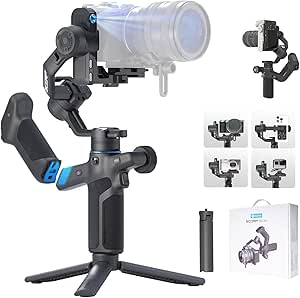 | Best for Multi-Camera Creators | Brand: FeiyuTech | Model: SCORP Mini 3 Pro | Stabilization: 3-axis | VIEW ON AMAZON | See Our Full Breakdown |
| FeiyuTech SCORP Mini 2 Kit 3-Axis Camera Gimbal Stabilizer with AI Tracking, Fill Light, Touchscreen, and Accessories |  | Best Lightweight Multi-Camera Kit | Stabilization: 3-axis | Maximum payload: 1,200 g | Item weight: 852 g | VIEW ON AMAZON | See Our Full Breakdown |
| FeiyuTech SCORP 2 Gimbal Stabilizer for DSLR and Mirrorless Cameras – Integrated AI Tracking Sensor, 3-Axis, 2.5 kg Payload, Touchscreen, Vertical Shooting |  | Best for Gesture-Controlled Vertical Shooting | Axes: 3 | Payload capacity: 2.5 kg | Touchscreen: 1.3 inches | VIEW ON AMAZON | See Our Full Breakdown |
| DJI RS 4 Camera Gimbal Stabilizer |  | Best for Heavier Mirrorless Rigs | Model: P14C | Payload capacity: 3 kg (6.6 lb) | Vertical shooting: Native vertical shooting | VIEW ON AMAZON | See Our Full Breakdown |
| FeiyuTech SCORP-C2 3-Axis Camera Gimbal Stabilizer with AI Tracking |  | Best for High-Payload FeiyuTech Tracking | Stabilization: 3-axis | Maximum payload: 7.72 lb | Tracking: AI face tracking with gesture control | VIEW ON AMAZON | See Our Full Breakdown |
| FeiyuTech SCORP Mini 2 Combo Camera Gimbal with AI Tracking |  | Best Compact All-in-One Combo | Stabilization: 3-axis | Weight: 1.87 lb (852 g) | Maximum payload: 2.65 lb (1.2 kg) | VIEW ON AMAZON | See Our Full Breakdown |
| DJI RS 4 Mini Camera Gimbal Stabilizer |  | Best for Fast Setup and Flexible Shooting | Brand: DJI | Model: RS 4 Mini (P24M) | Maximum payload: 2 kg (4.4 lb) | VIEW ON AMAZON | See Our Full Breakdown |
| DJI RS 3 Mini Camera Gimbal Stabilizer |  | Best Lightweight Standard Pick | Brand: DJI | Model: RS 3 Mini | Weight: 795 g (1.75 lb) in portrait mode; 850 g (1.8 lb) with horizontal arm | VIEW ON AMAZON | See Our Full Breakdown |
| DJI RS 3 Mini 3-Axis Mirrorless Camera Gimbal Stabilizer (Renewed) |  | Best Renewed Compact Option | Brand: DJI | Model: RS 3 Mini | Type: 3-axis mirrorless camera gimbal stabilizer | VIEW ON AMAZON | See Our Full Breakdown |
| camera gimbals mirrorless | Model | Brand | Maximum payload |
|---|---|---|---|
| DJI RS 4 Mini Combo Gimbal Sta | RS 4 Mini | DJI | — |
| FeiyuTech SCORP Mini 3 Pro Cam | SCORP Mini 3 Pro | FeiyuTech | 4.4 lbs |
| ZHIYUN CINEPEER WEEBILL 3E Mir | CINEPEER WEEBILL 3E | ZHIYUN | 3 kg (6.6 lbs) |
| ZHIYUN Weebill 3E 3-Axis Camer | Weebill 3E | ZHIYUN | 3 kg (6.6 lbs) |
| FeiyuTech SCORP Mini 3 Pro Gim | SCORP Mini 3 Pro | FeiyuTech | — |
| FeiyuTech SCORP Mini 2 Kit 3-A | — | — | 1,200 g |
| FeiyuTech SCORP 2 Gimbal Stabi | — | — | — |
| DJI RS 4 Camera Gimbal Stabili | P14C | — | — |
| FeiyuTech SCORP-C2 3-Axis Came | — | — | 7.72 lb |
| FeiyuTech SCORP Mini 2 Combo C | — | — | 2.65 lb (1.2 kg) |
| DJI RS 4 Mini Camera Gimbal St | RS 4 Mini (P24M) | DJI | 2 kg (4.4 lb) |
| DJI RS 3 Mini Camera Gimbal St | RS 3 Mini | DJI | — |
| DJI RS 3 Mini 3-Axis Mirrorles | RS 3 Mini | DJI | 2 kg (4.4 lb) |
More Details on Our Top Picks
DJI RS 4 Mini Combo Gimbal Stabilizer
The DJI RS 4 Mini Combo is a strong fit for mirrorless shooters who want a compact rig that can also handle phone-based filming. Its automated axis locks simplify setup and packing, while the included tracking module can help keep a moving subject framed without a separate operator. Compared with the FeiyuTech SCORP Mini 3 Pro, it offers a similar 4.4-pound payload and broad device compatibility, but DJI’s combo adds a briefcase handle for low-angle work. The limit is the same one that matters across this lighter class: a heavier body-and-lens pairing may exceed its capacity. Native vertical shooting is useful for social video, though Android users must download the Ronin app from DJI’s website rather than Google Play. I’d choose it for a camera-and-phone kit, not a heavy lens setup.
Pros:- Automated axis locks make setup and packing quicker
- Included intelligent tracking module helps keep subjects framed
- Supports both horizontal and native vertical shooting
- Works with mirrorless cameras, vlog cameras, and smartphones
Cons:- 2 kg payload restricts heavier camera and lens combinations
- Android users must download the Ronin app from DJI’s website
Best for: Mirrorless creators who also film with a smartphone and want tracking, low-angle handling, and quick setup in one compact kit.
Not ideal for: Filmmakers using a heavier camera-and-lens combination above 2 kg, or Android users who want to install the control app directly from Google Play.
- Brand:DJI
- Model:RS 4 Mini
- Payload capacity:2 kg (4.4 lbs)
- Compatibility:Mirrorless cameras, vlog cameras, and smartphones
- Shooting orientations:Horizontal and vertical
- Included tracking:RS Intelligent Tracking Module
- Included handle:Briefcase handle
- Other included items:Tripod, cables, quick-release plate, and screw kit
Our verdict“Choose the RS 4 Mini Combo for a compact mirrorless-and-phone kit with useful tracking and low-angle accessories, provided your rig stays within its payload limit.”
FeiyuTech SCORP Mini 3 Pro Camera Gimbal Stabilizer
The FeiyuTech SCORP Mini 3 Pro suits solo creators who want to move around the frame while the gimbal tracks them. Its stated 59-foot AI tracking range and detachable handle, with control up to 39 feet away, give it a more remote-filming focus than the DJI RS 4 Mini Combo, whose supplied package emphasizes axis locks and a briefcase handle. The 1.3-inch OLED screen puts settings on the removable handle, and the phone holder’s cooling fan is a useful inclusion for extended smartphone recording. Its 4.4-pound payload covers many compact mirrorless combinations, but not heavier rigs; the listed payload is no higher than the DJI’s. Battery-life details are limited in the supplied information, so I’d be cautious about choosing it for long shoots without checking runtime needs. Its appeal is the remote-control workflow, not extra carrying capacity.
Pros:- AI tracking is specified for distances up to 59 feet
- Detachable handle offers control from up to 39 feet away
- 1.3-inch OLED screen provides settings access on the handle
- Includes a smartphone holder with a cooling fan
Cons:- 4.4-pound payload may rule out heavier camera-and-lens combinations
- Supplied product details provide limited battery-life information
Best for: Solo video creators who need to reposition the gimbal or control framing remotely while tracking themselves or another subject.
Not ideal for: Operators with heavier mirrorless rigs or buyers who need clearly specified battery runtime before planning long shoots.
- Brand:FeiyuTech
- Model:SCORP Mini 3 Pro
- Maximum payload:4.4 lbs
- AI tracking range:Up to 59 feet
- Tracking response time:0.003 seconds
- Detachable handle control distance:Up to 39 feet
- Screen:1.3-inch OLED
- Supported devices:Mirrorless cameras, action cameras, and smartphones
- Warranty:1 year
Our verdict“Pick the SCORP Mini 3 Pro when remote solo control and long-range tracking matter more than a higher payload or clearly documented runtime.”
ZHIYUN CINEPEER WEEBILL 3E Mirrorless Camera Gimbal Stabilizer
Among these compact mirrorless options, the ZHIYUN CINEPEER WEEBILL 3E has the clearest payload advantage: its 3 kg (6.6 lb) capacity exceeds the 2 kg limit of the DJI RS 4 Mini Combo and the listed SCORP Mini 3 Pro variant. That extra room can make a difference when a camera needs a larger lens or added accessories, though payload figures alone do not confirm a specific rig will balance. Native vertical shooting avoids a separate portrait attachment, while Sling Mode 2.0 and its attachable wrist rest are aimed at reducing strain during extended handheld work. Bluetooth shutter control adds basic camera operation from the gimbal. Compared with the other WEEBILL 3E listing here, this version’s supplied data gives less detail on battery life and weight, so I’d favor it for payload headroom and handling features rather than a fully specified travel kit.
Pros:- 3 kg payload gives more room than the 2 kg DJI RS 4 Mini and SCORP Mini 3 Pro listing
- Native vertical shooting works without an extra attachment
- Sling Mode 2.0 and an attachable wrist rest support longer handheld use
- Bluetooth shutter control supports camera operation from the gimbal
Cons:- The 3 kg limit still excludes heavier camera-and-lens setups
- Some two-handed operation accessories may need to be purchased separately
Best for: Mirrorless shooters with camera-and-lens setups approaching 3 kg who want native vertical shooting and a wrist-rest option for longer handheld sessions.
Not ideal for: Travel creators prioritizing a fully documented lightweight kit, or anyone whose rig exceeds 3 kg or requires two-handed accessories included in the box.
- Brand:ZHIYUN
- Model:CINEPEER WEEBILL 3E
- Stabilization:3-axis
- Maximum payload:3 kg (6.6 lbs)
- Compatibility:Canon, Sony, Panasonic, and Nikon mirrorless cameras
- Connectivity:Bluetooth shutter control
- Shooting orientations:Native vertical shooting
- Handling feature:Sling Mode 2.0 with attachable wrist rest
- Mounting:Quick-release system
Our verdict“Choose this WEEBILL 3E when your mirrorless rig needs more payload headroom than the 2 kg compact alternatives and you value sling-style support.”
ZHIYUN Weebill 3E 3-Axis Camera Gimbal Stabilizer
The ZHIYUN Weebill 3E stands out for shooters who would rather plan around battery runtime than remote tracking. Its listed up-to-16-hour battery life and 14 W PD charging make it a stronger fit for a full day of work than the SCORP Mini 3 Pro listings, whose supplied details do not specify runtime. Like the CINEPEER WEEBILL 3E, it supports a 3 kg payload and native vertical shooting, but this listing adds a stated weight of 1.05 kg and dimensions that help buyers judge its carrying footprint. The tradeoff is accessory and cable cost: the included control cable is for Panasonic, while other camera brands may need a separately purchased cable, and the sling grip and wrist rest are separate. I’d choose this version for documented endurance, not a ready-to-go multi-brand control kit.
Pros:- Up to 16 hours of stated battery life
- 3 kg payload supports more camera-and-lens combinations than the 2 kg options
- Native vertical shooting needs no extra attachment
- 14 W PD charging is listed at approximately 2 hours 46 minutes
Cons:- Included camera-control cable is for Panasonic; other brands may require a separate cable
- Sling grip and wrist rest are sold separately
Best for: Mirrorless and DSLR owners planning long shooting days who want a stated battery-life figure and a gimbal weighing 1.05 kg.
Not ideal for: Buyers who need included camera-control cables for Canon or Sony, or want a sling grip and wrist rest supplied with the gimbal.
- Brand:ZHIYUN
- Model:Weebill 3E
- Stabilization:3-axis
- Maximum payload:3 kg (6.6 lbs)
- Weight:1.05 kg
- Dimensions:12 × 8 × 3 in
- Maximum battery life:Up to 16 hours
- Charging:14 W PD fast charging; approximately 2 hours 46 minutes
- Included control cable:Panasonic LN-UCUC-A02
Our verdict“Choose this Weebill 3E for long shoots and a higher payload, if you are prepared to source the right camera cable and handling accessories.”
FeiyuTech SCORP Mini 3 Pro Gimbal Stabilizer – 3-axis, 2 kg payload, AI tracking up to 18 m, detachable remote handle
This SCORP Mini 3 Pro listing is the most accessory-specific choice for creators who switch among mirrorless, compact, smartphone, and action cameras. It shares the 2 kg payload class with the DJI RS 4 Mini Combo, but its supplied kit lists adapters and cables for several device types, along with a slider and lens holder. That makes it more appealing for a mixed-camera workflow than the DJI’s emphasis on axis locks, tracking module, and briefcase handle. Its AI Tracking 4.0 is specified for up to 18 meters with a 0.003-second response time, and the detachable remote grip supports solo operation. The payload remains the limiting factor: versatility across camera types does not mean it can carry a heavier rig. The listing also notes that its weight may affect portability, so I’d pick it for kit flexibility over the lighter-feeling options.
Pros:- Supports mirrorless, compact, smartphone, and action cameras
- AI Tracking 4.0 has a stated 18-meter range and 0.003-second response time
- Detachable remote grip supports solo operation
- Included kit lists a GoPro adapter, slider, lens holder, and camera-control cables
Cons:- 2 kg payload limits heavier mirrorless camera-and-lens combinations
- Its weight may make it less appealing for creators prioritizing easy portability
Best for: Creators who alternate between a lightweight mirrorless camera, compact camera, smartphone, or action camera and want one gimbal kit with varied adapters.
Not ideal for: Mirrorless users with heavier camera-and-lens rigs, or travelers who put the smallest carrying footprint ahead of included accessories.
- Brand:FeiyuTech
- Model:SCORP Mini 3 Pro
- Stabilization:3-axis
- Payload capacity:2 kg (4.4 lbs)
- Maximum tracking distance:18 meters
- AI tracking:Version 4.0; 0.003-second response time
- Compatibility:Mirrorless, compact, smartphone, and action cameras
- Included accessories:USB-C to Lightning cable, Type-C to Type-C camera-control cable, USB-C charging cable, GoPro adapter, tripod, slider, fixed plate, quick-release plate, Allen key, and lens holder
Our verdict“Pick this SCORP Mini 3 Pro kit for multi-camera flexibility and remote tracking, but choose a higher-payload gimbal for heavier mirrorless rigs.”
FeiyuTech SCORP Mini 2 Kit 3-Axis Camera Gimbal Stabilizer with AI Tracking, Fill Light, Touchscreen, and Accessories
I’d choose this kit when low carry weight and built-in tracking matter more than supporting a heavy camera setup. At 852 g, it is lighter than the SCORP 2, and its 1.2 kg payload covers compatible mirrorless bodies with modest lenses as well as phones and action cameras. The tracking works without an app, while the touchscreen, fill light, case, extension rod, and mounting adapters make it a versatile starting kit for solo creators. Compared with the DJI RS 4, though, it has less payload headroom for larger lenses and doesn’t list the same focus on heavier mirrorless rigs. The product data also gives no battery-life figure, so I’d be cautious about planning long shoots around it. Check your fully rigged camera weight before choosing it.
Pros:- Built-in AI tracking follows faces and objects without requiring an app
- 852 g body is relatively easy to carry between locations
- Supports compatible cameras, phones, and action cameras
- Kit includes a wireless fill light, case, extension rod, tripod, and mounting adapters
Cons:- 1.2 kg payload limits the camera and lens combinations it can balance
- Battery life is not specified in the supplied product data
Best for: Solo creators who switch between a lightweight mirrorless camera, phone, or action camera and want built-in subject tracking with accessories included.
Not ideal for: Videographers using heavier camera-and-lens combinations or anyone who needs a stated battery runtime for long shoots.
- Stabilization:3-axis
- Maximum payload:1,200 g
- Item weight:852 g
- Screen:1.3-inch touchscreen
- Compatible devices:Cameras and cellphones
- Included accessories:Carrying case, wireless fill light, extension rod, tripod, smartphone clamp, GoPro adapter, and cables
- Folded size:11.8 x 5.9 x 21.4 cm
Our verdict“I’d pick this kit for lightweight, mixed-device solo filming, but choose the DJI RS 4 or SCORP 2 for heavier mirrorless rigs.”
FeiyuTech SCORP 2 Gimbal Stabilizer for DSLR and Mirrorless Cameras – Integrated AI Tracking Sensor, 3-Axis, 2.5 kg Payload, Touchscreen, Vertical Shooting
The SCORP 2 suits mirrorless shooters who want hands-free subject following and a quick way to make vertical footage. Its integrated AI sensor uses gestures for tracking, while the L-shaped quick-release plate supports portrait orientation without a separate accessory. A 2.5 kg payload gives it more room for substantial camera-and-lens combinations than the SCORP Mini 2 models, though the DJI RS 4 goes further at 3 kg. Bluetooth and cable control are useful when camera compatibility varies, and the touchscreen plus multifunction knob put adjustments within reach. The tradeoff is a learning curve: new users may need time to get comfortable with gesture controls and settings. I’d also check the weight of the complete rig, since larger professional lenses can exceed its capacity.
Pros:- Integrated AI sensor enables gesture-based subject tracking
- L-shaped quick-release plate makes vertical shooting fast to set up
- 2.5 kg payload supports heavier setups than the SCORP Mini 2 models
- Bluetooth and cable control offer multiple connection options
Cons:- Payload may not accommodate larger professional lens combinations
- Gesture controls and settings can take time for new users to learn
Best for: Mirrorless and DSLR creators who shoot vertical social video, work alone, and want gesture-controlled tracking with room for a midweight rig.
Not ideal for: Operators with heavy professional lenses or beginners who want the simplest possible control setup.
- Axes:3
- Payload capacity:2.5 kg
- Touchscreen:1.3 inches
- AI tracking:Integrated sensor with gesture-based subject following
- Control options:Bluetooth and cable
- Vertical shooting:L-shaped quick-release plate
- Compatible brands:Sony, Canon, Panasonic, and Nikon
Our verdict“I’d choose the SCORP 2 for gesture tracking and fast portrait setup, but the DJI RS 4 is a better fit for rigs approaching 3 kg.”
DJI RS 4 Camera Gimbal Stabilizer
For buyers whose mirrorless setup pushes past the limits of lighter gimbals, the DJI RS 4 offers the strongest stated payload here: up to 3 kg. That headroom can accommodate more substantial camera-and-lens combinations than the FeiyuTech SCORP 2, which tops out at 2.5 kg. Its native vertical shooting also avoids needing a separate portrait bracket, and Teflon-coated axis arms are intended to make balancing smoother. The included BG21 battery grip, quick-release plate, and extended grip/tripod add useful setup pieces. The compromise is workflow: changing between horizontal and vertical orientation calls for rebalancing, so frequent format switches can slow a shoot. I’d also factor in the DJI Ronin app requirement; the supplied product information says Android users must download it from DJI’s website rather than Google Play.
Pros:- 3 kg payload gives it more capacity than the SCORP 2
- Native vertical shooting avoids an additional portrait accessory
- Teflon-coated axis arms support smoother balancing adjustments
- Includes a BG21 battery grip, quick-release plate, and extended grip/tripod
Cons:- Switching between horizontal and vertical shooting requires rebalancing
- DJI Ronin app must be downloaded from DJI’s website rather than Google Play
- The supplied product data notes that an extended battery grip and some accessories are sold separately
Best for: Mirrorless videographers with heavier lenses who want a 3 kg payload, native portrait shooting, and a gimbal built around camera rigs rather than mixed devices.
Not ideal for: Lightweight travel shooters who prioritize a compact multi-device kit or frequently alternate between horizontal and vertical framing.
- Model:P14C
- Payload capacity:3 kg (6.6 lb)
- Vertical shooting:Native vertical shooting
- Axis arms:Teflon-coated
- Included battery grip:BG21
- Included accessories:Quick-release plate, extended grip/tripod, lens-fastening support, camera control cable, USB-C charging cable, and screw kit
Our verdict“I’d choose the RS 4 for heavier mirrorless rigs and native vertical shooting, provided its rebalancing and app setup fit your workflow.”
FeiyuTech SCORP-C2 3-Axis Camera Gimbal Stabilizer with AI Tracking
The SCORP-C2 is the FeiyuTech option I’d shortlist for a heavier DSLR or mirrorless rig that still needs built-in tracking and native vertical shooting. Its stated 7.72 lb payload is well above the SCORP 2’s 2.5 kg limit, giving it more scope for larger camera-and-lens combinations. The integrated rear handle, adjustable quick-release plate, and OLED status display round out a setup aimed at hands-on camera operation. Compared with the DJI RS 4, the SCORP-C2 offers a higher stated payload, while the RS 4’s 3 kg capacity and supplied details give a clearer picture of its included battery grip and balancing features. The main caveat is compatibility: payload alone does not confirm that every camera and lens combination will fit or balance correctly. I’d verify the complete rig before buying.
Pros:- 7.72 lb stated payload exceeds the SCORP 2’s listed capacity
- AI face tracking includes gesture control
- Native vertical shooting supports portrait-oriented video
- OLED display, adjustable quick-release plate, and integrated rear handle aid operation
Cons:- Camera-and-lens compatibility still depends on the specific rig and balance
- Supplied data does not state the unit’s weight or battery runtime
Best for: Camera operators with heavier DSLR or mirrorless setups who want AI face tracking, gesture control, and portrait shooting in one gimbal.
Not ideal for: Travel creators prioritizing a light setup or buyers who cannot confirm compatibility and balance for their specific camera rig.
- Stabilization:3-axis
- Maximum payload:7.72 lb
- Tracking:AI face tracking with gesture control
- Display:Built-in OLED
- Shooting modes:Native vertical shooting
- Compatible devices:DSLR and mirrorless cameras
- Included items:Gimbal, slider, quick-release plate, L-bracket base, lens support parts, screws, hex key, tripod, and USB-C cables
- Warranty:1 year
Our verdict“I’d shortlist the SCORP-C2 for heavier rigs that need tracking and portrait shooting, after confirming the full camera setup is compatible.”
FeiyuTech SCORP Mini 2 Combo Camera Gimbal with AI Tracking
I’d favor this SCORP Mini 2 combo for a creator who wants one portable gimbal for mirrorless, phone, and action-camera work, with a more clearly stated runtime than the SCORP Mini 2 Kit listing. It weighs 852 g, supports up to 1.2 kg, and lists up to 10 hours of battery life; that combination suits lightweight rigs and shorter location setups. Built-in face tracking and gesture controls help solo operators, while quick landscape-to-portrait switching saves time when changing deliverables. Its carrying case, carbon-fiber extension pole, and mounting accessories make the package flexible. Compared with the DJI RS 4, however, its payload is much lower, so larger mirrorless lenses are out of scope. The core limitation is the 1.2 kg ceiling, which buyers should check against the camera, lens, and attached accessories together.
Pros:- Supports smartphones, mirrorless cameras, DSLRs, and action cameras
- Built-in AI face tracking and gesture controls suit solo shooting
- Lists up to 10 hours of battery life
- Includes a carrying case, carbon-fiber extension pole, and multiple mounting accessories
Cons:- 1.2 kg maximum payload rules out many heavier camera-and-lens combinations
- At 852 g, the gimbal alone still adds weight to a travel kit
Best for: Traveling solo creators who alternate between lightweight mirrorless cameras, smartphones, and action cameras and want tracking plus a stated battery runtime.
Not ideal for: Mirrorless shooters with heavy lenses or accessories that bring the complete camera setup above 1.2 kg.
- Stabilization:3-axis
- Weight:1.87 lb (852 g)
- Maximum payload:2.65 lb (1.2 kg)
- Battery life:Up to 10 hours
- Display:1.3-inch OLED touchscreen
- Compatible devices:Smartphones, mirrorless cameras, DSLRs, and action cameras
- Included accessories:Carrying case, 10.8-inch carbon-fiber extension pole, tripod, smartphone holder, GoPro adapter, slider attachment, quick-release plate, lens holder, cables, screws, and Allen keys
Our verdict“I’d choose this combo for lightweight multi-device filming and a stated 10-hour runtime, but not for a heavy mirrorless rig.”
DJI RS 4 Mini Camera Gimbal Stabilizer
The DJI RS 4 Mini is the strongest fit here for mirrorless shooters who want less setup friction and an easy switch between landscape and vertical footage. Its automated axis locks speed packing and setup, while Teflon-enhanced balancing is intended to make fine adjustments smoother. The 2 kg payload limit puts it in the same compact class as the DJI RS 3 Mini, but the RS 4 Mini adds automated locks and responsive follow behavior. It can also handle a compatible smartphone, which gives it more flexibility for mixed-device creators.
The tradeoff is that the listed tracking module is only included with the Combo option, so buyers should check the package rather than assume subject tracking hardware is in the box. The Ronin app’s Google Play unavailability may also complicate setup for some Android users. Compared with the renewed RS 3 Mini, this is the more feature-forward standard option, but not necessarily the simpler choice for every phone-based workflow.
Pros:- Automated axis locks can shorten setup and packing
- Supports compatible mirrorless cameras, vlog cameras, and smartphones up to 2 kg
- Quick vertical-shooting switch suits social video workflows
- Responsive follow mode and tracking support dynamic framing
Cons:- DJI Ronin app is unavailable on Google Play according to the product information
- Tracking module and briefcase handle are included only with the Combo option
Best for: Mirrorless creators who frequently change shooting orientation, want quicker setup, and may also use a compatible smartphone.
Not ideal for: Android users who depend on Google Play for app installation, or buyers who expect the tracking module and briefcase handle in the standard package.
- Brand:DJI
- Model:RS 4 Mini (P24M)
- Maximum payload:2 kg (4.4 lb)
- Compatible devices:Mirrorless cameras, vlog cameras, and smartphones
- Stabilizer features:Automated axis locks, intelligent tracking, Teflon-enhanced balancing, responsive follow mode
- Shooting orientation:Supports vertical shooting
- Included items:Gimbal, tripod, quick-release plate, camera control cable, USB-C charging cable, screw kit
- Warranty:2 years
Our verdict“Choose the RS 4 Mini if quick setup and vertical shooting matter more than having every accessory included in the standard package.”
DJI RS 3 Mini Camera Gimbal Stabilizer
For a travel kit built around a compatible mirrorless camera, the DJI RS 3 Mini keeps weight low without giving up a useful set of controls. At 795 g in portrait mode, it is suited to creators who carry a gimbal for long days and want native vertical shooting rather than relying on an added bracket. The 1.4-inch touchscreen and Bluetooth shutter control also make core adjustments and camera triggering more direct than on a simpler compact stabilizer.
Its 2 kg tested payload matches the RS 4 Mini, but the newer RS 4 Mini adds automated axis locks, which can make repeated setup and packing less laborious. The RS 3 Mini’s appeal is its light, straightforward travel configuration, not those newer workflow touches. Activation and full functionality require the Ronin app, and the product information says it is unavailable on Google Play; that is a practical hurdle for some Android owners. Camera-and-lens compatibility also needs checking before purchase.
Pros:- Lightweight at 795 g in portrait mode
- Supports compatible camera and lens combinations up to 2 kg
- Native vertical shooting avoids a separate orientation adapter
- Touchscreen and Bluetooth shutter control provide convenient on-gimbal operation
Cons:- Requires the DJI Ronin app for activation and full functionality
- DJI Ronin app is unavailable on Google Play according to the product information
- Compatibility depends on the specific camera and lens combination
Best for: Traveling mirrorless photographers and solo video creators who want a lightweight gimbal with a screen, Bluetooth shutter control, and native vertical mounting.
Not ideal for: Android users who cannot install the required Ronin app, or owners of camera-and-lens combinations that approach the payload limit without verified compatibility.
- Brand:DJI
- Model:RS 3 Mini
- Weight:795 g (1.75 lb) in portrait mode; 850 g (1.8 lb) with horizontal arm
- Tested payload:Up to 2 kg (4.4 lb)
- Payload range:0.4–2 kg (0.8–4.4 lb)
- Screen:1.4-inch full-color touchscreen
- Controls:Bluetooth shutter control
- Shooting orientation:Native vertical shooting
- Included accessories:Quick-release plate, tripod, USB-C charging cable, multi-camera control cable, 1/4”-20 screw
Our verdict“Pick the RS 3 Mini for a lightweight, travel-oriented mirrorless setup if your camera combination is supported and the app requirement works for you.”
DJI RS 3 Mini 3-Axis Mirrorless Camera Gimbal Stabilizer (Renewed)
This renewed DJI RS 3 Mini suits buyers who want the same basic compact format as the standard RS 3 Mini, with a clear tradeoff: its condition is listed as renewed and its warranty is 90 days. For mirrorless travel filming, the 2 kg maximum payload, Bluetooth shutter control, and native vertical shooting cover the core needs without the added emphasis on newer setup features found on the RS 4 Mini. It is also described as compatible with cameras from Canon, Sony, Panasonic, Nikon, and Fujifilm, though that does not guarantee every lens pairing will balance.
The listed weight varies by configuration, from 795 g to as much as 860 g with the horizontal arm, so buyers should factor in their preferred orientation. Compared with the new RS 3 Mini, the main distinction in the supplied details is the renewed condition and shorter stated warranty—not a different stabilization feature set. That makes this a more conditional pick for shoppers who prioritize warranty coverage or want the certainty of a new unit.
Pros:- Compact listed weight supports travel and handheld filming
- Maximum payload is 2 kg (4.4 lb)
- Native vertical shooting suits social video capture
- Bluetooth shutter control and third-generation RS stabilization are included
Cons:- Renewed condition comes with a 90-day limited warranty
- Compatibility depends on the specific camera and lens combination
- Listed weight varies with shooting configuration
Best for: Budget-conscious mirrorless travelers comfortable buying a renewed gimbal and willing to verify their exact camera-and-lens pairing.
Not ideal for: Creators who want a new unit, a longer stated warranty, or a setup that has been confirmed for a particular heavy camera-and-lens combination.
- Brand:DJI
- Model:RS 3 Mini
- Type:3-axis mirrorless camera gimbal stabilizer
- Weight:795 g listed; up to 860 g with horizontal arm
- Maximum payload:2 kg (4.4 lb)
- Compatibility:Canon, Sony, Panasonic, Nikon, and Fujifilm mirrorless cameras
- Features:Bluetooth shutter control, third-generation RS stabilization algorithm, native vertical shooting
- Mounting screw:1/4”-20
- Condition and warranty:Renewed; 90-day limited warranty
Our verdict“Consider this renewed RS 3 Mini if compact mirrorless stabilization is the priority and you accept a shorter warranty and configuration-dependent fit.”

How We Picked
I ranked these mirrorless camera gimbals by how well their stated capabilities match real filming setups, not by brand or feature count alone. I looked at payload, portability, balancing and handling, tracking options, vertical shooting support, control features, and what each package includes. Payload carries particular weight because a gimbal must support the complete camera, lens, and accessories—not just the camera body.
The order favors models with a useful balance of handling, capacity, and practical features, then separates options built for specific priorities such as tracking, compactness, or a heavier rig. Combo and kit listings are judged partly on their included accessories, while similarly named standard and bundled versions are treated as distinct buying choices. A higher-capacity model does not automatically rank higher: it may be unnecessary bulk for a light setup, while an attractive feature set cannot make up for a poor payload match.
Factors to Consider When Choosing Camera Gimbals Mirrorless
Before choosing from these camera gimbals for mirrorless cameras, start with your complete rig and the shots you actually make. A gimbal that looks capable on paper can be frustrating if it is overloaded, slow to rebalance, or too awkward to carry for a full shoot.
Match Payload to the Whole Camera Rig
Weigh the camera with the lens you expect to use, then add a microphone, quick-release plate, filter, or other gear that will stay attached. Gimbal payload limits apply to the working setup, not just the body, and a lens change can alter balance even when the total weight seems modest. Avoid buying right at the stated limit if your rig may grow; extra capacity gives you more flexibility, though a larger gimbal can add carry weight. Also check camera and lens compatibility, since physical clearance and control support matter alongside payload. A compact body with a long, front-heavy lens may be harder to balance than its scale weight suggests.
Choose Portability for Your Actual Shooting Day
A small gimbal makes sense when you travel, walk between locations, or film handheld for long stretches. Larger options may provide more room for heavier camera builds, but that capability is wasted if the rig stays in the bag because it is tiring to carry. Think about the full packed kit, including handles, plates, batteries, and any tracking module. If you shoot mainly from a fixed position, portability may matter less than payload and adjustment controls. A common mistake is prioritizing the lightest body without checking whether it comfortably balances the lens you use most.
Decide Whether Tracking Features Fit Your Workflow
AI tracking can help solo creators keep themselves or a moving subject in frame without a separate camera operator. It is less valuable for locked-off compositions, deliberate manual reframing, or shoots where focus and framing are handled by a crew. Check how tracking is provided and whether it depends on an included sensor, a phone, or another accessory. Built-in tools can reduce setup steps, but they do not replace a sensible camera position or guarantee smooth subject movement. If tracking is your main reason to choose a model, compare the practical setup and control method rather than relying on the feature label alone.
Check Vertical Shooting and Camera Controls
Creators who publish portrait video should confirm how a gimbal switches to vertical orientation and whether that setup works with their camera and lens. Some workflows need a quick change between landscape and portrait, while others can accept a more involved reconfiguration. Camera control support also varies, so verify whether your camera can connect for recording or other supported functions before treating those controls as part of the package. A gimbal can stabilize movement without offering the exact camera integration you expect. Match its supported controls to your camera model and shooting routine before choosing.
Compare Kits by Useful Accessories, Not Bundle Size
Combo and kit names can make two versions of a gimbal sound nearly identical even when their included parts differ. List the accessories you would actually use, such as a tracking aid, fill light, handle, or mounting pieces, then confirm each one is included in the specific package. Bundled gear is only useful if it suits your camera and does not add unnecessary setup or weight. A standard model may be the cleaner choice when you already own compatible accessories. Check the exact listing contents, especially when comparing Mini, Combo, Kit, and similarly named versions.
Plan for Balancing, Batteries, and Setup Time
Stabilization depends on a properly balanced rig; motors cannot make poor balance disappear, and repeated camera changes can mean repeated adjustments. Consider how often you swap lenses, whether you can leave a plate on the camera, and how much setup time your filming style allows. Battery life claims and charging details matter most on long shoots, so check the manufacturer’s specifications for the exact model rather than assuming every version behaves alike. A fast setup can be more valuable than an extra mode when filming spontaneous moments. If you work on location, also think about how you will transport and protect the assembled or packed gimbal.
Frequently Asked Questions
How much payload headroom should I leave for a mirrorless camera gimbal?
Start with the weight of your complete filming setup, including the lens and any accessories that remain attached. Leaving headroom helps if you later add a microphone or change to a heavier lens, but there is no single margin that suits every rig. Balance and physical clearance still matter, even when the total weight sits below the published limit. Check the manufacturer’s compatibility guidance for your camera and lens combination. If your setup is already near a gimbal’s stated capacity, a higher-payload option is the safer shortlist.
Should I buy a Combo or Kit version, or the standard gimbal?
Choose a bundle when its included accessories solve a real need, such as solo subject tracking or an additional handle. A standard unit can be a better fit if you already own compatible gear or prefer to keep your rig light. Compare the exact contents of each listing rather than relying on the model name, since Combo and Kit packages can differ. Also check whether an accessory adds setup steps or requires a separate connection. The right choice is the package that supports your workflow without leaving you carrying parts you will not use.
Will one gimbal work for both landscape and vertical video?
Many models support vertical shooting, but the changeover method and compatibility can vary. Check the product details for how portrait orientation is achieved and whether your camera, lens, and mounting setup fit in that position. If you switch formats during a shoot, favor a setup that allows a practical changeover rather than one that makes you stop and rebuild the rig. Test your intended framing and access to camera controls before committing. Do not assume a gimbal’s vertical shooting feature means every camera combination is supported.
Is AI tracking worth prioritizing for a mirrorless gimbal?
Tracking can be helpful if you film yourself, follow moving subjects alone, or need to keep a person framed while operating the camera. It matters less when a second operator handles framing or when you make carefully composed, mostly static shots. Compare how tracking is activated and what extra equipment it requires; a feature that adds setup friction may not help during quick shoots. Tracking also cannot replace planning for obstacles, focus, or camera movement. Prioritize it when it solves a regular filming problem, not simply because it appears on a feature list.
Is a renewed gimbal a sensible choice for a first-time buyer?
A renewed model may suit a buyer who has confirmed that the specific gimbal supports their camera setup and is comfortable checking the seller’s condition and return details. It is a less straightforward choice for a beginner who needs clear guidance on included parts, setup, and support. In this lineup, compare the renewed DJI RS 3 Mini with the standard RS 3 Mini listing and verify exactly what each package contains. Make sure the plate, cables, and any required accessories are present and compatible. If certainty about condition and package contents matters most, a new listing may be easier to evaluate.
Conclusion
For the best overall balance, I’d start with the DJI RS 4 Mini Combo; choose the standard RS 4 Mini if you want the compact gimbal without the same bundled emphasis. The best value for a heavier rig is the FeiyuTech SCORP 2 when its 2.5 kg payload and tracking features suit your camera build. For a premium, larger-camera setup, consider the DJI RS 4 rather than paying for capacity you will not use. Beginners who want a compact, straightforward option can compare the ZHIYUN WEEBILL 3E and DJI RS 3 Mini against their camera and lens weight. For solo creators who prioritize tracking, look at the FeiyuTech SCORP Mini 3 Pro or SCORP Mini 2 packages, then verify the exact bundle contents. The best choice is the smallest model that balances your complete rig comfortably and includes the features you will use.