For most households, I’d start with the Midland WR120, a dedicated NOAA alert radio with localized alert programming that suits a fixed home setup. The 12,000mAh hand-crank NOAA radio stands out for backup power, while the DreamSky NOAA radio offers a simpler battery-backup approach. The main choice is between a radio that stays plugged in and monitors alerts, and a portable model that can keep working when household power fails. Features such as S.A.M.E. alert filtering, battery type, charging methods, and ease of setup matter more than a long feature list. Read on for the full breakdown of all 14 options and which type of emergency setup each one fits.

Get everyday essentials delivered free with Prime
- Fast, free delivery on millions of items
- Prime Video, Amazon Music and more included
- Member-only deals all year
Key Takeaways
- Dedicated alert radios lead for home monitoring: The Midland WR120 and WR120B are built around NOAA alerts and localized programming, while many portable models split their design between weather listening and emergency power.
- Backup power comes in different forms: The 12,000mAh crank-and-solar model emphasizes a larger built-in battery, while the 5,000mAh version offers a more compact battery capacity; neither removes the need to plan charging and backup use.
- Simple battery operation can be a practical advantage: The DreamSky and Goodes models use replaceable batteries, avoiding reliance on a built-in battery that may need periodic charging.
- Extra functions can add compromises: Flashlights, Bluetooth, shortwave reception, and waterproofing serve particular needs, but buyers should not let those extras outweigh alert reception and dependable power.
- Household placement changes the best choice: A plug-in alert radio suits a central room, while a portable or waterproof model is more adaptable for moving around the home or keeping near a damp area.
| NOAA Weather Alert Radio with S.A.M.E. Localized Alerts |  | Best for Customizable Home Alerts | Alert technology: S.A.M.E. | Location codes: Up to 23 | Emergency alerts: More than 75 hazards | VIEW LATEST PRICE | See Our Full Breakdown |
| Portable Emergency Weather Radio with Solar, Hand Crank, NOAA, AM/FM/SW, and 5000 mAh Battery |  | Best for Power-Outage Preparedness | Radio bands: AM, FM, shortwave, NOAA | Battery capacity: 5000 mAh | Power sources: Rechargeable battery, solar panel, hand crank, 5V USB input, 3 AAA batteries | VIEW LATEST PRICE | See Our Full Breakdown |
| Retekess TR604W AM/FM/NOAA Portable Radio |  | Best Simple AC-and-Battery Radio | Model: TR604W | Tuner: AM/FM/NOAA | NOAA channels: 7 | VIEW LATEST PRICE | See Our Full Breakdown |
| PRUNUS Portable AM/FM/SW/NOAA Weather Radio with Flashlight |  | Best for Straightforward Controls | Bands: AM, FM, shortwave, and 7 NOAA weather channels | Frequency ranges: AM 520–1710 kHz; FM 87–108 MHz; SW 7.0–19.0 MHz | Power sources: AC power cord or 3 D-cell batteries | VIEW LATEST PRICE | See Our Full Breakdown |
| Midland WR120 NOAA Emergency Weather Alert Radio |  | Best for Multilingual County Alerts | Model: WR-120C | Weather band channels: 7 | County programming: Up to 25 counties | VIEW LATEST PRICE | See Our Full Breakdown |
| Tenergy Emergency Hand Crank Weather Radio with AM/FM/NOAA, Solar Charging, and Flashlight |  | Best for Multi-Source Backup Power | Radio bands: AM, FM, NOAA weather, and shortwave | Charging methods: Hand crank, solar panel, micro-USB, and 3 AAA batteries | Battery capacity: 2000mAh | VIEW LATEST PRICE | See Our Full Breakdown |
| NOAA Weather Radio with S.A.M.E. Localized Programming |  | Best for Detailed Local Alerting | Weather band channels: 7 | Selectable emergency alerts: More than 80 | County programming: Up to 23 counties | VIEW LATEST PRICE | See Our Full Breakdown |
| DreamSky NOAA Emergency Weather Radio with Battery Backup and FM |  | Best for Simple County-Specific Alerts | Radio bands: FM and 2-band weather radio | Emergency alerts: More than 80 | County codes: 23 customizable | VIEW LATEST PRICE | See Our Full Breakdown |
| Goodes Portable NOAA Weather Radio with AM/FM, Headphone Jack, and 2 AA Battery Power |  | Best Compact Battery-Powered Pick | Radio bands: AM, FM, and NOAA weather | NOAA frequency range: 162.400–162.550 MHz | FM frequency range: 87–108 MHz | VIEW LATEST PRICE | See Our Full Breakdown |
| ROCAM Portable FM and NOAA Weather Radio with Bluetooth |  | Best for Everyday Listening Plus Alerts | Radio bands: FM and NOAA weather | FM frequency range: 87.5–108 MHz | Presets: 40 | VIEW LATEST PRICE | See Our Full Breakdown |
| Midland WR120B NOAA Emergency Weather Alert Radio |  | Best for Localized Home Alerts | Radio band: 1-band | Frequency: 108 MHz | Power: AC adapter or 6 AAA batteries | VIEW LATEST PRICE | See Our Full Breakdown |
| NOAA Weather Radio with 12,000mAh Battery, Hand Crank and Solar Charging | 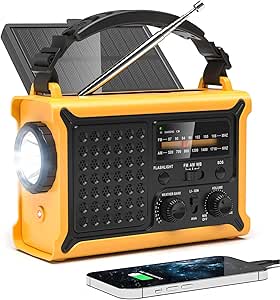 | Best for Outage Readiness | Battery capacity: 12,000mAh | Radio bands: AM, FM, and 7 NOAA weather channels | Power options: USB-C, solar, hand crank, or 3 AAA batteries | VIEW LATEST PRICE | See Our Full Breakdown |
| Sangean H201 Waterproof AM/FM Shower Radio with NOAA Weather Alerts |  | Best Water-Resistant Pick | Water resistance: IPX7; designed to float | Radio bands: AM, FM, and weather | Weather channels: 7 NOAA channels | VIEW LATEST PRICE | See Our Full Breakdown |
| NOAA Weather AM/FM Portable Radio with AC Adapter or 3 D Batteries |  | Best for Simple Backup Listening | Weather band range: 162.40–162.55 MHz | FM range: 87–108 MHz | AM range: 520–1710 kHz | VIEW LATEST PRICE | See Our Full Breakdown |
| weather radios for home emergencie | Dimensions | Power | Radio bands |
|---|---|---|---|
| NOAA Weather Alert Radio with | 1.5 × 4.8 × 5.28 in | USB-C or 3 AA batteries | FM 87–108 MHz; NOAA 162.400–162.550 MHz |
| Portable Emergency Weather Rad | — | — | AM, FM, shortwave, NOAA |
| Retekess TR604W AM/FM/NOAA Por | — | AC adapter or 3 D batteries | — |
| PRUNUS Portable AM/FM/SW/NOAA | 9.33 × 6.22 × 1.97 in | — | — |
| Midland WR120 NOAA Emergency W | — | AC; requires 3 AA batteries | — |
| Tenergy Emergency Hand Crank W | 6.1 × 1.93 × 3.7 inches | — | AM, FM, NOAA weather, and shortwave |
| NOAA Weather Radio with S.A.M. | — | AC adapter; backup with 4 AA batteries | — |
| DreamSky NOAA Emergency Weathe | 5.8 × 5.1 × 1.9 inches | Corded electric or 3 AA alkaline batteries | FM and 2-band weather radio |
| Goodes Portable NOAA Weather R | 5.1 × 2.76 × 0.98 inches | 2 AA batteries, not included | AM, FM, and NOAA weather |
| ROCAM Portable FM and NOAA Wea | — | — | FM and NOAA weather |
| Midland WR120B NOAA Emergency | 2 x 5.3 x 6.1 inches | AC adapter or 6 AAA batteries | — |
| NOAA Weather Radio with 12,000 | 4.7 × 2.9 × 6.8 inches | — | AM, FM, and 7 NOAA weather channels |
| Sangean H201 Waterproof AM/FM | 9.25 x 2.2 x 5.5 inches | — | AM, FM, and weather |
| NOAA Weather AM/FM Portable Ra | 9.17 × 2.4 × 5.24 inches | 3 D-cell batteries or AC power cord | — |
More Details on Our Top Picks
NOAA Weather Alert Radio with S.A.M.E. Localized Alerts
For a home setup where the main job is to wake you for relevant local warnings, this model’s S.A.M.E. filtering supports up to 23 location codes and more than 75 hazard types. Its customizable advisory, watch, and warning settings help reduce alerts you do not need, while a monthly test button, warning light, and LCD give you several ways to check its status. Compared with the Midland WR120, it offers fewer location codes, but adds USB-C power and a three-AA backup option. That backup can help during an outage; however, settings may reset when batteries are changed without USB-C connected. This is a dry-indoor radio, not a grab-and-go storm companion, and setup requires following the manual to configure locations and alert preferences.
Pros:- S.A.M.E. programming supports up to 23 location codes and alerts for more than 75 hazards.
- USB-C power with three-AA battery backup provides an alternative during household power loss.
- Customizable alert tiers and tones, plus a monthly test button.
- LCD, warning light, and external antenna offer useful status and reception aids.
Cons:- Settings may reset when batteries are changed unless USB-C power remains connected.
- Not waterproof and intended for dry indoor use.
- Location and alert configuration requires following the instruction manual.
Best for: Households that want to filter alerts by several local areas and tailor which hazard levels trigger notifications.
Not ideal for: People who need a waterproof radio for a shelter, garage, or outdoor use, or who want setup without consulting a manual.
- Alert technology:S.A.M.E.
- Location codes:Up to 23
- Emergency alerts:More than 75 hazards
- Power:USB-C or 3 AA batteries
- Radio bands:FM 87–108 MHz; NOAA 162.400–162.550 MHz
- Alert settings:Advisory, Watch, Warning; customizable tones
- Display and audio:LCD; 3.5 mm headphone jack
- Dimensions:1.5 × 4.8 × 5.28 in
- Use:Dry indoor use; non-waterproof
Our verdict“Choose this for configurable, location-specific alerts at home, but skip it if you need a weather radio that can handle wet conditions.”
Portable Emergency Weather Radio with Solar, Hand Crank, NOAA, AM/FM/SW, and 5000 mAh Battery
This is the lineup’s most self-reliant choice when an emergency may last beyond the time your household batteries can cover. Its five power options include a rechargeable 5000 mAh battery, solar panel, hand crank, USB input, and three AAA batteries, while the built-in flashlight, reading lamp, and USB phone charging add practical backup functions. Unlike the NOAA Weather Alert Radio with S.A.M.E. Localized Alerts, this model is designed to travel and sustain basic use away from an outlet, rather than emphasize tailored alert settings and a home display. That flexibility comes with a tradeoff: the provided details do not specify battery runtime, and the description does not establish S.A.M.E. county filtering. Its water resistance is useful, but it should not be treated as waterproof.
Pros:- Five power sources provide flexibility when mains power is unavailable.
- Receives NOAA, AM, FM, and shortwave broadcasts.
- Flashlight, reading lamp, and USB phone charging add useful emergency functions.
- Water-resistant construction suits carry-kit use better than indoor-only radios.
Cons:- Battery runtime is not specified in the product details.
- Three AAA batteries are needed for one power option and are not listed as included.
- No S.A.M.E. location-filtering capability is specified.
Best for: Households building an outage kit who want a portable radio with multiple ways to restore power and basic lighting.
Not ideal for: Buyers who prioritize county-specific alert filtering, a fixed home alert station, or a stated battery-runtime figure.
- Radio bands:AM, FM, shortwave, NOAA
- Battery capacity:5000 mAh
- Power sources:Rechargeable battery, solar panel, hand crank, 5V USB input, 3 AAA batteries
- Lighting:3 W flashlight; 2.5 W reading lamp
- Speaker output:3 W
- Display:LED
- Water resistance:Water resistant
- Dimensions and weight:6.69 × 3.74 × 2.36 in; 16 oz
- Audio connection:3.5 mm headphone jack
Our verdict“Pick this for a portable outage kit with several backup power methods, not as your first choice for finely localized home alerts.”
Retekess TR604W AM/FM/NOAA Portable Radio
The Retekess TR604W suits buyers who want a straightforward way to tune into local weather broadcasts without programming a digital alert system. It receives seven NOAA channels, runs from AC power or three D batteries, and has a carry handle and long telescopic antenna for repositioning when reception is weak. Compared with the Midland WR120 NOAA Emergency Weather Alert Radio, it is less focused on automatic, county-specific warnings: the product details describe broadcast reception, not S.A.M.E. alerts. That makes it a better fit for someone willing to tune in and listen, rather than relying on a tailored alert wake-up. Its analog display and controls keep the operation simple, though they offer less precise visual feedback than a digital LCD. D batteries are not included.
Pros:- Receives seven NOAA weather channels alongside AM and FM.
- Can run on AC power or three D batteries.
- Carry handle makes it easier to move to a better reception spot.
- 23.6-inch telescopic antenna can help with tuning.
Cons:- No S.A.M.E. alert programming is specified, so it is less suited to unattended localized warnings.
- Analog display provides less precise visual information than digital alert radios.
- Three D batteries are not included.
Best for: People who want a basic home radio for listening to NOAA broadcasts, with AC operation and D-cell backup.
Not ideal for: Households that need automatic localized alerts, a digital display, or a radio with batteries supplied.
- Model:TR604W
- Tuner:AM/FM/NOAA
- NOAA channels:7
- Power:AC adapter or 3 D batteries
- Display:Analog
- Antenna:23.6-inch telescopic
- Audio connection:3.5 mm audio jack
- Dimensions and weight:8.66 × 2.44 × 5.71 in; 746 g
- Warranty:1 year
Our verdict“Choose the TR604W for simple NOAA listening with AC and D-cell power, but choose the Midland WR120 if automatic county alerts matter more.”
PRUNUS Portable AM/FM/SW/NOAA Weather Radio with Flashlight
For someone who prefers a visible tuning dial to menus and alert programming, the PRUNUS keeps operation direct: turn the knobs, use the large dial, and tune across AM, FM, shortwave, or seven NOAA channels. Its 31-inch telescopic antenna and AC-or-D-cell power give it more flexibility as a listening radio than a compact, alert-focused model such as the NOAA Weather Alert Radio with S.A.M.E. Localized Alerts. The tradeoff is substantial for home emergency use: no S.A.M.E. filtering or automatic hazard alerts are specified, so users may need to monitor broadcasts themselves. A built-in flashlight is handy during an outage, but this radio is not water resistant, and its three D batteries are not included. It makes the most sense as a simple household receiver, not a hands-off warning system.
Pros:- Receives AM, FM, shortwave, and seven NOAA weather channels.
- Large dial and simple knobs make manual tuning approachable.
- AC cord and three-D-cell option support normal use and outages.
- Built-in flashlight adds a basic lighting source.
Cons:- No S.A.M.E. programming or automatic hazard-alert function is specified.
- Not water resistant, limiting use around wet conditions.
- Three D-cell batteries are not included.
Best for: Buyers who favor tactile knobs and a large tuning dial for listening to NOAA and other broadcasts at home.
Not ideal for: People who need automatic location-specific alerts or plan to use the radio in damp or wet emergency conditions.
- Bands:AM, FM, shortwave, and 7 NOAA weather channels
- Frequency ranges:AM 520–1710 kHz; FM 87–108 MHz; SW 7.0–19.0 MHz
- Power sources:AC power cord or 3 D-cell batteries
- Antenna:31-inch telescopic
- Additional features:Flashlight, auxiliary input, earphone jack
- Dimensions:9.33 × 6.22 × 1.97 in
- Weight:1.29 lb
- Water resistance:Not water resistant
Our verdict“Pick the PRUNUS for uncomplicated manual listening and a built-in flashlight, but not for unattended localized storm alerts.”
Midland WR120 NOAA Emergency Weather Alert Radio
The Midland WR120 is the strongest fit here for households that want a dedicated alert radio with S.A.M.E. programming and clear county targeting. It can cover up to 25 selected counties—two more than the NOAA Weather Alert Radio with S.A.M.E. Localized Alerts—and its English, Spanish, and French display languages can make alert information more accessible across a household. A clock with alarm and snooze also gives it a place on a bedside table, beyond weather monitoring. Compared with the portable hand-crank radio in this roundup, the WR120 is less flexible away from home: it relies on AC power or three AA batteries and does not list solar or crank charging. Its role is a stationary warning device, not a lighting or phone-charging kit, so keep a separate outage light available.
Pros:- S.A.M.E. programming covers up to 25 selected counties.
- Display supports English, Spanish, and French.
- Scans seven NOAA weather band channels.
- Clock, alarm, and snooze add useful bedside functionality.
Cons:- Requires AC power or three AA batteries.
- No solar, hand-crank charging, flashlight, or phone-charging feature is specified.
- Less suited to mobile emergency use than the portable multiband hand-crank model.
Best for: Multilingual households that want a home-based alert radio programmed for multiple nearby counties.
Not ideal for: People seeking a portable, self-charging emergency kit radio with a flashlight or phone-charging function.
- Model:WR-120C
- Weather band channels:7
- County programming:Up to 25 counties
- Display languages:English, Spanish, French
- Power:AC; requires 3 AA batteries
- Connectivity:USB
- Dimensions and weight:6 × 5 × 1.5 in; 1 lb
- Clock functions:Clock, alarm, and snooze
- Warranty:1 year parts and labor
Our verdict“Choose the WR120 for multilingual, multi-county alerts at home, and pair it with separate lighting and portable power for outages.”
Tenergy Emergency Hand Crank Weather Radio with AM/FM/NOAA, Solar Charging, and Flashlight
For a home emergency kit that may need to work through a long outage, the Tenergy stands out for its four power options: hand crank, solar, micro-USB, and three AAA batteries. Its NOAA reception is joined by AM, FM, and shortwave, giving it broader broadcast coverage than the Goodes Portable NOAA Weather Radio, which runs on AA batteries but lacks solar and crank charging. The Tenergy also adds dual 120-lumen flashlights, an SOS siren, and a phone-charging function, so it can serve as more than a way to hear alerts. The tradeoff is that its 2000mAh capacity is modest for charging a phone, and the radio is not water resistant. I’d choose it for a sheltered home kit, not for wet or exposed conditions.
Pros:- Hand-crank, solar, micro-USB, and AAA power options provide flexibility during an outage.
- Receives NOAA, AM, FM, and shortwave broadcasts.
- Dual 120-lumen flashlights and SOS signaling add emergency visibility.
- Can provide a basic phone charge through its 2000mAh battery.
Cons:- Not water resistant, limiting use in damp or exposed areas.
- Three AAA batteries are required for battery operation.
- The 2000mAh capacity offers limited phone-charging reserve.
Best for: Households building a versatile outage kit that want weather alerts, lighting, and several ways to power the radio.
Not ideal for: People who need reliable operation in rain or want a substantial phone-charge reserve; it is not water resistant and its battery capacity is 2000mAh.
- Radio bands:AM, FM, NOAA weather, and shortwave
- Charging methods:Hand crank, solar panel, micro-USB, and 3 AAA batteries
- Battery capacity:2000mAh
- Flashlights:Dual LED, 120 lumens
- Emergency signaling:SOS siren and flashing Morse code light
- Dimensions:6.1 × 1.93 × 3.7 inches
- Weight:275 g
- Water resistance:Not water resistant
Our verdict“Choose the Tenergy if you want one compact device with several backup power methods, radio reception, and emergency lighting for indoor use.”
NOAA Weather Radio with S.A.M.E. Localized Programming
This is the most alert-focused choice in this group: S.A.M.E. programming for up to 23 counties helps narrow warnings to the areas a household cares about, while seven weather-band channels and more than 80 selectable emergency alerts broaden coverage. Voice, siren, and display alerts give households options for how warnings are delivered. Compared with the DreamSky NOAA Emergency Weather Radio, it adds an external antenna and a separate flashing alert light, useful when a warning needs to be noticed across a room. It also has AC power with four AA batteries as backup. The main compromise is its stationary, outlet-oriented design: it is not water resistant, and the four backup batteries must be supplied separately. I’d favor it for a bedroom or central indoor alert station rather than portable use.
Pros:- S.A.M.E. county programming can cover up to 23 counties.
- Voice, siren, and display alert modes suit different rooms and hearing preferences.
- AC operation with four-AA backup helps maintain alerts during a power outage.
- External antenna and flashing alert light add reception and notification options.
Cons:- Four AA batteries for backup power are not included in the listed power setup.
- Not water resistant.
- Its AC-oriented format is less convenient for portable emergency use.
Best for: Households in areas with frequent localized alerts that want county-specific warnings and visible or audible notification at home.
Not ideal for: Buyers seeking a compact carry-around radio or a weather device for damp locations; this AC-oriented unit is not water resistant.
- Weather band channels:7
- Selectable emergency alerts:More than 80
- County programming:Up to 23 counties
- Alert modes:Voice, siren, and display
- Power:AC adapter; backup with 4 AA batteries
- Display:LCD
- Additional alert features:External antenna and external flashing alert light
- Water resistance:Not water resistant
Our verdict“Pick this model for a home alert station where county-level filtering and multiple warning modes matter more than portability.”
DreamSky NOAA Emergency Weather Radio with Battery Backup and FM
The DreamSky makes sense for buyers who want a plug-in home alert radio with county filtering, without moving into a more feature-heavy setup. Its S.A.M.E. programming supports 23 customizable county codes, and more than 80 alert types can come through as voice, tone, or display notices. A clock, snooze alarm, adjustable volume, and three LCD backlight settings make it easy to keep on a bedside table. Compared with the NOAA Weather Radio with S.A.M.E. Localized Programming, it offers a similar county-focused approach but does not list that model’s external antenna or flashing alert light. Its radio entertainment is also limited to FM, unlike the Tenergy Emergency Hand Crank Weather Radio, which receives AM and shortwave too. Three AA batteries are needed for backup and are not included.
Pros:- S.A.M.E. programming supports 23 customizable county codes.
- More than 80 emergency types can use voice, tone, or display alert modes.
- Corded operation with three-AA battery backup provides two power options.
- Clock, snooze alarm, adjustable volume, and three backlight settings suit bedside use.
Cons:- Three AA batteries are required for backup and are not included.
- FM is the only listed broadcast band besides weather alerts.
- It lacks the hand-crank and solar charging options offered by the Tenergy.
Best for: People who want a straightforward bedside or household radio with county-specific weather alerts, an FM tuner, and a clock.
Not ideal for: Listeners who want AM or shortwave, or buyers who need included backup batteries or a portable crank-powered radio.
- Radio bands:FM and 2-band weather radio
- Emergency alerts:More than 80
- County codes:23 customizable
- Alert modes:Voice, tone, and display
- Power:Corded electric or 3 AA alkaline batteries
- Batteries included:No
- Display:LCD with always-on, always-off, and 5-second backlight modes
- Dimensions:5.8 × 5.1 × 1.9 inches
Our verdict“Choose the DreamSky for a simple, county-programmable bedside alert radio if FM is enough and you can provide backup batteries.”
Goodes Portable NOAA Weather Radio with AM/FM, Headphone Jack, and 2 AA Battery Power
At 4.4 ounces and under an inch thick, the Goodes is the simplest portable choice here for keeping weather reception close at hand. It receives NOAA, AM, and FM broadcasts, and its swivel antenna helps with positioning when reception varies. Unlike the Tenergy Emergency Hand Crank Weather Radio, it has no solar or crank charging, flashlight, or phone-charging feature; that keeps the Goodes more focused, but leaves fewer ways to manage a prolonged outage. Two AA batteries are widely available, though they are not included, and the built-in speaker can be swapped for private listening through the 3.5 mm headphone jack. This is a personal radio rather than a household alert station: there is no listed S.A.M.E. county filtering or dedicated alert system. Its lack of water resistance also calls for indoor or dry-bag storage.
Pros:- Receives NOAA weather, AM, and FM broadcasts.
- Lightweight 4.4-ounce design is easy to store or carry.
- Swivel antenna supports adjustments for reception.
- Built-in speaker and 3.5 mm headphone jack offer shared or private listening.
Cons:- Requires two AA batteries, which are not included.
- No solar, hand-crank, or rechargeable power option is listed.
- Not water resistant and has no listed S.A.M.E. alert programming.
Best for: People who want a lightweight radio for monitoring NOAA, AM, and FM broadcasts during an evacuation or around the house.
Not ideal for: Households seeking automatic county-specific alerts, backup charging methods, emergency lighting, or water resistance.
- Radio bands:AM, FM, and NOAA weather
- NOAA frequency range:162.400–162.550 MHz
- FM frequency range:87–108 MHz
- AM frequency range:520–1710 kHz
- Power:2 AA batteries, not included
- Weight:4.4 ounces
- Dimensions:5.1 × 2.76 × 0.98 inches
- Audio connections:Built-in speaker and 3.5 mm headphone jack
Our verdict“Choose the Goodes as a lightweight, battery-powered listening radio, not as a full-featured household alert or outage-lighting system.”
ROCAM Portable FM and NOAA Weather Radio with Bluetooth
The ROCAM is the most entertainment-oriented option in this batch, pairing NOAA reception with Bluetooth 5.0, an 8W speaker, and microSD playback. Its rechargeable 3000mAh battery is rated for up to 18 hours, while USB-C charging makes it a more modern everyday listening device than the AA-powered Goodes Portable NOAA Weather Radio. For home emergencies, auto scan, 40 FM presets, a color display, and a 120dB SOS siren add practical extras. But it is not a dedicated county-alert receiver: the listed features do not include S.A.M.E. programming or AM reception, and NOAA reception can vary with local coverage and conditions. Compared with the alert-focused NOAA Weather Radio with S.A.M.E. Localized Programming, the ROCAM trades localized warning controls for broader audio features. I’d treat it as a useful secondary radio, not the household’s only alert device.
Pros:- 3000mAh rechargeable battery is rated for up to 18 hours of playtime.
- Bluetooth 5.0, microSD playback, and a headphone jack provide several listening options.
- FM auto scan and 40 presets make station access straightforward.
- NOAA reception and a 120dB SOS siren add emergency utility.
Cons:- Does not receive AM or shortwave bands.
- No S.A.M.E. county programming is listed.
- NOAA reception depends on local coverage and conditions.
Best for: Households that want a rechargeable FM and NOAA radio for everyday listening, with an SOS siren and extra audio sources for outages.
Not ideal for: Buyers who need AM or shortwave reception, county-specific alert programming, or a primary dedicated weather-alert station.
- Radio bands:FM and NOAA weather
- FM frequency range:87.5–108 MHz
- Presets:40
- Battery capacity:3000mAh
- Bluetooth:5.0
- Speaker output:8W
- Display and charging:2.4-inch color display; USB Type-C charging
- Emergency and audio features:120dB SOS siren, microSD playback, and 3.5 mm headphone jack
Our verdict“Pick the ROCAM if you want a rechargeable everyday audio radio with NOAA and SOS features, but pair it with a dedicated alert receiver for localized warnings.”
Midland WR120B NOAA Emergency Weather Alert Radio
For a household that needs to know when a warning applies to its area, the Midland WR120B is the most focused choice here. Its S.A.M.E. programming for up to 25 counties helps narrow alerts to selected locations, while NOAA Weather Scan and alerts for more than 60 hazard types make it more useful as a dedicated warning device than a general radio. Color-coded indicators and selectable tones can help residents distinguish an alert at a glance or by sound. Compared with the NOAA Weather Radio with 12,000mAh Battery, Hand Crank and Solar Charging, this Midland gives priority to localized alerting rather than portable power, lighting, and phone charging. The tradeoff is that it is designed for NOAA alerts, not broad radio listening, and backup operation takes six AAA batteries.
Pros:- S.A.M.E. programming can target alerts for up to 25 counties
- NOAA Weather Scan covers more than 60 hazard types
- Color-coded indicators and selectable alert tones make warnings easier to identify
- Can operate from an AC adapter or six AAA batteries
Cons:- Battery backup requires six AAA cells
- Focused on NOAA alerts rather than general AM/FM listening
Best for: Households that want localized NOAA warnings for their home and can keep the radio connected to AC power, with AAA batteries ready for outages.
Not ideal for: Buyers who want an all-purpose AM/FM radio, a large rechargeable battery, or a hand-crank backup system.
- Radio band:1-band
- Frequency:108 MHz
- Power:AC adapter or 6 AAA batteries
- Programmable alert coverage:Up to 25 counties
- Alert types:More than 60
- Display:LCD with LED display technology
- Dimensions:2 x 5.3 x 6.1 inches
- Weight:16 ounces
Our verdict“Choose the WR120B if localized home warnings matter more than broad radio listening or off-grid charging options.”
NOAA Weather Radio with 12,000mAh Battery, Hand Crank and Solar Charging
This model is the strongest fit for a home emergency kit that needs to keep working when wall power is unavailable. Its 12,000mAh rechargeable battery can run the radio, lighting, and emergency phone charging, while USB-C, solar, hand-crank, and AAA power provide several ways to replenish or replace its supply. The flashlight, reading light, and SOS siren add practical functions beyond listening. Compared with the Midland WR120B, it is much more versatile during an extended outage, but it gives up that radio’s S.A.M.E. county programming and dedicated alert-focused design. One key limitation is that NOAA alerts require the radio to be on and tuned to a weather channel; it is not the same kind of standby alert monitor. The wall adapter is also not included.
Pros:- 12,000mAh battery supports radio use, lighting, and emergency phone charging
- USB-C, solar, hand crank, and three AAA batteries offer multiple power options
- Receives NOAA, AM, and FM broadcasts
- Includes a flashlight, reading light, and SOS siren
Cons:- NOAA alerts require the radio to be on and tuned to a weather band
- Wall adapter is not included
- Does not offer the localized S.A.M.E. county alerting found on the Midland WR120B
Best for: Households assembling an outage kit that want a rechargeable radio, emergency lighting, and a way to provide limited phone power.
Not ideal for: People seeking a set-and-forget alert radio with automatic warnings while tuned to another station or with the unit off.
- Battery capacity:12,000mAh
- Radio bands:AM, FM, and 7 NOAA weather channels
- Power options:USB-C, solar, hand crank, or 3 AAA batteries
- Solar panel area:8,500mm²
- Flashlight brightness:300 lumens
- Reading light brightness:250 lumens
- SOS siren:115dB
- Dimensions:4.7 × 2.9 × 6.8 inches
Our verdict“Pick this radio for a multi-function outage kit if rechargeable power and emergency lighting matter more than automatic localized alerts.”
Sangean H201 Waterproof AM/FM Shower Radio with NOAA Weather Alerts
The Sangean H201 suits buyers who want NOAA reception in places where splashes, rain, or a fall into water are concerns. Its IPX7 rating and floatable design set it apart from the Midland WR120B, which is described as waterproof but is more focused on fixed home alerting than wet-area portability. AM and FM reception, station presets, an LED light, and an emergency buzzer give the Sangean more everyday use than a dedicated warning unit. For home emergencies, though, it is better treated as a portable listening option than a localized alert station: the listed features do not include S.A.M.E. county programming or automatic alert notifications. It also runs on two D batteries, so buyers should plan for battery storage and replacement rather than rechargeable or hand-crank backup.
Pros:- IPX7-rated construction and floatable design suit wet locations
- Receives AM, FM, and seven NOAA weather channels
- LED light and emergency buzzer add simple emergency functions
- Handle, strap, and wall plate provide several mounting or carrying options
Cons:- Requires two D batteries
- No S.A.M.E. county programming is listed
- At 2 lb, it is heavier than a compact emergency radio
Best for: People who want a floatable radio for a bathroom, poolside, or damp outdoor area that can also receive NOAA weather broadcasts.
Not ideal for: Households prioritizing localized automatic alerts, lightweight portability, or a rechargeable emergency power source.
- Water resistance:IPX7; designed to float
- Radio bands:AM, FM, and weather
- Weather channels:7 NOAA channels
- Station presets:10 FM, 5 AM, and 5 weather
- Power source:2 D batteries
- Display:LCD
- Dimensions:9.25 x 2.2 x 5.5 inches
- Weight:2 lb
Our verdict“Choose the H201 for wet-area use and flexible listening, but choose the Midland WR120B for more focused home alerting.”
NOAA Weather AM/FM Portable Radio with AC Adapter or 3 D Batteries
This radio is a straightforward choice for households that want to tune in to weather broadcasts and regular AM/FM stations without extra emergency-kit features. Its AC or three-D-cell power, carrying handle, and simple analog controls make it easy to place at home and move if needed. The telescopic antenna and DSP chip support reception, while the headphone jack allows private listening. Compared with the NOAA Weather Radio with 12,000mAh Battery, Hand Crank and Solar Charging, this model is simpler and offers neither a flashlight nor phone charging. Its largest drawback for home emergencies is more important: it does not automatically notify users of NOAA alerts, so someone must tune to a weather band to hear updates. It is also not water resistant, making it a poor fit for damp or outdoor use.
Pros:- Runs from an AC power cord or three D-cell batteries
- Telescopic antenna and DSP chip support radio reception
- 3W speaker and 3.5 mm headphone jack offer listening flexibility
- Simple controls and a carrying handle suit basic home use
Cons:- Does not automatically notify users of NOAA alerts
- Three D-cell batteries are not included
- Not water resistant
Best for: Buyers who want a simple AC-powered home radio with battery backup for manually checking NOAA, AM, and FM broadcasts.
Not ideal for: People who need automatic warnings, hands-free alert monitoring, rechargeable or hand-crank power, or water protection.
- Weather band range:162.40–162.55 MHz
- FM range:87–108 MHz
- AM range:520–1710 kHz
- Power:3 D-cell batteries or AC power cord
- Battery life:Up to about 36 days at 2 hours of listening per day
- Speaker output:3 W
- Headphone jack:3.5 mm
- Dimensions:9.17 × 2.4 × 5.24 inches
Our verdict“Choose this model for simple manual weather-radio listening, not as a substitute for an automatic home alert radio like the Midland WR120B.”
How We Picked
I ranked these weather radios for home emergencies by how well each product appears suited to the jobs a household needs most: receiving NOAA weather information, making alerts usable, and staying available when power or routines are disrupted. I gave more weight to dedicated alert functions and clear power choices than to extras such as Bluetooth, shortwave, or a flashlight. A feature only helps if its role is clear and the buyer can maintain it.
The order reflects home readiness first, then versatility and portability. Dedicated NOAA alert models rank ahead of general-purpose portable radios for households that want a radio monitoring alerts in one place. Crank, solar, and larger-battery options rise for buyers concerned about outages, while replaceable-battery and specialized models earn their places for simplicity or a particular setting. Because listed features do not establish reception quality, alert loudness, or runtime under real conditions, I treat those as points buyers should verify rather than assume.
Factors to Consider When Choosing Weather Radios For Home Emergencies
Choosing an emergency radio is less about finding one model with every feature and more about deciding what role it should fill in your household plan. These factors help separate reliable alert monitoring from backup listening and identify which compromises matter before you buy.
Decide Whether You Need Automatic Alerts or a Portable Radio
A dedicated alert radio is designed to stay in a set location and notify you when relevant weather information is broadcast. A portable AM/FM/NOAA model gives you more freedom to move it, but may require you to turn it on and tune in when you want updates. These roles are not interchangeable: a portable radio can be useful during an outage without serving as a constantly monitored alert system. Decide who will hear the alert, where the device will sit, and whether anyone in the home may sleep through or miss a sound. If you need both functions, plan for two devices or confirm that a single model provides the alert behavior you expect.
Check Alert Filtering and Local Coverage Before Setup
S.A.M.E. programming can help a radio target alerts for selected counties or areas instead of broadcasting every alert it can receive. That can reduce irrelevant warnings, but it adds setup work and depends on entering the correct location information. Buyers should check that their area is supported and that they can find the right county codes before relying on the feature. Reception also depends on local signal strength, building materials, and radio placement, not only the product label. Test the radio in the room where it will live, then try a different position if reception is weak.
Match Backup Power to Your Household’s Habits
Hand cranks and solar panels provide alternatives when wall power is unavailable, while replaceable batteries can be ready without a charging routine. A built-in battery offers convenience, but it can lose charge during long storage or eventually require replacement. Solar charging often depends on suitable light and may be slow, so do not assume it will replenish a radio quickly indoors. Think about who will operate a crank, whether spare batteries will be stored nearby, and how often the radio will be checked. A modest power plan that the household maintains is more useful than several charging methods that nobody remembers to test.
Treat Battery Capacity and Runtime as Different Claims
A battery capacity figure describes stored energy, not how long the radio will run in every mode. Flashlight use, volume, Bluetooth, signal conditions, and charging losses can all change runtime. Compare models by looking for stated runtime conditions and charging details, rather than assuming a larger number guarantees more dependable emergency service. If runtime information is missing, plan conservative use and keep another power source available. For a radio that may sit unused, also check how the battery is maintained and whether the manufacturer gives storage guidance.
Choose Extras Only When They Solve a Real Need
A flashlight can reduce the number of devices you need to find during an outage, and waterproofing can suit a bathroom, utility area, or damp location. Bluetooth is useful for everyday listening but does not improve weather alerts. Shortwave expands listening options, though it may add controls that a household does not need during an emergency. Each extra can affect size, controls, and power use, so prioritize the radio’s main emergency role first. If several family members will use it, favor controls and alert behavior they can operate without searching through unfamiliar modes.
Plan Placement, Accessibility, and Routine Checks
A radio stored in a closet may be portable but is less helpful if no one can find it quickly. Keep a home alert radio near a frequently used area, with its power supply connected where appropriate and spare batteries stored nearby. Avoid placing it where walls, appliances, or metal surfaces may interfere with reception, and keep any printed setup instructions with the device. Test alert reception and backup power periodically, especially after moving the radio or changing its batteries. A simple household routine—checking power, location settings, and operation—often matters more than adding another feature.
Frequently Asked Questions
Should I choose a dedicated NOAA alert radio or a portable emergency radio?
Choose a dedicated alert radio if your main goal is to receive warnings at home without remembering to tune in each time. A portable model is a better fit when you also need to carry the radio between rooms or rely on it during an outage. Some portable radios include alert features, but verify how alerts are received and whether the device can monitor them in the way you expect. If your household needs both continuous alerting and portable listening, separate devices may be simpler to manage. Make placement and alert setup part of the decision rather than treating all NOAA labels as equivalent.
Is S.A.M.E. programming worth setting up?
S.A.M.E. programming can make alerts more relevant by narrowing them to selected geographic areas. It is most helpful when a radio would otherwise receive warnings for several places you do not need to monitor. The feature requires accurate setup, so check that you can identify your area’s code and enter it correctly. Buyers who prefer a simpler device may be comfortable with broader alerts instead. Either way, confirm reception at home and keep the radio’s setup instructions accessible.
Can I rely on solar charging or a hand crank as my only backup power?
I would treat both as backup methods rather than the only power plan. Solar charging depends on access to usable light and may take time, while a hand crank requires effort and may provide limited operating time per charging session. A radio with replaceable batteries or a charged internal battery gives you another option if those methods are impractical during an emergency. Check the manufacturer’s charging and runtime information, since these can vary by model and usage. Keep a way to test the backup method before severe weather threatens.
Where should I place a weather radio in my home?
Put a dedicated alert radio somewhere people are likely to hear it, such as a commonly used room, rather than storing it with emergency supplies. Test reception in that spot and move it if the signal is weak; walls, appliances, and building materials can affect reception. For a portable model, pick an accessible location and keep its backup batteries or charging cable alongside it. If overnight alerts matter, think about whether the sound can reach sleeping areas. Placement should also allow the radio to remain connected to its normal power source when it has one.
Do I need both a home alert radio and a battery-powered portable model?
Not every household needs two radios, but the combination covers different jobs. A dedicated alert model can stay in one place and monitor warnings, while a portable radio can move with you or serve as a listening source when household power fails. If you choose only one, decide which job matters more and check that its power arrangement fits your plan. A household with several floors or people who may not hear a single alert location could benefit from a second receiver. Whatever the setup, test both devices and keep their power supplies ready.
Conclusion
For most households seeking a fixed home alert system, I’d choose the Midland WR120 as the best overall, with the WR120B as a close alternative for buyers comparing dedicated NOAA alert radios. The Goodes portable radio is a sensible best-value-style pick for buyers who prefer replaceable AA batteries and basic portable listening, while the 12,000mAh crank-and-solar model is the best premium-style choice for layered backup power—provided its charging and runtime details fit your needs. For beginners, I’d favor a straightforward setup such as the DreamSky with battery backup over a model whose many extra functions add complexity. Choose the Sangean H201 for a waterproof setting, or a crank-and-solar portable option if moving the radio and charging without an outlet matter most. The best match is the one your household can set up, hear, power, and check regularly.