
TL;DR

Get everyday essentials delivered free with Prime
- Fast, free delivery on millions of items
- Prime Video, Amazon Music and more included
- Member-only deals all year
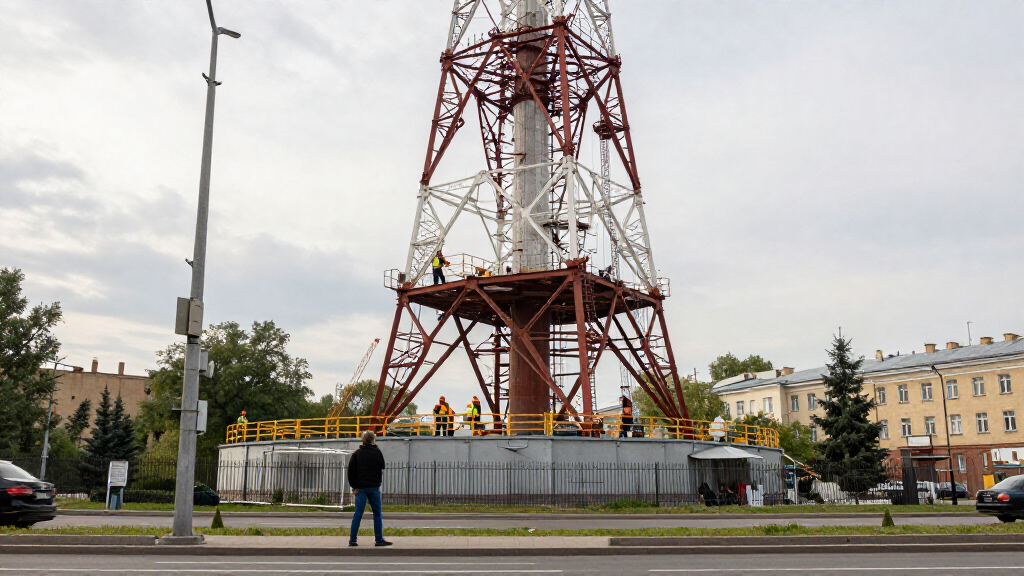
Russia’s broadcasting network RTRS plans to dismantle almost all of Moscow’s 1922 Shukhov Tower this fall and replace the original steel with replica components by 2028. Specialists cited in Meduza’s report say preserving the original metal is central to preserving engineer Vladimir Shukhov’s work. The full restoration plan and how much original material would remain are not clear from the available report.
Russia’s Television and Radio Broadcasting Network (RTRS) plans to dismantle almost all of Moscow’s 1922 Shukhov Tower this fall and replace it with a replica by 2028, according to a report by Meduza. The proposed work has prompted concern from specialists who say that retaining the original steel is part of preserving engineer Vladimir Shukhov’s work, not just the tower’s recognizable shape.
The 144-meter tower, also known as the Shabolovka Tower, was built between 1919 and 1922. RTRS owns the structure and plans the overhaul, Meduza reported. The report says the project would remove and replace almost all of the tower’s original metal; it does not provide a detailed inventory of which parts would be retained.
Shukhov designed the tower as a lattice of straight steel rods arranged in a hyperboloid form. Its six sections were raised one after another using a method known as telescopic assembly. The design made the structure comparatively light while allowing wind to pass through the lattice. The tower was once the Soviet Union’s principal radio and television transmitter and remains a landmark in Moscow’s Shabolovka neighborhood.
Specialists quoted by Meduza argue that a replica could preserve the tower’s outline while losing much of its historical substance. The report describes the planned replacement as a disputed overhaul, but the available material does not include RTRS’s detailed technical justification, cost, or responses to the specialists’ concerns.
Why Original Steel Matters
The dispute turns on what counts as preserving a historic structure. The tower’s form can potentially be reproduced, but its original steel carries material evidence of its construction in the early Soviet period. Specialists cited by Meduza say replacing nearly all of that metal would amount to destroying Shukhov’s work, even if a replica retained the same silhouette.
The decision also affects how Moscow’s architectural heritage is treated. The tower is a recognized neighborhood landmark and an example of Shukhov’s engineering. If the reported plan proceeds, the result could keep the familiar structure on the skyline while substantially changing the amount of original fabric that survives.
From Radio Landmark to Restoration Dispute
Shukhov developed lattice hyperboloid structures from the late 19th century; his first such tower was built for an exhibition in Nizhny Novgorod in 1896. The Shabolovka project was backed by Vladimir Lenin, who had ordered a powerful Moscow radio station built with urgency. The tower opened in 1922 as the Comintern Radio Tower.
At 144 meters, it was Moscow’s tallest structure until Moscow State University’s main building was completed in 1953. It transmitted a television signal in 1937, and regular broadcasts began on March 10, 1939. It later lost its role as the Soviet Union’s main television tower after the Ostankino Tower was built.
“newspaper without paper and without distance”
— Vladimir Lenin, as quoted in Meduza’s report
Details of the Replacement Plan
The available report does not specify how much original steel would remain, how the replacement components would be made, or how RTRS assessed the tower’s condition. It also does not include the network’s detailed response to heritage specialists who oppose replacing nearly all of the metal.
The schedule is reported as a plan: dismantling is expected this fall and a replica is planned by 2028. The source material does not confirm that dismantling has begun, that all required approvals are in place, or that the stated timetable is final.
The Route to Work Beginning
RTRS’s reported next step is to begin dismantling the tower this fall, followed by construction of a replica targeted for completion by 2028. The project’s progress, any final technical or heritage decisions, and the amount of original material that may be preserved will determine how closely the outcome matches the stated restoration plan.
Key Questions
Who owns the Shukhov Tower?
RTRS, Russia’s Television and Radio Broadcasting Network, owns the tower and is the organization reported to be planning the work.
What does RTRS plan to do?
According to Meduza, RTRS plans to dismantle almost all of the tower this fall and replace it with a replica by 2028.
Why are specialists objecting?
Specialists cited by Meduza say the original steel is part of Shukhov’s work. Reproducing the tower’s shape while replacing nearly all its original metal, they argue, would not preserve the historic structure in a meaningful material sense.
When was the tower built?
The Shabolovka Tower was built between 1919 and 1922 and opened as the Comintern Radio Tower in 1922.
Has dismantling started?
The report describes dismantling as planned for this fall. The available source material does not confirm that work has started.
Source: rss
Halloween Picks
halloween
As an affiliate, we earn on qualifying purchases.