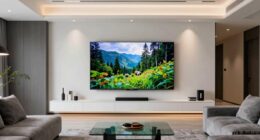
If you want the best contrast and deep blacks, OLED is a great choice because each pixel lights up on its own. For brighter images and more energy efficiency, QLED offers vivid colors and high brightness, ideal for well-lit rooms. Mini LED balances the two, giving you good blacks and brightness with less power use. Understanding these options helps match your viewing habits, and if you keep exploring, you’ll find out which tech suits you best.
Key Takeaways
- OLED pixels emit their own light, providing perfect blacks and better contrast than QLED or Mini LED.
- QLED uses quantum dots for brighter images and is more energy-efficient in well-lit environments.
- Mini LED offers a balance with deep blacks, high contrast, and better power efficiency than traditional LCDs.
- QLEDs excel in brightness but struggle with black levels compared to OLED and Mini LED.
- Mini LED combines the advantages of OLED and QLED, delivering excellent contrast and vibrant colors with less power use.

Are you trying to decide between OLED, QLED, and Mini LED TVs? Choosing the right one depends on what matters most to you, whether it’s picture quality, energy efficiency, or overall value. Let’s break down the differences in a straightforward way.
OLED TVs stand out because each pixel emits its own light, giving you incredible contrast and deep blacks. When you watch a dark scene, the black areas look truly black, not just dark gray. This makes images appear more vibrant and lifelike. Because of this pixel-level control, OLEDs often have fantastic color accuracy, making every hue pop with clarity. Additionally, OLED technology often results in wider viewing angles, maintaining color fidelity from different perspectives. However, they tend to consume more power when displaying bright images since each pixel is actively lit. If you watch a lot of bright content, your energy bill might be slightly higher compared to other types. Still, the picture quality generally outweighs this concern for most viewers. It’s also worth noting that OLED screens can be more susceptible to image retention or burn-in over time. Moreover, the manufacturing process of OLEDs involves organic materials, which can influence longevity and cost.
OLEDs deliver stunning contrast and deep blacks, making images vibrant and lifelike, though they use more power with bright scenes.
QLED TVs, on the other hand, use a layer of quantum dots to enhance the backlight of an LCD panel. This design delivers bright images with excellent color accuracy, often surpassing OLEDs in brightness levels. This makes QLEDs ideal for viewing in well-lit rooms or during daytime. Because they rely on a backlight, QLEDs are usually more energy-efficient when displaying bright scenes, consuming less power than OLEDs under the same conditions. Their ability to produce vibrant colors and high brightness levels makes them perfect for watching HDR content, where color and contrast are essential. However, since they use a backlight, achieving perfect blacks is more difficult, and you might notice some light bleed around dark scenes. The local dimming technology in Mini LED TVs builds upon this concept to provide even better contrast. In addition, QLEDs tend to be more affordable than OLEDs, making them a popular choice for budget-conscious consumers.
Mini LED technology takes the strengths of QLEDs even further. It uses thousands of tiny LEDs for backlighting, allowing for more precise control of local dimming zones. This results in better contrast and deeper blacks than standard QLEDs, bringing it closer to OLED performance but without some of the drawbacks. Because Mini LEDs can turn off small sections of the backlight independently, they improve black levels and reduce blooming. In addition, Mini LED technology employs more LEDs than traditional backlit screens, further enhancing picture quality. This increased control over local dimming zones also helps in reducing light bleed, making dark scenes more detailed. In terms of power consumption, Mini LEDs tend to be more efficient than OLEDs when displaying bright scenes, but their power use can vary depending on content. Overall, Mini LED offers a compelling balance: vibrant, accurate colors, deep blacks, and relatively low power consumption.
In conclusion, the choice depends on your viewing habits and what you value most in a TV. If you want perfect blacks and superior contrast and don’t mind slightly higher power use, OLED is your best bet. If you prefer brighter images and better energy efficiency in bright scenes, QLED could suit you better. And if you want the best of both worlds with excellent contrast, color accuracy, and efficient power use, Mini LED might be the ideal choice. Selecting the appropriate technology involves understanding these display characteristics to match your specific needs.
OLED TV 55 inch
As an affiliate, we earn on qualifying purchases.
As an affiliate, we earn on qualifying purchases.
Frequently Asked Questions
Which Technology Is Best for Gaming?
For gaming, OLED is your best bet because it offers superior color accuracy and faster response latency, giving you smoother, more vibrant visuals with less motion blur. QLED and Mini LED screens can also be good, but they often lag behind in response times and color depth. If you prioritize fast gameplay and stunning visuals, OLED provides the most immersive experience, making it ideal for serious gamers.
How Durable Are OLED Screens?
While OLED screens are quite impressive, they do have a gentle tendency toward screen burn-in if you’re not careful, which can affect longevity. However, with proper usage and modern advancements, their lifespan remains quite respectable. You’ll find that, when managed well, OLED displays offer vibrant visuals and durability that hold up over time, making them a reliable choice for everyday use and long-term enjoyment.
Do QLEDS Consume More Power?
Yes, QLEDs generally consume more power than OLEDs because they use a backlight to illuminate the entire screen, which increases energy use. If you’re concerned about energy efficiency, OLEDs tend to be more power-efficient, especially when displaying darker images. So, when you choose between QLED and OLED, consider your preferences for power consumption and overall energy efficiency to get the best fit for your needs.
Can Mini LED TVS Be as Thin as OLEDS?
Mini LED TVs can be as thin as OLEDs, thanks to their advanced backlight design. While OLEDs are known for their ultra-slim panels, Mini LED technology has improved, reducing thickness to around 1.5 inches or less. This makes Mini LED TVs competitive in panel thickness, offering sleek designs without sacrificing picture quality. You’ll find that both options can now fit seamlessly into modern, stylish entertainment setups.
Which Displays Are More Cost-Effective Long-Term?
You’ll find that QLED and Mini LED displays tend to be more cost-efficient long-term compared to OLEDs. While OLEDs offer stunning picture quality, their higher initial prices and potential for burn-in reduce investment longevity. QLEDs and Mini LEDs, with their lower costs and durability, provide better value over time. If you’re looking for a budget-friendly, reliable screen that lasts, QLED or Mini LED options are smarter choices for sustained cost efficiency.
QLED TV with high brightness
As an affiliate, we earn on qualifying purchases.
As an affiliate, we earn on qualifying purchases.
Conclusion
So, now that you know the differences, you’re practically a display wizard! Whether you pick OLED’s perfect blacks, QLED’s vibrant colors, or Mini LED’s stunning brightness, your TV game will never be the same. Prepare for jaw-dropping visuals that will blow your mind and make every movie night feel like a cinematic adventure. Get ready to experience the future of TV tech — it’s so incredible, it’s almost like having a magic window into another world!
Mini LED TV 4K
As an affiliate, we earn on qualifying purchases.
As an affiliate, we earn on qualifying purchases.
best contrast OLED TV
As an affiliate, we earn on qualifying purchases.
As an affiliate, we earn on qualifying purchases.