This checklist is for reporters, freelancers, and small newsroom teams preparing to gather audio, video, and files in the field. It focuses on practical kit decisions and flags where a listed pick may not match the job, so you can check the fit before packing.

Get everyday essentials delivered free — and shop member deals
- Fast, free delivery on millions of items
- Access to Prime Big Deal Days deals on October 6–7
- Prime Video, Amazon Music and more included
The sections follow the supplied picks: audio recorder, wireless lavalier microphone, LED camera light, tripod, rain cover, and portable SSD. Each section explains what that slot is meant to do, what to verify, and where the named product deserves a closer look. Product names are reproduced as provided, including truncated names.
Use the checklist alongside your camera and recording-device manuals. Confirm ports, mounting points, supported media, power needs, and working conditions before buying or heading out; product names alone do not establish compatibility or field performance. Treat any mismatch as a reason to verify the exact model and intended use.
Portable Audio Recorder
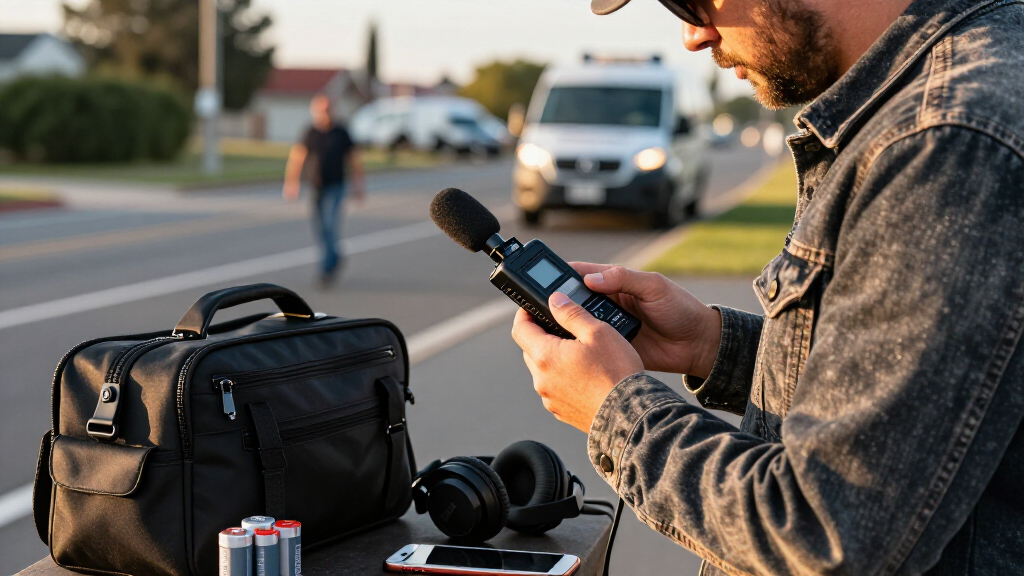
A dedicated recorder can give a reporting kit a separate path for capturing interviews, ambient sound, or other audio, rather than relying only on a camera’s built-in recording. The listed pick is the Zoom H5 4-Track Handheld Recorder. Before choosing it, compare the recorder’s inputs and workflow with the microphones you actually plan to use and the number of sources you need to capture at once. The product name identifies a four-track handheld recorder, but does not establish which accessories are included or whether it suits a particular microphone setup.
A common buying mistake is treating track count as a guarantee that a recorder will accept every mic or make every interview setup easy. Check connector types, any required adapters or power, monitoring options, recording formats, and how files transfer to your editing device. Consider how you will keep the recorder accessible while reporting and how you will protect it in a bag. For field work, plan a test recording and playback before relying on the device for an important conversation. Confirm the exact model documentation and your full signal chain before purchase.
What to look for:
- Confirm microphone connector and power compatibility.
- Check the number of simultaneous sources you need to record.
- Verify monitoring and playback options for your workflow.
- Check recording formats and transfer method against your editing setup.
- Confirm what accessories are included and what must be packed separately.
Zoom H5 4-Track Handheld Recorder

The Zoom H5 is a portable four-track audio recorder designed for filmmakers and musicians. It features a system of interchangeable input capsules, including a detachable X/Y capsule (XYH-5) with shock-mounted mics, plus two XLR/TRS combo inputs with phantom power.
Pros:
- Interchangeable input capsule system offers flexible recording configurations
- Four-track simultaneous recording with professional XLR/TRS inputs and phantom power
- Portable design powered by AA batteries with SD card storage
- Doubles as a USB audio interface for PC, Mac, and iPad
Cons:
- SD card support limited to 32GB
- Screen is small at 1.9 inches
Best for: Reporters seeking a separate handheld audio recorder to evaluate for their setup
Not ideal for: Anyone who has not confirmed microphone and accessory compatibility
Bottom line: Choose the Zoom H5 only after checking its connections, workflow, and included accessories against your reporting kit.
Wireless Lavalier Microphone
A wireless lavalier system can help keep a speaker mic’d while allowing the camera or recorder to sit elsewhere, but the exact kit configuration matters. The supplied pick is DJI Mic 3 Wireless Microphone (2 Transmitters + 1 Receiver + Charging, a name that appears incomplete. Verify the full model name and package contents before comparing it with your needs; do not assume that the truncated listing fully describes the charging case or included accessories.
Think through how many people you record, what device receives the signal, and how the receiver connects to it. Check the compatible camera, phone, or recorder connection, any required adapters, monitoring options, and how the transmitters are powered and stored. A frequent mistake is buying a wireless kit based on transmitter count alone without confirming receiver compatibility or the complete package. Also consider how you will secure a lavalier, manage clothing noise, and test the system in the location where you plan to report. Read the exact product documentation and test the entire recording chain before an assignment.
What to look for:
- Confirm the complete product name and exact kit contents.
- Match the receiver connection to your camera, phone, or recorder.
- Check how many speakers you need to mic at the same time.
- Verify monitoring, power, and storage arrangements for field use.
- Test placement and audio capture with the clothing and devices you will use.
DJI Mic 3 Wireless Microphone (2 Transmitters + 1 Receiver + Charging Case)
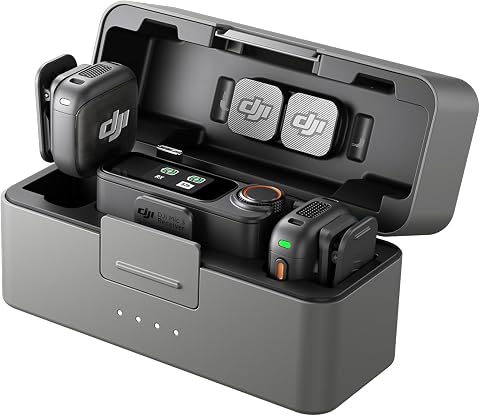
The DJI Mic 3 is a lightweight, portable wireless microphone system designed for professional content creation. It features multi-channel support, adaptive gain control, noise cancellation, lossless audio transmission, and extended battery life, making it ideal for vlogs, interviews, and live recordings.
Pros:
- Compact and lightweight design for portability
- Supports multiple channels and adaptive gain control for versatile recording
- Dual-band anti-interference ensures reliable audio transmission
- Long battery life of up to 28 hours
Cons:
- Requires 4 C batteries which need replacement
- Limited details on compatibility with non-Apple/Android devices
- Price and availability information not provided
Best for: Teams considering a two-transmitter wireless setup after confirming compatibility
Not ideal for: Buyers relying on the truncated listing to establish package details
Bottom line: Verify the full DJI Mic 3 listing and receiver connections before deciding whether this kit suits your reporting workflow.
LED Camera Light
Reliable on-camera or portable lighting can matter when available light is not enough, but a product’s name should match the job. The supplied pick is Portable Karaoke Machine with 2 Wireless Microphones & LED Party Light. That title describes a karaoke machine and party light, not clearly a camera light. Do not assume the LED feature means it can mount to a camera, provide controllable interview lighting, or meet a reporting need.
Before using this as a camera-light choice, confirm that the exact product offers the kind of illumination, mounting, power, and controls your camera setup requires. Check whether it can be positioned safely, whether its light can be directed and adjusted as needed, and how it is powered during a shoot. A common mistake is choosing by the word “LED” without confirming camera-light functionality. If the listing does not document a suitable lighting role, look for a product explicitly intended for camera or video use instead. Make a practical test in the environment where you plan to film, and confirm that the light and camera can be positioned together without obstructing operation.
What to look for:
- Confirm the product is intended for camera or video lighting.
- Verify mounting options and compatibility with your camera support.
- Check light direction and available adjustment controls.
- Confirm power requirements and how they fit your field kit.
- Test the setup in the shooting environment before relying on it.
Portable Karaoke Machine with 2 Wireless Microphones & LED Party Lights

This portable karaoke machine features a 60W sound system with multiple speakers, advanced bass and treble technology, and vibrant LED lights that sync with music. It offers long-lasting battery life, Bluetooth connectivity, and supports various input options, making it ideal for parties and outdoor entertainment.
Pros:
- Powerful 60W sound with clear bass and treble
- Long battery life of 6-8 hours for outdoor use
- Supports dual speaker TWS mode for immersive stereo sound
- Vibrant LED lights enhance party atmosphere
Cons:
- Relatively large size may affect portability for some users
- Limited to Bluetooth and auxiliary connections, may lack some modern inputs
- Sound quality may vary in very noisy outdoor environments
Best for: Shoppers investigating whether this listed karaoke product has a documented camera-light use
Not ideal for: Reporters who need a confirmed, mountable camera light
Bottom line: The product name does not establish camera-light suitability, so verify its intended use or select a clearly specified video light.
Camera Tripod
A tripod can help stabilize a camera and keep framing consistent, but the supplied pick is Compact Wi-Fi Indoor Security Camera with Night Vision and Motion Dete, which appears to describe a security camera rather than a tripod. The name is also truncated. Do not treat “compact” as evidence of a camera support, and do not assume this product includes a tripod or mount suitable for field reporting.
For a tripod slot, confirm that the actual product is a camera support and check its mounting interface against your camera or quick-release plate. Consider the camera and lens load, the working height and packed size you need, the surface where you will set it up, and how securely the legs lock. A common mistake is confusing a camera that may have a mounting point with a tripod itself. Verify the full listing and manual for support and mounting details; if the item is truly an indoor security camera, it does not fill this checklist’s tripod role. Test setup and stability with your own equipment before taking it into the field.
What to look for:
- Confirm the product is a tripod or camera support, not a security camera.
- Match the mounting interface to your camera or quick-release plate.
- Check stated load capacity against your camera and lens combination.
- Consider packed size, working height, and the surfaces you expect to use.
- Verify leg locks and test stability with your equipment.
Compact Wi-Fi Indoor Security Camera with Night Vision and Motion Detection

This compact wireless indoor camera records high-definition video, with infrared night vision and motion-triggered recording and app alerts. It supports microSD cards up to 128 GB, loop recording, and USB power for extended operation; its built-in battery provides up to 2.5 hours of standby time.
Pros:
- Infrared night vision for low-light recording
- Motion-triggered recording and mobile alerts
- Supports microSD storage and loop recording
- Can run from a USB power source
Cons:
- Built-in battery provides only up to 2.5 hours of standby time
- Requires a microSD card for local storage
Best for: Anyone checking the full listing to identify the supplied product correctly
Not ideal for: Reporters needing a verified camera tripod for field use
Bottom line: The supplied name describes a security camera, so confirm the exact product or choose a clearly identified tripod.
Camera Rain Cover
A rain cover can help protect camera gear from wet conditions, but the fit has to match the camera and lens combination you plan to carry. The supplied pick is Think Tank Photo Emergency Rain Cover for DSLR and Mirrorless Cameras,. The name identifies it as a camera rain cover, while the trailing comma suggests the product title may be incomplete. Check the exact model and its fit guidance rather than assuming one cover works equally well with every body, lens, or configuration.
Common mistakes include checking only the camera body, overlooking a longer lens or attached accessories, and assuming a cover makes equipment safe in any weather. Review the manufacturer’s compatibility information for your camera-and-lens setup, access needs, and how the cover is secured and operated. Consider whether you can still reach the controls and view the screen or finder while the cover is in place. Verify any care and use instructions, and practice fitting it at home before an assignment. A tested fit is more useful than a product category alone; keep your gear’s own handling guidance in mind and do not treat a rain cover as a substitute for sensible exposure precautions.
What to look for:
- Confirm the full product name and exact cover model.
- Check fit guidance for your camera body and longest planned lens.
- Verify access to controls, screen, or viewfinder while covered.
- Check how the cover secures and how to practice fitting it.
- Follow the manufacturer’s use and care instructions for wet conditions.
Think Tank Photo Emergency Rain Cover for DSLR and Mirrorless Cameras, Medium (R

This rain cover provides extreme protection for DSLR and mirrorless cameras with 70-200mm lenses in heavy rain or dusty conditions. It features a seam-sealed design, a large viewing window, and compresses into a compact pouch for easy transport.
Pros:
- Provides excellent protection in harsh weather conditions
- Compact and portable design
- Large window for easy LCD viewing and controls
Cons:
- May be bulky for small cameras
- Limited to medium-sized lenses
- Requires careful fitting to ensure waterproof seal
Best for: DSLR and mirrorless users checking a dedicated emergency cover against their kit
Not ideal for: Anyone assuming the cover fits every body-and-lens combination
Bottom line: The product is clearly listed as a camera rain cover, but confirm model-specific fit and practice using it before field work.
Portable SSD Drive
A portable SSD can give a reporting workflow a dedicated place for moving or carrying files, but useful fit depends on the computers and devices involved. The supplied pick is Samsung T9 Portable SSD 4TB, USB 3.2 Gen 2×2 External Solid State Driv, with a truncated final word. Confirm the full listing and device documentation before relying on the name to establish the complete specifications or package contents.
Check that your computer has a compatible connection and supports the drive’s interface; a connector that fits physically does not by itself confirm that the connection will work as expected. Verify the cable and adapters you need, the file system and workflow your devices can use, and whether your reporting process calls for a separate backup. A common mistake is treating one portable drive as the whole backup plan or assuming it will connect directly to every camera, phone, or editing device. Confirm capacity and connection needs against the amount and type of material you handle, then test transfers and file access before travel. Keep a separate copy of important reporting material according to your newsroom’s procedures.
What to look for:
- Confirm the full product listing and the stated drive specifications.
- Check USB interface support on the computer or device you will use.
- Verify cable and adapter needs for each intended connection.
- Confirm file-system compatibility with your editing and transfer workflow.
- Plan a separate backup and test file transfers before field use.
Samsung T9 Portable SSD 4TB, USB 3.2 Gen 2×2 External Solid State Drive
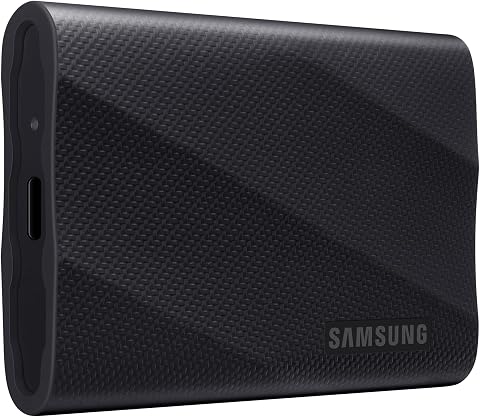
The Samsung T9 is a 4TB portable solid state drive with read and write speeds of up to 2,000MB/s and thermal management for sustained use. It works with desktops, cameras, gaming consoles, and iPhone 15 Pro for ProRes 4K video recording, and supports drive monitoring, firmware updates, and encryption through Magician Software.
Pros:
- High read and write speeds of up to 2,000MB/s
- Thermal management designed for sustained workloads
- Broad device compatibility, including iPhone 15 Pro
- Magician Software offers firmware updates, encryption, and drive health monitoring
Cons:
- Maximum speeds may depend on the connected device and workload
- The included SSD cable is recommended for iPhone video recording
Best for: Reporters who need portable file storage and can confirm device compatibility
Not ideal for: Anyone expecting the drive alone to provide a complete backup workflow
Bottom line: Check the full Samsung T9 specifications, connection support, and backup plan before making it your field-storage choice.
Build the kit in a practical order: first confirm the tools that make your reporting possible, such as compatible audio capture and a workable file-transfer plan. Next, resolve the clear role mismatches in the supplied light and tripod picks before treating them as usable gear. Then check the microphone package, rain-cover fit, and the accessories your setup requires. Prioritize verified compatibility and a complete workflow over filling every slot quickly.
Before your next assignment, connect the equipment, record a short test, review the files, and practice packing and setup. The supplied list is a starting point, not a substitute for confirming exact models and intended uses. With a few careful checks, you can build a field kit that is easier to operate and better matched to the work ahead.
Fall Picks
fall essentials
As an affiliate, we earn on qualifying purchases.