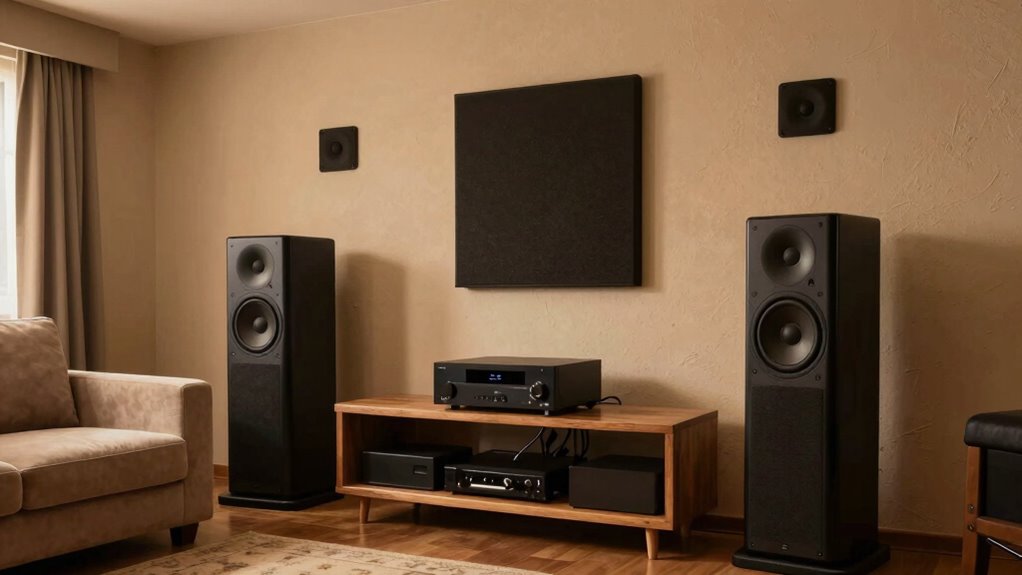

Start by placing your front speakers at ear level and directly beside your display, angling them inward for balanced sound. Position the center channel aligned with the screen, and place surround speakers slightly behind and above ear level. Experiment with subwoofer placement near walls for better bass. Control reflections by adding soft furnishings and acoustic treatments. Fine-tune your setup for a natural, immersive experience. Keep exploring these tips to perfect your home surround sound environment.
Key Takeaways
- Properly position speakers at ear level and create an optimal layout around your viewing area.
- Use acoustic treatments like panels and diffusers to manage reflections and improve sound clarity.
- Experiment with speaker angles and placements, adjusting for balanced soundstage and immersion.
- Minimize hard surface reflections with soft furnishings and strategic placement of furniture.
- Utilize auto-calibration features and fine-tune manually for the best surround sound experience.
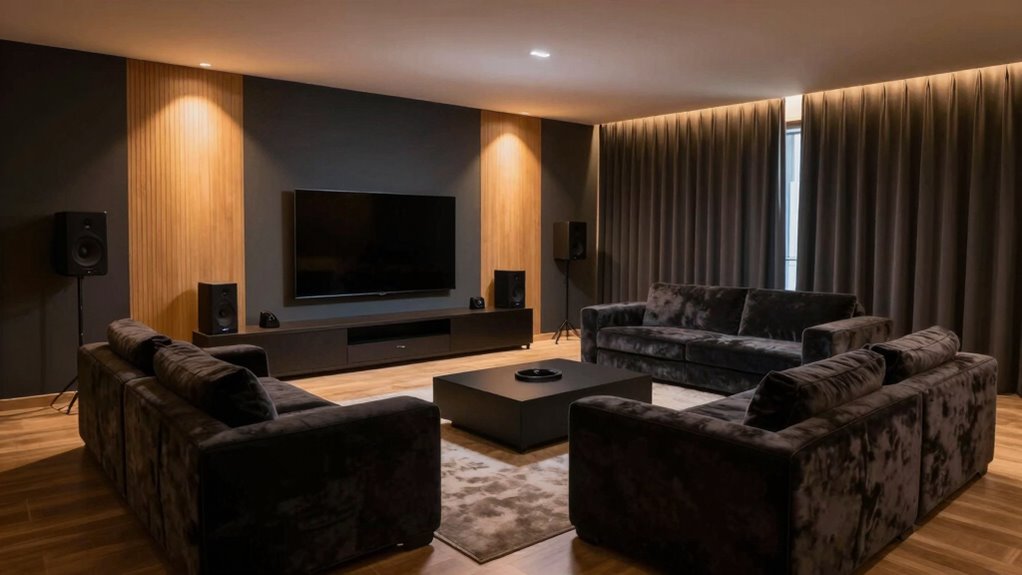
Ever wondered how to create a truly immersive surround sound experience in your home? The key lies in thoughtful planning, especially when it comes to speaker placement and understanding your room’s acoustics. The right setup makes all the difference, transforming your space into a personal theater with crisp, balanced sound. First, focus on speaker placement. Position your speakers at ear level when seated, aiming for symmetry around your main listening area. Front speakers should be placed directly to the left and right of your TV or screen, angled slightly inward to focus the sound toward you. The center channel speaker needs to sit right above or below your display, aligned with the screen’s center to anchor dialogue and vocals. Surround speakers are best placed slightly behind and to the sides of your seating area, about 2-3 feet above ear level, to envelop you in sound without overpowering it. Subwoofers can usually be placed near walls or corners, but experiment with positions to avoid boomy or muddy bass. Keep in mind that room acoustics drastically influence how sound travels and reflects. Hard surfaces like glass, tile, or bare walls reflect sound waves, creating echoes and muddiness that distort the audio experience. Soft furnishings such as curtains, carpets, and upholstered furniture absorb excess sound, helping to balance acoustics for a clearer, more natural sound. If your room is large or irregularly shaped, you might consider acoustic treatments like panels or diffusers to control reflections and standing waves. These adjustments improve clarity and ensure that sound reaches your ears evenly. Proper speaker placement is crucial to achieving optimal sound quality, and it’s worth experimenting with different configurations to find what works best for your space. Additionally, understanding room acoustics can help you make more informed decisions about speaker positioning and acoustic treatments. When setting up, don’t just rely on measurements; listen carefully. Fine-tune speaker angles and positions by playing familiar audio tracks and adjusting until you find a balanced, immersive soundstage. Use a calibration microphone if your AV receiver offers auto-calibration, but still trust your ears for final tweaks. Remember, the room’s acoustic environment can significantly affect your sound quality, so paying attention to how your space influences sound reflections is essential. The goal is to create a seamless sound environment that enhances your viewing experience without causing fatigue or distraction. Proper speaker placement combined with an understanding of room acoustics maximizes every dollar you spend on your surround sound system. It’s about making your space work for you, not against you. A well-balanced audio environment can significantly enhance your overall entertainment experience. To achieve the best results, consider learning about how different acoustic treatments can be tailored to your specific room characteristics. With careful planning and a bit of experimentation, you’ll enjoy rich, accurate sound that pulls you into your favorite movies, shows, or games. Creating an immersive home theater isn’t just about the gear; it’s about how you set it up, so take your time and listen closely.

WALI Speaker Wall Mount, Surround Sound Speaker Stand with Adjustable Swivel Tilt Angle, Small Bookshelf Speaker Mount for Living Room, Home Theater, Hold up to 7.7 Lbs, (SWM602), 5 Pack, Black
Compatibility: Sound bookshelf satellite speaker mount brackets built to be mounted on stud, concrete or brick/stone walls. Max….
As an affiliate, we earn on qualifying purchases.
As an affiliate, we earn on qualifying purchases.
Frequently Asked Questions
What Is the Ideal Number of Speakers for a Small Room?
For a small room, two to four speakers usually do the trick, ensuring a balanced sound without clutter. You should calibrate your speakers properly to optimize the soundstage, and consider acoustic treatment to minimize echo and improve clarity. Keep speaker placement precise, avoiding corners or reflective surfaces. This setup provides immersive audio while maintaining clear dialogue and music, making your small space feel like a mini home theater.
How Do I Hide Wires for a Clean Look?
To hide wires for a clean look, you should focus on effective wire concealment and cable management. Use in-wall or under-carpet cable routing to keep wires out of sight, or opt for cable covers that match your wall color. Velcro straps or cable ties help organize loose wires behind furniture. Concealed wiring not only enhances aesthetics but also minimizes tripping hazards, giving your home a sleek, clutter-free appearance.
Can I Upgrade My Existing Surround Sound System Easily?
Yes, upgrading your existing surround sound system is usually straightforward. You can enhance your setup by adding wireless integration options, eliminating the need for extensive wiring. Just make certain your new components are compatible with your current system’s speakers and receiver. Check for speaker compatibility, especially when upgrading or expanding, to guarantee seamless performance. This way, you achieve better sound quality without overhauling your entire setup.
What’s the Best Placement for Subwoofers?
For ideal sound, place your subwoofer near a wall or corner, as this enhances bass response through boundary reinforcement. Subwoofer placement is essential; avoid placing it in the center of the room or against an interior wall, which can cause uneven bass. Experiment with subwoofer positioning by moving it around and testing sound quality. Remember, small adjustments in subwoofer placement can greatly improve your surround sound experience.
How Do I Calibrate Sound Levels for Different Content?
To calibrate sound levels for different content, start with speaker calibration using a sound level meter or your receiver’s auto-calibration feature. Adjust volume levels to guarantee balanced sound across all speakers, paying attention to dialogue clarity and bass levels. Use your receiver’s sound balancing tools to fine-tune the audio, ensuring consistent audio quality whether you’re watching movies, playing games, or listening to music. This creates an immersive and well-balanced listening experience.

NeatiEase Wood Slat Wall Panels, 4-Piece 96" x 12.6", Soundproof & Noise Cancelling, Acoustic Wall Panels (Black)
Modern and Elegant Design – The wood slat wall panels have been carefully designed to effortlessly transform any…
As an affiliate, we earn on qualifying purchases.
As an affiliate, we earn on qualifying purchases.
Conclusion
Planning your surround sound is like planting a symphony in your home—every piece needs to be perfectly placed for harmony. By considering room layout, speaker positioning, and your personal preferences, you’ll create an immersive experience that transforms your space into a personal theater. Don’t rush the process; think of it as crafting a musical masterpiece where every note counts. With patience and attention to detail, your home will become a sanctuary where sound truly surrounds you.

cunueae Terminal Cups, 2-Position 4-Way Terminal Block Connectors, Suitable for Car Speakers and Home Subwoofers.
【Robust and Long-lasting Stability】The meticulously crafted circular grooved panel structure, paired with high-performance spring-loaded terminals, ensures a secure…
As an affiliate, we earn on qualifying purchases.
As an affiliate, we earn on qualifying purchases.

New Sony Calibration Mic Measurement Microphone ECM-AC2 Part Number 154277421 1-542-670-21 154271011 1-542-710-11 154267021 1-542-774-21, Auxiliary
Genuine SONY ECM-AC2 Calibration Microphone for SONY Audio Video Receiver Home Theater systems. Pic 2 shows common Error…
As an affiliate, we earn on qualifying purchases.
As an affiliate, we earn on qualifying purchases.